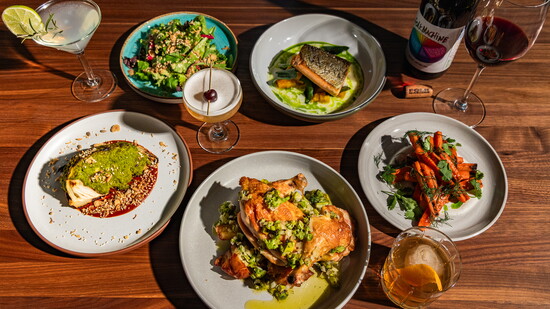
Something is happening around the North Shore dinner table. The question is no longer simply where to eat, but what kind of experience you are hungry for.
Maybe it means a Highwood dining room where steak frites and sushi share the same menu. Maybe it is a farmer-driven dinner in Evanston, a Japanese-inspired night in Glenview or a deeper dive into South Indian cooking. Even one of Highland Park’s most familiar gathering places is beginning a new chapter, while a celebrated Chicago restaurant prepares to head north.
Together, they point to a dining scene becoming more ambitious, varied and capable of delivering experiences that once seemed to require a drive into Chicago. The personalities and menus are different. What connects them is a sense that North Shore diners are ready for more.
So, what are you hungry for?
FOR SOMETHING UNEXPECTED
Juniper
200 Green Bay Rd., Highwood | juniperhighwood.com
Juniper begins with a pairing that should feel mismatched, yet somehow does not: modern American comfort food and a serious sushi program under one roof.
Chef-owner Todd Stein, whose three decades in Chicago kitchens include Formento’s, The Bristol, Ballyhoo Hospitality and mk the restaurant, opened the Highwood restaurant in late August with the goal of creating the kind of neighborhood place he wanted for himself. The result feels polished without becoming precious, a restaurant suited to cocktails, weeknight dinner or celebration.
The menu moves confidently between worlds. Filet mignon sliders arrive with roasted onion and herb butter, while mini lobster rolls feature chilled Maine lobster and Old Bay remoulade. A half rotisserie chicken, steak frites and penne vodka sit comfortably beside a sushi list led by Executive Sushi Chef Akira Yang. Specialty rolls range from the Juniper, with tuna, salmon, white tuna and poke sauce, to the pressed-rice Black Diamond layered with unagi, spicy tuna and masago.
The room reflects the same blend. Deep blues and soft greens meet red and wood accents, while a 35-foot mural of a Lake Michigan sunrise anchors the space. During a recent dinner, the room was already buzzing beneath warm ceiling lights and a dramatic indoor tree.
Juniper calls itself “a little bit supper club, a little bit neighborhood hangout.” That describes Stein’s idea neatly: familiar enough for regulars, unpredictable enough to keep them curious.
FOR FOOD WITH ROOTS
Burl
2545 Prairie Ave., Evanston | burlevanston.com
At Burl, the menu begins long before anything reaches the kitchen.
Chef Tom Carlin and his wife and co-owner, Rachel Canfora-Carlin, built the Evanston restaurant around relationships with Midwestern farmers and producers, allowing the seasons to influence what lands on the plate. For Carlin, those relationships run deep. He spent six years as head butcher at Publican Quality Meats, where he got to know farmers including Marty, a producer in Fairbury, Illinois, who still supplies the restaurant.
That connection gives Burl a sense of place that goes beyond the now-familiar language of “farm to table.” Dinner feels rooted in the Midwest, but never rustic for rustic’s sake. Wood fire provides another through line, adding smoke and depth while the kitchen lets vegetables, meats and grains retain their individual character.
Even the restaurant’s name tells the story. A burl is the rounded growth that appears on a tree and, when cut open, reveals intricate grain prized by woodworkers. For the couple, it is both a nod to wood-fired cooking and an analogy for their restaurant: just off Evanston’s Central Street and still connected to Chicago’s larger food scene, but with something distinctive happening on its own branch.
Canfora-Carlin sees Evanston as a sweet spot for diners who appreciate Chicago-level food and service but do not necessarily want to head downtown for it. “People want the Chicago service,” she said, “but in your neighborhood.”
Burl makes a persuasive case that staying close to home no longer means settling.
FOR A TRIP TO TOKYO
Zenzi Den
1822 Glenview Rd., Glenview | zenziden.com
At Zenzi Den, the transformation begins with the room. Paper lanterns glow overhead, tassels and beaded screens create layers of texture and dark ceramics and warm amber light give Ballyhoo Hospitality’s modern Japanese izakaya a cocoon-like intimacy.
Then the food starts arriving.
A traditional robata grill fueled by binchotan charcoal anchors part of the kitchen, producing intense, clean heat for skewers and other dishes. The menu moves through sushi, dumplings, sizzling rice, noodles and larger plates, encouraging the table to order widely and share. Among the current offerings are hamachi with chili crisp, tuna with wasabi and caviar, spicy pork and shrimp ghost dumplings, miso black cod and sizzling rice topped with crispy duck miso yaki.
The sushi program is led by Executive Sushi Chef ChoongKi Kim, originally from Seoul, whose résumé includes training under former Nobu chef Danny Rei at Shakou, serving as head sushi chef at Kamehachi in Northbrook and working as sous chef at Michelin-starred Omakase Yume. His background gives the menu technical credibility without making dinner feel overly reverent.
For a more secluded experience, the Tatami Room sits behind translucent shoji screens, designed for communal, multi-course dining.
What makes Zenzi Den work is the balance. It is dramatic without feeling like a theme restaurant, serious about technique without becoming intimidating and polished enough for an occasion while still encouraging the kind of evening where another roll, another plate and another round seem like perfectly reasonable ideas.
FOR SOME SERIOUS SPICE
Madurai Kitchen & Bar
1831 Tower Dr., Glenview | maduraikitchenusa.com
If your definition of Indian food begins with the dishes most commonly found on North Indian restaurant menus, Madurai Kitchen & Bar opens a different door.
The Glen Town Center restaurant centers on South Indian cooking, specifically the flavors founders Hemalatha Ravishankar and Karthikeyan Srirangarajan grew up eating in Madurai, Tamil Nadu. At the heart of the menu are Ravishankar’s mother’s recipes, passed down through cooking rather than simply copied from a written collection. Ravishankar says the restaurant’s spices and curry powders come from India, preserving flavors that are deeply tied to home.
South Indian cooking, Ravishankar explained during our visit, often brings more vegetables, fish, spice and tangy flavors into the mix. The eggplant curry, for example, can carry tang, heat and sweetness at once.
That complexity came through across the table: crisp cauliflower layered with spice, lamb chops on black slate, flaky parotta and a richly colored salmon presentation. Yet heat is not treated as a dare. Ravishankar is quick to point out that dishes can be made milder while retaining flavor.
The Glenview location gives the family recipes a more polished setting than the brand’s earlier restaurants, with orange banquettes, chandeliers and a full cocktail program incorporating ingredients such as curry leaves, cardamom, ginger and rose water.
For Ravishankar, who spent years working in IT while pursuing cooking on the side before leaving corporate life to focus on restaurants full time, the expansion is personal.
For diners, it is an invitation to taste beyond the familiar.
FOR SOMETHING FAMILIAR
Norton’s
1905 Sheridan Rd., Highland Park | nortons-restaurant.com
Not every new chapter needs a rewrite.
After 27 years under founders Jeff Mages and Richie Holleb, Norton’s changed hands this summer, passing to David Rosenstein, Simon Leibovich and Jeff Poulsom. The trio understood almost immediately that Highland Park regulars were less interested in hearing what would change than what would not.
The answer: almost everything.
The longtime staff stayed. The menu stayed. Prices stayed. Even the pours stayed. The new owners cleaned, painted and replaced aging televisions but resisted reinventing a restaurant generations of customers already considered theirs.
That loyalty is visible on busy evenings. The patio fills quickly. Regulars settle in with servers who know them, sometimes well enough to have a drink waiting by the time they sit down. Inside, hand-packed burgers, Santa Fe chicken salad, French onion soup and the signature pot pie continue making their familiar rounds.
The owners can play with specials and modernize the operation, but preserving Norton’s role as a neighborhood gathering place is the larger mission. Asked why this particular business was worth buying, Rosenstein’s answer was simple: “I love Norton’s. I love this place. I didn’t want to see it not be here.”
In a dining culture constantly chasing what is next, there is something refreshing about recognizing what does not need fixing.
Sometimes what you are hungry for is exactly what you remember.
OPENING SOON
avec highwood
250 Waukegan Ave., Highwood | avecrestaurant.com
By the time this issue reaches North Shore homes, the countdown to one of the year’s most anticipated openings should be nearing its end.
One Off Hospitality plans to open avec Highwood in October, marking the acclaimed Chicago restaurant group’s first North Shore location. The project combines two neighboring buildings into a single destination with a main dining room, expansive barroom and, eventually, a private dining room and outdoor patio.
For longtime Chicago diners, avec needs little introduction. Since opening in the West Loop in 2003, the restaurant has built its reputation around Mediterranean-inspired shared plates, close relationships with local farmers and a stripped-down approach that lets quality ingredients do much of the talking. Its chorizo-stuffed Medjool dates have become one of the restaurant’s signatures.
Highwood will give that identity considerably more room to breathe. The 5,000-square-foot restaurant is planned as a warm, minimalist interpretation of the avec aesthetic, not a reproduction of the famously narrow original.
Highwood has long punched above its weight as a dining town, and avec’s arrival further blurs the line between “city dining” and “suburban dining.”
That may be the larger story connecting all of these restaurants. The North Shore is not simply getting more places to eat. It is developing a dining identity broad enough to encompass sushi and steak frites, South Indian spice and Midwestern farms, longtime neighborhood institutions and celebrated Chicago imports.
The difficult part may be deciding what you are hungry for first.