I was maybe nineteen the first time a record store changed my life, a University of Michigan student looking for music that wasn't on the radio, that would give me a taste of real soul. As I walked through the store, my eyes landed on an album by a band called the Dead Kennedys. I immediately thought, I’m not cool enough to be in here.
But I was brave enough to go up to the front and describe what I was looking for. The guy behind the counter said, “Oh, you want this guy,” and handed me two Bill Withers albums.
I went back to my dorm, started listening to the first one—and my life was forever changed.
I thought about that moment often while I was talking to Joe Lalich. Joe still has the first record he ever owned: the debut KISS album. He was maybe six or seven when he got it. Years later, he tracked down all four members and got them to sign it.
"It's not in great shape," he says. "But that makes it cooler to me."
Joe is a graphic designer, creative director, illustrator, and published comic book artist (Batman Annual, New Super-Man). He’s done work for Mötley Crüe, KISS, McDonald's, Carhartt, and the NBA, among others.
He’s also the co-founder and co-owner of the Detroit Record Club, a boutique vinyl shop on Woodward Avenue in Royal Oak. He and his partner Tara de Boer opened it in 2019, after signing a lease on a retail space before even deciding what they were going to do with it.
"It was never a dream," he says. "Neither of us had ever been in retail. I was just driving around looking at retail spaces, and we decided to give it a try.”
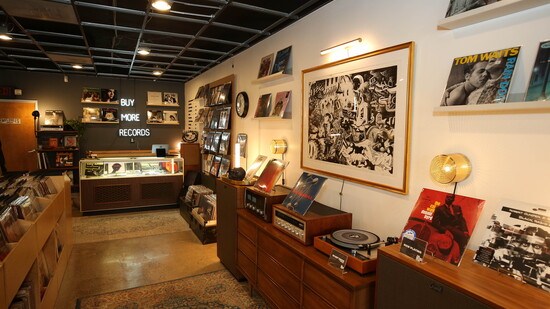
The store is clean. There’s no old-record-store smell, a detail Joe mentions with quiet satisfaction. That familiar mustiness of the archetypal record shop was one of several things he specifically designed the Detroit Record Club not to be.
Instead, there are plants. An Eames chair near a listening station. The records have been ultrasonically cleaned in distilled water baths, the grooves blasted at a microscopic level, arguably cleaner than the day they were pressed.
And yet none of that is really the point. The point, if you press Joe on it, is that an object becomes more interesting the longer it's been with someone. So the cleaning isn't about making records feel new. It's about making sure what’s in the grooves makes its impact on new ears.
Joe grew up drawing. As a small kid, he'd burst into his grandparents' house, go straight for the stationery, and just start creating. "I came by it honestly,” he recalls. “I just had that built-in interest.” He still has a Batman he did at two, the Batmobile rendered in the background.
After going to Detroit’s famed College for Creative Studies, Joe landed in graphic design: the practical negotiation between artistic instinct and the need to eat. He moved to New York with Tara for advertising, went freelance a few years in, worked for a decade, then returned to Michigan — and happened by that space for rent.
"I had tons of records at the house," Joe says. "Tara and I put those into the store."
The only thing they knew they wanted was to build a community. But they knew what they didn’t want: a place with that musty smell, records in unsearchable piles, the atmosphere of ambient judgment that’s almost a tradition in record store culture. "Listen to whatever you want to listen to,” Joe says. “I would never discourage people from buying what they love."
The curation, then, isn’t taste-policing. It's what a good bookstore does: maintain enough depth that the person who knows what they want can find it, while keeping enough surprise on the shelves that the person who doesn't know what they want — like me at college — can stumble into a treasure.
This is what Joe gives you that a streaming platform’s algorithm can't: the expertise of a well-traveled ear. He’s no enemy of digital; he streams in the car, same as everyone. But a record asks something of you that a playlist doesn’t: intention.
And it gives you something a playlist can’t: “cultural touchstones," Joe observes. He knows what his were. A Billy Joel concert, two comic books from a pharmacy… and that KISS album. He thinks about that every time a young kid comes in with a parent and walks out with their first record.
A record store makes a certain kind of sense for someone whose whole creative life has moved along the border between sound and image: album art, covers, liner notes. “And you go, ‘oh my god, this person wrote that?’” he says. As an example, he shocks me with this fact: the liner notes for David Bowie’s Young Americans is where he found out Luther Vandross, David Bowie’s former background singer, came up with the phrasing of the titular song.
Audiophiles always teach me something. What surprised me about Joe was how little he wants credit for it. His humility shows in the clarification he makes when I ask for three words to describe the Detroit Record Club.
"Comfortable," he says. He thinks for a second. “And…" He searches. “Just cool.” I laugh. Then his clarification: “Not like ‘I'm telling you what's cool.’ Cool is there on the shelves. Go find it."
That's the offer. Not an algorithm. A room full of objects that are just cool, and a guy who wants to help you figure out which one’s yours.
The Detroit Record Club is at 28834 Woodward Avenue in Royal Oak. thedetroitrecordclub.co
"Listen to whatever you want to listen to. I would never discourage people from buying what they love."
Joe still has the first record he ever owned: the debut KISS album. Years later, he got all four members to sign it. "It's not in great shape. But that makes it cooler to me."