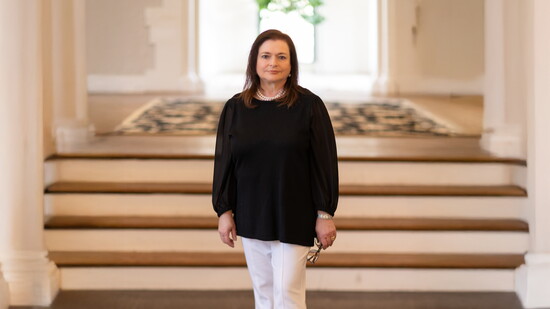
In a city known for finance, technology, and corporate leadership, some of the most meaningful investments aren’t measured in quarterly returns—but in cultural legacy. Few people embody that long view more clearly than Lynn Villency Cohen, an art historian whose career has bridged European museums, the federal government, and nearly twenty-five years of leadership at the Stamford Museum & Nature Center.
Cohen’s relationship with art began early, shaped by both circumstance and curiosity. Raised in a New York suburban household with older parents, she experienced a childhood that blended American normalcy with a distinctly European sensibility. Summers spent traveling through England, France, Spain, Italy, and Portugal exposed her—while still a young adolescent—to centuries-old paintings, architecture, and sacred spaces. Art, design, and communication weren’t extracurricular interests in the Cohen household; they were part of daily conversation.
At college, however, Cohen initially felt out of step. Surrounded by pre-med and pre-law students, she found her footing only after a pivotal encounter with art history. When her college hired its first art history professor—an expert on a modern art collection donated to SUNY Purchase—Cohen was encouraged to combine her modern languages major with art history. That guidance helped her carve out what she calls “a little niche,” one that ultimately defined her professional life.
That niche led to not one but two graduate degrees: a master’s in art history from Boston University, followed by advanced study at Oxford University focusing on nineteenth-century European art and criticism. Between degrees, Cohen interned at the Brooklyn Museum, learning curatorial practice and contributing to exhibition catalogues. She also wrote art reviews and pursued appraisal training—laying the groundwork for a career that would eventually intersect with public service.
In 1986, Cohen joined the Internal Revenue Service as an art appraiser, assisting the IRS Commissioner’s Art Advisory Panel. The work required deep expertise and careful judgment: evaluating artworks submitted for income, estate, and gift tax purposes. Cohen researched everything from Old Master paintings to early twentieth-century works, tracked art markets, and regularly interfaced with museum curators, dealers, attorneys, and federal counsel. Challenging and exacting, the role sharpened her understanding of art as both cultural treasure and tangible asset—an education in how value is assigned, defended, and preserved.
Yet it is at the Stamford Museum & Nature Center where Cohen’s philosophy of investment truly comes alive. She chairs the committee overseeing exhibitions and stewardship of the museum’s permanent art collection—more than 20,000 objects spanning modern American painting, outdoor sculpture, natural history, Native American artifacts, and scientific collections.
For Cohen, museums are living civic spaces. They are places where generations mix, where art meets science, and where curiosity is cultivated across backgrounds and ages. As the Stamford Museum approaches its 90th anniversary in 2026—celebrating decades of thoughtful growth across its 118-acre campus—Cohen reflects on her role with gratitude. Helping guide an institution that balances education, nature, and art, she says simply, has been “joyous.”
Helping guide an institution that balances education, nature, and art, has been joyous.