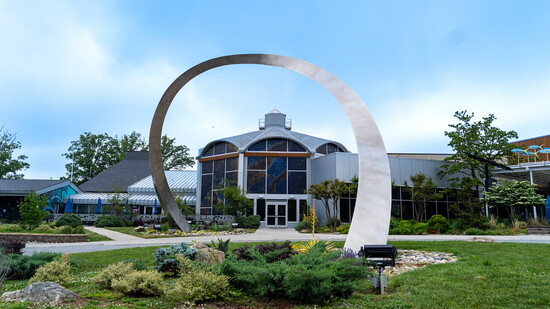
When Glenn Dobrogosz arrived at the Greensboro Science Center (GSC) in 2004, it was a modest institution that welcomed fewer than 100,000 guests a year—and tourism was certainly not a defining force in Greensboro. As director, he had aspirations of taking a “sleepy facility” and turning it into something bigger.
Glenn’s career had taken him to several states, serving as director of zoos and helping facilities get reaccredited. By the time he got to Greensboro, he had developed a clear leadership philosophy: Institutions thrive when guided by a master plan. And so he created a blueprint called “Science City USA,” envisioning a campus that combined an accredited zoo, aquarium, and science museum.
Now, 22 years later, the transformation is remarkable. The facility opened Animal Discovery, the aquarium, and Revolution Ridge, and it is now the only facility in North Carolina accredited by both the Association of Zoos and Aquariums (AZA) and the American Alliance of Museums (AAM), which recognizes rigorous standards in animal care, conservation, and education.
The staff has increased from 18 full-time employees to 70, supported by 150 part-time staff and more than 400 volunteers. The facility currently houses 1,500 individual animals, but that will soon jump to nearly 1,800 individual animals representing more than 250 species. The operating budget has grown from $1.4 million to $12 million, with projections to grow to support further expansion. Attendance has climbed to as high as 635,000 annual visitors following the opening of Revolution Ridge in 2021. The next goal is to reach 750,000 annual guests—placing Greensboro among the state’s premier destinations.
Glenn thinks that’s well within reach considering the next exciting development on the horizon. Expedition Rainforest: The Greensboro Biodome and Aquatic Rehabilitation and Conservation Center (ARCC) is anticipating a grand opening in September 2027. The ARCC will expand upon the Science Center’s animal rehabilitation efforts. The Biodome will be five stories high and span the length of a football field. Guests will be able to experience complete immersion in the vibrant ecosystem of an 82-degree tropical rainforest with an open-flight aviary. The biodome will connect to an aquatic rehabilitation center where guests can observe real-time work, including endangered seahorse propagation and sea turtle rescue. There will be a new stingray touch tank, expanded animal hospital, and breeding facilities. And if that weren’t enough, the new expansion will also include new restrooms, a restaurant, gift shop, and private event space.
Every expansion at the Science Center is deliberate. Some exhibits are refreshed, others retired. The Omnisphere Theatre is being reimagined with new programming. The meerkat habitat is being rebuilt. Outdoor adventure components like SkyWild are being reinvested and integrated into the rainforest experience. The facility is always pushing forward.
The ultimate vision, Glenn says, is based on the goal of teaching kids and families about opportunities in the field of science. Glenn sees that emotional impact as part of the return on investment. “We provide a space where other creatures matter,” he says. “That immersion creates conversations at the dinner table. It inspires.”
This spring and summer, a temporary rainforest-themed exhibit will preview the biodome vision, complete with an eight-foot model and interactive giving opportunities—even allowing children to contribute coins toward construction. Tours of the project run several times a week, inviting residents to see progress firsthand.
For Glenn, that transparency reinforces connection. The Science Center isn’t just a campus—it’s part of Greensboro’s civic identity.
After more than two decades, Glenn has helped transform a struggling facility into a regional destination. Yet he frames the achievement not as expansion for its own sake, but as sustained investment in curiosity, conservation, and community pride—and that may be the most meaningful return of all.
"Whether you're 2 or 92, there's something for everybody at the Greensboro Science Center." —Glenn Dobrogosz