Jakob Carmichael was still in high school when the idea that would become RescAlert first took shape.
It was 2017. Hurricane Harvey had just devastated Texas. Watching news coverage from his Pensacola home, Carmichael noticed something that unsettled him. First responders were working tirelessly yet agencies appeared disconnected, resources overlapped, and communication lagged.
“I remember thinking, we have all this technology in the world, why aren’t these systems talking to each other?” he says.
He took the question to the person he trusted most: his father, a master electrician with a PhD in computer science.
The answer was simple and revealing. Emergency departments operate within separate systems, budgets, and software platforms. Each works well independently, but when disaster strikes and multiple agencies converge, those systems often don’t communicate seamlessly.
For a teenager already fascinated by programming and technology, that explanation wasn’t satisfying.
“That’s when I started asking, what if there was a way to connect them all?” Carmichael says. “What if you could see everything in one place and actually anticipate what’s coming instead of just reacting to it?”
That question became the foundation for RescAlert.
Born in Charlotte, North Carolina, but raised in Pensacola since first grade, Carmichael credits this community with shaping both his ambition and his sense of responsibility. Growing up in a region accustomed to hurricane season and later witnessing the impact of Hurricane Sally firsthand reinforced the reality that preparedness is not optional along the Gulf Coast.
“Pensacola feels like a big town with a small-town heart,” he says. “People here look out for each other.”
That mindset, protection, readiness, and community run through his company’s mission.
Today, at just 23 years old, Jakob Carmichael, President and Founder of RescAlert, leads a public safety technology firm operating in eight states with more than 40 employees and expanding rapidly. RescAlert’s core function is straightforward but powerful: move emergency response from reactive to proactive.
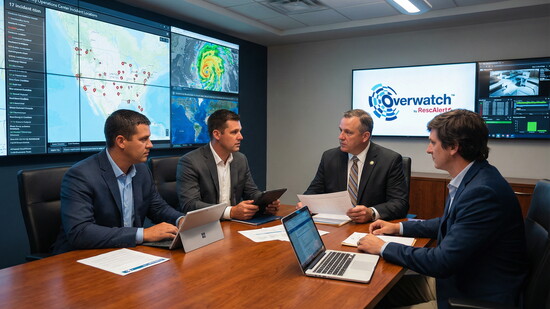
Using predictive analytics and artificial intelligence, the platform integrates multiple data sources — weather patterns, infrastructure monitoring, public alerts, environmental sensors, and more into one unified system. Instead of waiting for a river to overflow, agencies can anticipate flooding hours in advance. Instead of responding after impact, they can deploy resources earlier and with greater precision.
“If we can give decision-makers more time and better clarity, outcomes change,” Carmichael explains. “Time is everything in an emergency.”
Approximately 80 percent of RescAlert’s work serves local and state governments, particularly in hurricane-prone states like Florida and Texas. The remaining projects support industrial facilities requiring advanced safety monitoring.
What sets the company apart is its turnkey approach. RescAlert doesn’t simply design software it installs and integrates the infrastructure itself, from sensors and cameras to fiber networks and alert systems, bringing everything into one coordinated platform. An internal AI analytic engine filters overwhelming data into prioritized insights, helping leaders focus on what matters most.
The biggest hurdle, Carmichael admits, has not been technology but education. “Four years ago, AI sounded like science fiction,” he says. “Now, people are beginning to see that predictive tools aren’t optional. They’re part of the future.”
And that future remains anchored here.
RescAlert is preparing to move into a larger facility near Nine Mile Road this spring, with plans to grow to more than 200 employees within two years many of them in Pensacola. The company has also secured additional land in Santa Rosa County to support long-term expansion.
“Pensacola supported me when this was just an idea,” Carmichael says. “I want our headquarters here. I want to grow with this city.”
His advice to readers to young dreamers and experienced leaders alike, is this: “Take the leap. I didn’t know everything on day one. I still don’t. But forward is forward. If you have an idea you believe can make a difference, don’t wait until you feel ready. You become ready by starting.”
As Pensacola continues to grow and define its next chapter, innovation in readiness may prove just as important as expansion itself.
Sometimes the future of a city begins with a young person asking a simple question: Why can’t we do this better?
And then deciding to build the answer.