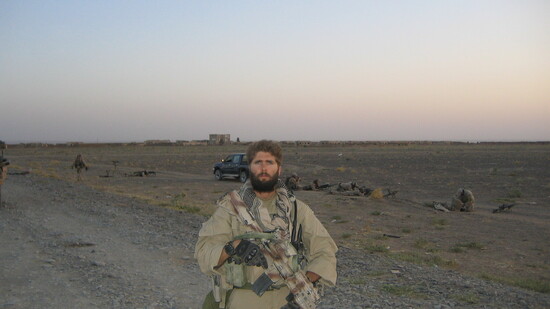
As we celebrate America 250, and as skies fill with fireworks this Fourth, we are reminded that the liberties we cherish were never without sacrifice. This month, we honor a war hero whose story embodies patriotism, courage, and the unbreakable spirit of this country.
Retired Navy SEAL, severely wounded warrior, New York Times bestselling author, veteran advocate, business leader, and acclaimed leadership and resilience speaker Jason Redman has defied staggering odds.
After overcoming early career leadership failures, earning back the respect of my fellow SEALs, and surviving life-altering injuries during my service in Iraq, I became living proof that adversity can transform into purpose.
With part of Jason’s team now operating out of the Valley, and with frequent speaking appearances across Arizona, PVCL's Nadine Bubeck was honored to have this exclusive conversation with Jason about service, sacrifice, and the American spirit.
For anyone who might not know your full story, how do you introduce yourself today?
I am a retired warrior, a retired Navy SEAL, an author, entrepreneur, husband, father, and a patriot.
Take us back. What led you to the Navy?
I came from a military family. I'm a product of my grandparents both fighting in World War II. My dad also served in the Army, so I grew up with this idea of service.
As a kid, I was a product of the GI Joe generation and fascinated with the military. Add in all these things, and it was the only path I wanted.
I originally thought I wanted to be a pilot like my grandfather. Top Gun came out when I was young, and I wanted to be a Maverick. But I later learned about special operations, and when I discovered the SEAL teams around 14 years old, I locked onto that immediately. Hardest training in the military. Toughest and most secretive missions. The more I learned, the more I knew it was for me.
It’s one thing to say you want to become a SEAL, and it’s another thing to become a SEAL.
We have an 80% attrition rate from U.S. Navy SEAL training. My class started with 148 individuals. I think we graduated 19 original members.
Lessons I learned in the SEAL teams are things I still speak about today. At the end of the day, it comes down to understanding where you want to go, what you want to accomplish, what it’s going to take to get there, and then breaking that into action steps. That’s exactly what I did when I was 16 or 17 years old.
What’s funny is when I decided I wanted to be a Navy SEAL, I barely played sports. I was a little runt of a kid, and I think most people laughed at me. But I knew if I wanted to become a SEAL, I had to do hard things.
So I went out for the football team and got the snot kicked out of me, but it taught me teamwork and toughness. I also joined the wrestling team.
Then I started training specifically for the SEAL pipeline. I learned the requirements and started executing every day in preparation for boot camp and the SEAL training test.
Then came boot camp.
When I went through boot camp in Orlando, the pipeline was very different than it is today. There wasn’t a direct path into SEAL training. During boot camp, everyone had to complete swim testing, and my recruiter had told me that’s where the opportunity to try out for the SEAL pipeline would happen.
The swim test itself was pretty basic, but at the same time, there was a Navy SEAL recruiting candidates. About a week later, 10 of us took the test, and only three qualified.
I was 18 when I started SEAL training, 19 when I graduated, and about 20 years old when I earned my Trident.
What did that mean to you?
When you get your Trident pinned on, it’s incredible. Back then, every SEAL on the team would punch the Trident into your chest. People hear that now and think it sounds crazy, but it symbolized pride, accomplishment, and becoming part of this elite brotherhood of warriors. There’s actually a photo in my book of me as this skinny kid with a bruised chest from getting my Trident “tacked on.”
At the time, though, I don’t think I fully understood the weight of everything. We were pre-war, and I had accomplished this huge goal. It wasn’t until years later, going to war and leading men into combat, that I truly understood what it meant.
You served in multiple countries before 2007.
Yes. My SEAL team specialized in jungle warfare, so from 1996 to 2001, I spent a lot of time in Central and South America conducting counter drug operations. I became fluent in Spanish, fell in love with the people, culture, and food. Those years exposed me to both the good and bad in the world.
But nothing could have fully prepared you for what was about to happen.
Actually, in some ways they did prepare me. That’s the interesting thing about life. Every hardship, every bit of adversity, all of SEAL training, the good, the bad, and the ugly, shapes who we become. Looking back, all of it built toward that moment.
What’s even more interesting is that along the way, I failed as a young leader.
Before Iraq, I became a commissioned officer, and that’s a really important part of the story because I think a lot of young people who find success early can become a little enamored with themselves. That definitely happened to me.
I excelled as a young SEAL, became a SEAL training instructor, was recommended for officer school, and graduated ranked number one in my ROTC unit before returning to the SEAL teams in 2004 as a young officer.
But I allowed ego and arrogance to drive a lot of my decision making. I speak about leadership now because a title or rank doesn’t make you a leader. It’s how you carry yourself. Unfortunately, I started falling into that “do as I say, not as I do” style of leadership, which is dangerous, especially in combat units.
Eventually, I made a bad call on a mission in Afghanistan that almost got me kicked out of the SEAL teams. It was such a humbling and rock bottom moment. I sat alone in my room in Bagram after being told I was dangerous.
Thankfully, I went and found the special operations chaplain, and he convinced me I was about to make a permanent decision over a temporary problem. I also had strong leadership that gave me the opportunity to grow from that failure. That’s ultimately why my book is called The Trident: The Forging and Reforging of a Navy SEAL Leader.
Looking back, those failures and lessons became part of what mentally, emotionally, and physically prepared me for what was coming next.
You were leading when something life changing happened to you in 2007.
Due to editorial guidelines, some details of Jason's combat injuries and battlefield experience have been condensed. What follows reflects the significance of the event without recounting its graphic realities.
On September 13, 2007, during a mission in Iraq, me and my team were caught in a devastating enemy ambush while pursuing a high-value target. Multiple team members were wounded, and I sustained life-threatening injuries requiring years of recovery and reconstruction. My survival was made possible by the courage of my teammates, who risked their own lives to bring me to safety.
The months that followed tested me in ways few can imagine. Yet through pain, uncertainty, and an arduous recovery, I emerged with a renewed sense of purpose and a powerful message about resilience.
Were you scared going into that mission?
Due to editorial guidelines, some operational details have been condensed.
100%. There’s no courage without fear.
By that point in the deployment, our team had completed nearly 80 combat missions. We were experienced, well-trained, and confident in our ability to execute the mission. Still, the intelligence we received beforehand made it clear this would be different. We knew we were pursuing a highly protected target surrounded by a capable and determined security force.
As a SEAL, you're trained to manage fear and remain focused under pressure. That's part of the job. But there are moments when your instincts tell you something isn't right, and I'll never forget feeling that as we moved toward the objective. The environment, the intelligence, and the circumstances all suggested we were walking into a particularly dangerous situation.
Despite those warnings, our mission remained the same: trust our training, trust each other, and keep moving forward. Looking back, it was one of those moments that reinforced how quickly circumstances can change and how important preparation, teamwork, and leadership become when they do.
That said, my team performed incredibly well, and I owe my life to those guys.
Do you remember the pain of getting shot?
Due to editorial guidelines, some details of Jason's injuries have been condensed.
Absolutely. When I was wounded, I immediately knew the situation was serious. In the chaos of the firefight, adrenaline carried me through much of it, but I also had a moment when I realized the extent of what had happened. My body was no longer responding as it should, and I found myself fighting to stay focused and aware of what was unfolding around me.
When I regained consciousness, I was disoriented, exhausted, and struggling to process everything that had occurred. The full weight of my injuries had not yet set in, but I knew I was fighting for my life. As my teammates worked to get me to safety, the reality of the situation became impossible to ignore.
What I remember most is not the pain itself, but the overwhelming realization that the men around me refused to leave me behind. In one of the darkest moments of my life, their courage, loyalty, and determination carried me through.
You had a sign on your hospital door that became iconic.
About a week later, I arrived at Bethesda Naval Hospital and began to grasp the full reality of what had happened. The prognosis was daunting. Doctors explained that I faced a long and uncertain recovery, one requiring numerous surgeries, intensive rehabilitation, and extraordinary perseverance.
At that point, I could barely communicate, depended on medical support for basic needs, and lacked the strength to do even the simplest tasks on my own. Physically, emotionally, and mentally, I was at one of the lowest points of my life.
The future felt uncertain. Yet even in those difficult moments, I made a decision that would ultimately shape the rest of my recovery: I could not control everything that had happened to me, but I could control how I responded to it.
At one point, I remember thinking life as I knew it was over. My military career was done. Everything I had worked for had come to a screeching halt. And on top of that, people kept coming into the room expressing pity.
I remember laying there after one conversation thinking, “Is that who I’m going to become?” But then I went back to everything the SEAL teams had taught me about overcoming adversity and leading through hardship. I decided right then that I would never feel sorry for myself and wouldn’t allow anyone else to feel sorry for me either.
So when my wife came back into the room, I asked her for a pen and paper and wrote the sign that eventually hung on my hospital door stating:
Attention to all who enter here. If you are coming into this room with sadness or sorrow, don’t bother. The wounds I received, I got in a job that I love, doing it for people that I love, defending the freedom of a country that I deeply love.
I will make a full recovery. What is full? That is the absolute utmost physically my body has the ability to recover. Then I will push that about 20% further through sheer mental tenacity.
This room you are about to enter is a room of fun, optimism, and intense rapid regrowth. If you are not prepared for that, go elsewhere.
We signed it “The Management” and put it on the door. It took on a life of its own.
You had 37 surgeries and still stayed in the SEALs until 2013.
I wanted to leave on my terms, not the enemy’s or someone else’s.
Thankfully, the SEAL teams took care of me and allowed me to continue contributing to the mission through leadership, operational, and management roles.
What does America mean to you after everything you’ve seen?
I love this country. It hurts me when people attack America because I’ve seen the best and worst mankind has to offer all over the world. I've seen extreme poverty, oppressive governments, and intense regimes. No country is perfect, but America and this experiment of freedom is an incredible thing worth fighting for.
I had friends who came home draped in this flag. But I still believe the American dream exists. I’m living proof. The military gave me opportunity, purpose, and a path to build successful businesses and a meaningful life afterward. In many places around the world, that simply wouldn’t be possible.
Tell us about your books.
The Trident is my life story. It’s about a young man who found success early, lost his way, got into trouble, earned an opportunity to redeem himself, then was horrifically wounded and forced to overcome all of it. At its core, though, it’s also a love story because it follows the journey my wife and I went through together and how she stood beside me through every stage of it.
Overcome is more of the “how to.” After The Trident came out, so many people asked me, “How did you get through all of that?” So Overcome breaks down the mindset and lessons I now teach companies, teams, and organizations.
Everybody gets ambushed in life. You don't have to serve in combat to understand adversity. Life challenges all of us through setbacks, loss, illness, failure, rejection, and moments that test our resolve. Overcome is about how we navigate those moments and ultimately “get off the X.”
What’s your biggest tip when it comes to getting off the X?
Don’t lay there feeling sorry for yourself. Build a victor mindset, not a victim mindset.
Bad things happen to good people all the time, but we still have to drive forward.
If you can take adversity and turn it into something that ultimately makes you better, that’s part of the overcome mindset.
To me, getting off the X starts with three principles: awareness, preparation, and action. I live my life understanding everything I’ve built could be gone tomorrow, and that awareness drives preparation. In life, you have to prepare. Because when bad things happen, if you don’t have awareness and preparation, you freeze.
Ultimately, getting off the X requires action. You have to keep moving forward.
What do you want people to leave with today?
Live greatly.
Not many people get a second chance at life after coming that close to death, and it gives you a tremendous appreciation for life, people, and opportunity.
My motto is “no bad days.” If you woke up this morning, it’s already a good day. Now it’s up to you to make it great.
That doesn’t mean life won’t be hard. But if you have a dream, today is the day to go after it. I don’t care who you are. If you’re still here, it’s not too late.
At the end of your life, you don’t want to regret the things you never did. Stop worrying about failure or what other people think. Go do it so one day you can honestly say, “I did it.”
www.jasonredman.com
Jason's unfiltered interview is now streaming everywhere on the Now with Nadine podcast.
"The wounds I received, I got in a job that I love, doing it for people that I love, defending the freedom of a country that I deeply love."
"There’s no courage without fear. Don't lay there feeling sorry for yourself. Build a victor mindset, not a victim mindset."