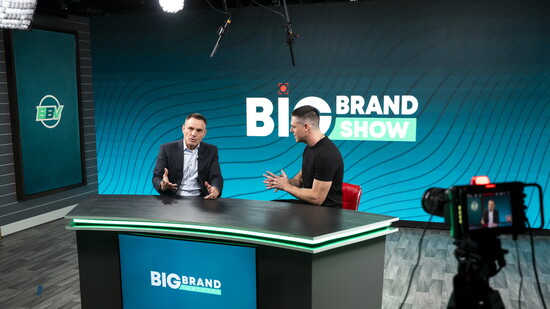
For our April Business and Investing Issue, we go one-on-one with Kevin Harrington to talk capital, customer acquisition, scaling in the digital era, and what “winning the race” really means now.
Kevin Harrington remembers the exact moment the industry changed. It was 1980. He had just ordered cable television and was flipping through nearly 30 channels, something that felt revolutionary at the time. CNN was running 24 hours of news. ESPN was running 24 hours of sports. Then he hit one channel that was blank.
Discovery Channel only aired 18 hours a day. 6 hours sat empty.
“I called the cable company and asked why nothing was on. They said they didn’t have anything to fill it with. I said, ‘What if I do?’”
That question built an empire.
But long before cable, before Shark Tank, before billion-dollar exits, Kevin was a teenager washing dishes in his father’s bar.
His father, a World War II fighter pilot turned entrepreneur, opened Harrington’s Irish Pub after the war. Kevin started working there young. He watched. He listened. He learned.
“He’d say to me, ‘You worked 40 hours this week. You made $1 per hour. After taxes you take home $36. I’m the owner. I make the money. You’re washing dishes. If you want to make the money, you need to own something.’”
That lesson stuck.
By 15, Kevin had launched his own driveway sealing business in Cincinnati. He also remembers living in a nice neighborhood, but on the “poorer” side of it. Other kids were handed cars at 16. He bought his own.
“I was convinced I had to do it myself. I wasn’t going to let anybody give it to me.”
Ownership became the goal. Independence the expectation.
So when he saw 6 empty hours on a cable channel, he didn’t see dead air. He saw inventory.
From that moment, the infomercial industry was born. Ginsu knives. George Foreman grills. Tony Little fitness. More than 1,000 product launches. Tens of millions in sales. And eventually the phrase that would become a retail badge of honor: As Seen on TV.
But when I ask Kevin about legacy, he doesn’t talk about television. He talks about teams.
“Surrounding yourself with the right people and creating that dream team is everything. If you try to do it all yourself, good luck. It’s not going to be easy.”
Kevin has made more than 1,000 investments and helped take 23 companies past $100 million in revenue. Several have crossed the $1 billion mark. Yet he insists most entrepreneurs still misunderstand scale.
“They tell me how big their industry is. Beauty is billions. Fitness is billions. If I get 1% I’ll have a $50 million dollar business. That’s not a strategy.”
What is a strategy, in his view, is less glamorous and far more disciplined. Build the right team. Raise capital. Create a real customer acquisition plan. Increase average order value. Focus on subscription revenue.
“If you don’t have acquisition and you don’t have retention, you don’t have a scalable business.”
He sees thousands of pitches every month. Most of them he walks away from. Not because the product is bad, but because the system is missing.
When he joined Celsius in 2013, the company did not have the budget for a traditional television blitz. Instead of forcing the old model, Kevin built a new one.
“Influencer marketing barely existed 13 years ago. We went to Flo Rida. We went to Khloe Kardashian. We structured smart partnerships. We didn’t throw piles of cash around.”
The strategy worked. Fitness influencers posted organically. The brand grew inside gyms before it exploded into mainstream retail. Celsius is now a $14 billion company.
Kevin does not romanticize Shark Tank either. In the early seasons, decisions were made in real time.
“I’d tell my wife I was going to Los Angeles for two weeks and I might invest a couple million dollars. And she’d ask, ‘In what?’ And I’d say, ‘I don’t know yet.’”
Today he invests differently. More selectively. Through Big Brand Ventures, he holds equity in more than 40 companies and acts as a strategic partner, often taking minority stakes and empowering founders to lead.
“You have to bet on the jockey, but the jockey needs a team.”
He talks about AI the same way he once talked about cable television. As an inflection point.
“We’ve created massive amounts of content using AI. It’s a game changer.”
He explains that AI now allows his team to produce creative, ad variations, landing pages, and product positioning concepts at a speed that would have required entire departments just a few years ago. Testing cycles shrink. Iteration accelerates. Campaigns scale faster.
But he is cautious about misuse. Fake endorsements. Fabricated videos. Manufactured authority.
“You’ve got to be careful.”
Still, he leans toward optimism. Every era creates disruption. Every era creates opportunity. The entrepreneurs who win are the ones who learn how to use new tools without letting the tools use them.
Now, nearly 50 years into building brands, he defines winning simply.
“Winning the race means staying ahead of the pack and building massive brands in a creative fashion.”
Then he adds the line that explains his entire career.
“If you have $10 million, it’s easy. Spend it. If you don’t, you have to be creative.”
Kevin may be known as the jockey who rides companies across the finish line.
But listening to him, it is clear he is something else entirely.
He builds the track.
“If you want to make the money, you need to own something. But without acquisition and retention, you don’t have a scalable business.”
Kevin’s Five Rules for Building a Big Brand
Build the dream team
No one scales alone. Surround yourself with people who bring skill sets you do not have.
Raise capital strategically
You cannot build a billion-dollar brand without funding. Be intentional about how and when you raise.
Master customer acquisition
Hope is not a strategy. Know exactly how you will acquire and retain customers.
Focus on subscription and retention
Recurring revenue builds real enterprise value.
Stay ahead of the curve
Whether it was cable television, influencer marketing, or AI, the edge goes to those who move early.
kevinharrington.tv