Patrick J. McGroder III grew up on the sidelines.
His father helped pioneer the Buffalo Bills alongside founder Ralph Wilson, serving as executive vice president and, at times, general manager. He accepted a salary of one dollar a year because, as his son explains, “He never wanted to work for anybody.”
“Some of my dad's early best friends were George Halas, the founder of the Bears, Art Rooney, the founder of the Steelers, and Wellington Mara, the founder of the New York Giants. Dad had control of the stadium in Buffalo as the city’s sports coordinator, and he wanted an NFL franchise. He turned down Lamar Hunt’s offer for the Buffalo franchise for $25,000.”
When Buffalo was passed over for an NFL franchise in 1958, Wilson purchased the city’s American Football League franchise. Patrick’s father, as the Buffalo Sports Coordinator, controlled the stadium, and the two men quickly became lifelong friends.
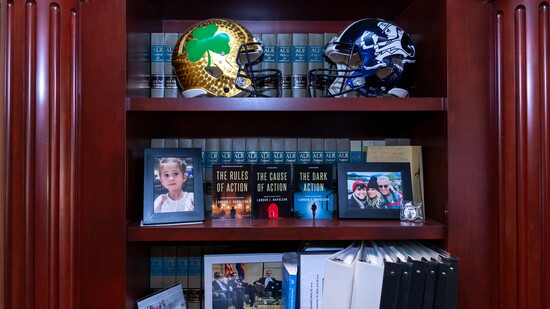
"After my father died in 1986, the Bills placed his initials on their helmets for five years. One photo in my office shows quarterback Jim Kelly wearing that helmet during a Super Bowl."
Patrick attended Catholic preparatory schools before enrolling at the University of Notre Dame, a choice influenced by his Irish family. After college, Patrick considered returning home to work for the Bills, but his Dad felt otherwise.
“He said, ‘If you come back to Buffalo, you’ll always be known as my son. You won’t have your own name.’ He said, ‘Go west.’”
Patrick listened. He enrolled at the University of Arizona College of Law, although becoming an attorney had never been part of his plan.
“I wanted to be a doctor, but wasn’t gifted in science and math, so Dad suggested law school,” he says.
The profession he resisted would eventually become the center of his life.
Today, Patrick is a founding partner of Beus O’Connor McGroder PLLC and leads the firm’s Plaintiffs Catastrophic Injury and Wrongful Death practice. Now in his 50th year of practicing law, he has served as lead counsel in more than 1,000 personal injury cases and recovered more than $1 billion for his clients.
"I have lost cases, although my most recent jury-trial loss was in 1985. No trial lawyer who claims to be a trial lawyer has won every case. Because of the types of cases we handle, which are high-profile catastrophic injury and wrongful death cases, there are millions of dollars at stake.”
The numbers are extraordinary, but to Patrick, they are not what matters most. He calls his greater purpose “social architecture:" using the civil justice system to help those harmed and change the conditions that allowed tragedy to occur.
“If you put aside the monetary recovery, I’m most proud of the way we’ve been able to influence how people act, create accountability for their actions and, most importantly, affect change.”
The evidence can be found throughout Arizona and across the country.
For nearly a decade, Patrick represented police officers and their families nationwide in cases involving Ford Crown Victoria Police Interceptors that caught fire in rear-impact crashes. Among them was a Phoenix officer who survived catastrophic injuries when his patrol car erupted in flames and first responders saved his life.
“The litigation resulted in modifications to approximately 350,000 Ford police vehicles. It saved lives. The ultimate social architecture was that Ford fixed those cars.”
Patrick’s cases have shaped road design, aviation, police and fire practices, penal reform and vehicle safety. His work helped bring cable barriers to State Route 51 and remediation to Oak Creek Canyon. He also represented the families of people who drowned in the Salt River before Tempe Town Lake was built.
"The dangerous condition was subsequently addressed by the advent of Tempe Town Lake. I could go on and on. All of these cases are devastating, but we have been able to change the way things are done.”
After two news helicopters collided over downtown Phoenix, killing four people, Patrick played a role in the subsequent litigation.
"At the time, news stations operated separate helicopters that often pursued the same stories. The case led them to adopt a single pool helicopter, improving aviation safety."
"After a man died at a trampoline park, we helped write legislation to regulate the industry. In a separate fraternity-hazing case, we helped draft the bill that made hazing a crime in Arizona."
For Patrick, those reforms ensure that a life lost or permanently altered can carry meaning beyond a tragedy.
“The families we represent are concerned their loved ones died for nothing.”
His cases include families, victims of aviation disasters, and survivors of shootings.
“I tell clients like that they have a lawyer for life... and they do. When the lights go out, I cry. It is hard to deal with parents who have lost children and children who have lost parents. I try to be empathetic, sympathetic and compassionate, but they are here to put their trust in me to find accountability and achieve justice.”
It's a responsibility that steadies him when the facts become nearly unbearable.
“I’ve had the privilege of representing people I consider heroes. I’m not sure I could match their strength.”
To carry that responsibility into a courtroom, Patrick prepares like an athlete.
"I adjust my sleep, nutrition and exercise. Trial work is hard. You’ve got one eye on the witness box, one eye on the judge, one eye on the jury, and one eye on the defense. It takes exertion.”
He believes technology can assist attorneys, but it cannot recreate the trust built with someone whose life has been shattered.
“AI can never replace the relationship between a lawyer and a client.”
He expects young attorneys at his firm to understand every part of a case, from how a complaint is filed and served to the medicine underlying a catastrophic injury.
“Know your medicine. Younger lawyers skip steps, running to Google or AI to get results instead of taking a book and reading about a particular issue in a case. The art of communication is often lost.”
Patrick still prefers a suit and tie, a habit that began when he was required to wear one since first grade in Catholic schools.
“Law is a noble profession; work is my passion. There is the fear of losing, letting people down, or not being the advocate my clients expect me to be. Fear is a motivator.”
Asked whether anyone can still outwork him after more than five decades, he smiles.
“I haven’t met that lawyer yet.”
His commitment has earned nearly every major distinction available to a trial lawyer. Patrick has been inducted into the Lawdragon Hall of Fame and the Maricopa County Bar Association Hall of Fame, recognized repeatedly among the nation’s leading trial attorneys and honored for professionalism, service and lifetime achievement by the State Bar, and ironically by the defense bar who he opposes every day.
The recognition that means the most came from the International Academy of Trial Lawyers, a peer-selected organization limited to the best 500 trial lawyers in the United States.
“It's a two-year vetting process. Ultimately I became President of the International Academy. Such an honor.”
His career has also made its way into fiction. A writer who first met Patrick while profiling him for an article became so intrigued by his practice that he followed him for two years. The two later collaborated on more than 50 cases, giving the writer an unusually intimate view of Patrick’s work, personality and legal world.
"The resulting three novels center on Connor Devlin, an Irish lawyer practicing in Phoenix, drawing inspiration from my career and cases. They’re fictional novels with fictionalized names."
A screenplay has also been developed from the series.
His life outside the courtroom remains grounded in the lessons he learned in Buffalo.
"Generosity was a responsibility rather than a choice."
Patrick has carried that expectation into decades of service supporting food banks, youth organizations, schools, churches, legal-aid efforts and community boards.
He has also passed the family story to his children. His daughter Lizzie is an actress and comedian in Hollywood, while his daughter Caroline and his son, Patrick IV, became attorneys at his firm.
He spends time with his children and grandchildren, goes to church, and swims three or four miles each week.
"Retirement is not under consideration. People call me Benjamin Button. My dad taught me never to be the smartest guy in the room, and I’m far from the smartest lawyer you can find. But I like to think I’m as good as there is.”
beusoconnormcgroder.com
“My dad’s early friends included George Halas, Art Rooney and Wellington Mara. He turned down Lamar Hunt’s offer for the Buffalo franchise for $25,000.”
“Most of the clients I see are horribly broken. They are here to put their trust in me to find accountability and achieve justice.”