There are moments in a woman’s life that change everything. Not loudly, and not always visibly, but deeply in ways the world may never fully understand.
A diagnosis. A surgery. A reflection in the mirror that suddenly feels unfamiliar.
And in the quiet space that follows, a question so many women carry, often unspoken. Will I ever feel like myself again?
It’s within that question that Knitted Knockers finds its purpose.
Not as a product, but as a deeply human response to a need that extends far beyond the physical. A need for dignity, for comfort, and for the quiet restoration of confidence in a season that can feel anything but steady.
The story begins with founder Barb Demorest, who never set out to create a global movement. In 2011, she was simply walking through her own breast cancer diagnosis, navigating uncertainty, fear, and the quiet decisions that define that journey.
“Like so many women, I was in shock,” Barb shares. “I felt self-conscious and embarrassed about needing a mastectomy.”
Her plan, like many others, was reconstruction. To restore what had been lost and return to a sense of normalcy. But healing does not always follow the path we expect. Complications altered that course, leaving her in a space that was both physical and deeply emotional. One where recovery wasn’t just about the body, but about identity.
In the midst of that, a practical concern surfaced. How do you feel like yourself again?
“I called the local cancer society to ask about getting a prosthesis,” she recalls. “They told me I couldn’t wear anything against the scar for at least six weeks. Six weeks… I had a life to get back to. That was the first time I cried.”
At a follow-up appointment, her doctor offered unexpected insight. Traditional prosthetics, he explained, can feel heavy, hot, and uncomfortable, especially early on. Then he asked a simple question.
Do you knit?
Barb did. But in that moment, she wasn’t physically or emotionally able to make one herself. Instead, she went home and reached out to her dear friend, Phyllis, a gifted knitter, asking if she would consider making one for her.
That Sunday, Barb did what so many women quietly do. She improvised. A sock tucked into her bra, a jacket pulled over her shoulders, and she stepped into church anyway, carrying both courage and vulnerability.
Soon after, Phyllis arrived with something unexpected. Two beautifully made knitted knockers, carefully placed inside a Victoria’s Secret bag.
Barb didn’t wait. She stepped into a bathroom stall, placed one into her bra, and in that moment, everything shifted.
“It was fabulous,” she shares. “Light, soft, and it fit perfectly. I took off my jacket and for the first time, I felt like myself again.”
That moment did more than offer comfort. It sparked a vision.
What if every woman facing this journey had access to something like this? Not a photocopied image or a clinical solution, but something real. Something ready. Something made with care.
With the support of her medical team, Barb began providing these handmade alternatives to other women. What started as a small, local effort quickly grew into something far greater, fueled by compassion and connection.
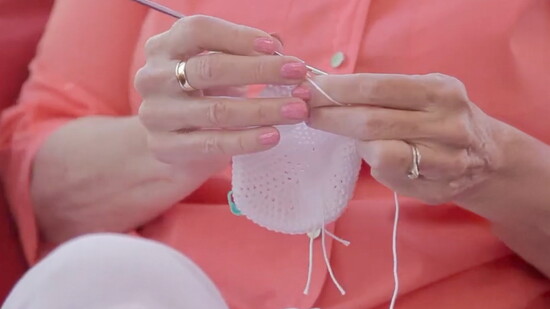
Today, Knitted Knockers is a global community, linking volunteer knitters and crocheters with breast cancer survivors, providing soft, handcrafted prosthetics completely free of charge. Each one is lightweight, comfortable, and designed to be worn in a standard bra, allowing women to move through their lives with ease.
But what they offer goes beyond function.
They offer normalcy. Confidence. A quiet return to self.
To date, more than one million Knitted Knockers have been distributed worldwide. Each one a reflection of the hands that made it and the heart behind it.
Because behind every piece is a story. A woman navigating healing. A volunteer choosing to give. A moment of care that reminds someone they are not alone.
“I never wanted anyone to feel alone,” Barb says. “And thanks to this incredible community, they don’t have to.”
In a world that often moves quickly past pain, Knitted Knockers offers something different.
Something soft. Thoughtful. Human.
Because healing is not always defined by what is restored physically.
Sometimes, it’s found in the quiet moments.
In the way a woman stands a little taller.
In the way she begins to recognize herself again.
And sometimes, it begins with something as simple, and as powerful, as knowing she is seen.