Did you know that, to create wine, the grapes need to be stressed out? A scrappy climate forces the vine to work hard and to focus on its fruit so that, come harvest time, you won’t have lazy grapes. Instead, you’ll find premium, flavorful, and rich bulbs of juice worthy of a corked bottle.
The Langman Winery vineyard is set in the Sierra foothills; a high desert climate where the atmosphere is thin, the sun is intense, and the soil is composed mostly of crushed granite.
“We want the grapes to stress themselves,” explains owner James [Jim] Langman. “We limit the number of vines per acre, and growth arms to four. Then, the annual growth shoots, we clip every other bud. The vine wants to have 500 growth arms and 10,000 annual growth shoots, so we make it focus.”
The resilience and hyperfocus that create Langman Wines aren’t unlike its founder. Langman grew up in a dangerous area of Chicago where mob rumors and crime were commonplace, and immigrant families poured their blood, sweat, and tears into family businesses to create a better future for their children’s children.
“When Al Capone was so bad he got kicked out of Chicago, he moved to Cicero, and that’s where I grew up. We just wanted to survive.”
Despite the stressful environment, Langman found peace in working for his neighborhood pharmacy. “My whole family, all eight of us, at one time or another, worked at the local pharmacy. Mr. Osblack, without realizing it, taught me business and how to care for patients, and his wife, she taught me empathy in a neighborhood that had none of it.”
Langman worked at that neighborhood pharmacy from age ten until he was a junior in pharmacy school. His 44-year career, which brought him to Bentonville for leadership roles with Sam’s Club Pharmacy and Walmart Health and Wellness, had an unsuspecting influence on his retirement plan: To buy a vineyard and open a California winery with his wife, Susan.
Between 2001 and 2009, the Langmans began exploring land in Napa and Sonoma, but quickly realized it wasn’t where they wanted to do business. “Big companies were buying up these family wineries and turning them into large corporations. I worked in a large corporation my whole life, but the corporate mindset is not the mindset that traditional winemaking has had for the last 1,500 years.”
To understand how the industrialization of American-made wine has affected production, Langman says to think of it like Coca-Cola versus Diet Coke. “You can tell the difference, right?”
According to Langman, two-thirds of wines in the US are packed with added chemicals. “In America, 132 ingredients can legally be added to wine, and they don’t have to tell you about it,” he said. “41 of those ingredients caused histamine release, and 71 of them start as petroleum. As a pharmacist, I was horrified.”
Conversely, in Europe, where the art of winemaking has existed for centuries longer than in the US, there are purity standards, which are identified by a DOCG label. “That stands for: ‘Purity in the vineyard, purity in the barrel, purity in the bottle. It also means that’s a state wine,’” Langman explains. “If you see DOC, it’s pure, but it's coming from other vineyards.”
After a realtor recommended the Sierra foothills as an alternative, the Langmans discovered their place. He describes the rural, family farms as “Old World style” wineries, where the wines are pure and smell like produce.
“Your wine should smell like food. Our wines are pure. They won’t give you a headache and make you sick. We have the starter yeast to make the wine, and the juice from the grapes, and that’s it.”
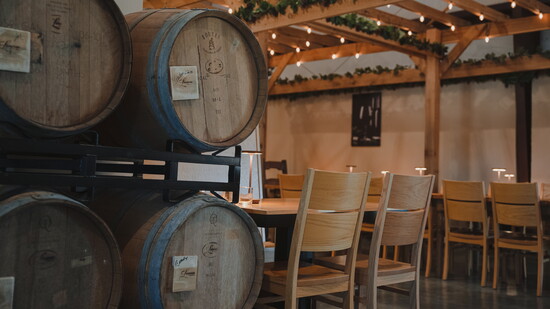
At first, Langman aimed to finish out his career in Bentonville while his grapes grew for a few years, then build a winery and move to California. But the ease of living in Northwest Arkansas was so appealing, they decided to stay, leaving the vines to be managed by a winemaker, Marco Capelli, and establishing Langman Winery and Restaurant on the edge of town at 11507 AR-72 in Centerton.
The young establishment, polished with lessons in perseverance and purity, strives to mimic the "Old World" experience with wines cared for from root to sip, and quality foods that inspire gathering with loved ones, like those honored on each of Langman’s bottles.