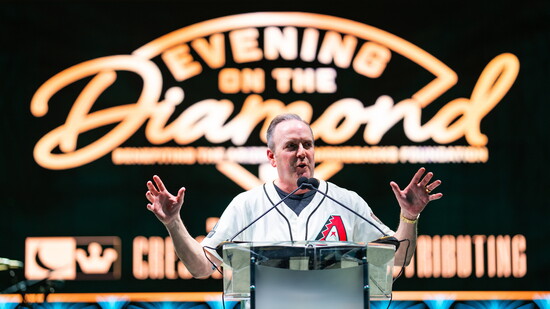
There is a red seat inside Chase Field that tells you a lot about Derrick Hall.
For years, Diamondbacks season ticket holder Bob Ellmer sat among a sea of green seats. When the team changed its colors to Sedona Red, Bob wasn’t exactly a fan of the decision. Then, while battling cancer, he called Derrick with a story.
Bob told him he had dreamed he was flying above the ballpark, looking down on his favorite place. As he moved closer, he noticed something unusual: every seat was green except one. It was red. His seat.
Today, that red seat remains, marked with a plaque in his memory.
It is one story among thousands accumulated during Derrick’s more than two decades with the Arizona Diamondbacks, but perhaps it explains why his latest honor feels particularly fitting.
Derrick Hall, President, CEO and General Partner of the Arizona Diamondbacks, has been named one of the 77th Arizona Leaders of the Year, a longstanding honor recognizing Arizonans whose leadership and service have made a lasting difference. During his tenure, the organization’s charitable giving has surpassed $100 million, while community impact has become as fundamental to the D-backs identity as anything that happens on the field.
When asked whose face first came to mind when he learned of the honor, he didn’t name a baseball legend, business mentor or civic leader.
“My wife Amy,” Derrick says. “The sacrifices and support make us a team. And her morals and integrity give me the roadmap.”
For our November Giving Issue, we asked Derrick about the lessons behind the numbers.
When you took this job, what did you believe a baseball team could mean to a city?
Baseball is the greatest sport of all time, and having a team is the best point of civic pride. Seeing our young fans wearing D-backs uniforms all around the state puts the exclamation point on the importance of having an MLB team.
More than $100 million in giving is a remarkable number. Which moment has stayed with you longer than any dollar figure?
There is nothing like seeing 2,000 runners and walkers lining up to start the Race Against Cancer each year. Everyone knows someone impacted by cancer, and for the community to come together to make a difference is remarkable.
Did you have a philanthropic upbringing?
My parents always preached giving to others who are less fortunate. And my first owner at the Dodgers came to me in spring training when I was an intern and we were in the midst of a company-wide fundraising campaign and said he noticed I had not given.
I said, “With all due respect, I don’t make that much.”
Without missing a beat, he said, “Then don’t give that much.”
That stuck with me: give something, be it money or time.
When someone brings you an idea for helping the community, what makes you say, “We have to do this?”
All I need to hear is how we can better the lives of Arizonans. It is then a no-brainer and a done deal.
What can you accomplish through baseball that you couldn’t through a traditional charity?
Our fans make the difference. They contribute every night with the 50/50 raffle because they want to be a part of our giving. Whether the broadcast auction, Evening on the Diamond, or our game authentics, our fans come through for us.
What has a player taught you about generosity?
Corbin Carroll is an amazing individual. Every year we ask the players to come and sign autographs during spring training for fans, community and corporate partners.
A few years ago, he asked if we sign for our employees and said they are our biggest fans. We told him we do not sign for them, and he said he wanted to. He asked for every employee to bring something special to them for him to sign, and he did over a two-week period.
After your prostate cancer diagnosis, was there a conversation you wished someone had started with you sooner?
Yes, to get in and get tested sooner. Medical experts had always said to get tested after 50 years of age. My diagnosis was caught as a mistake at just 42 years of age. I stress that men get in sooner, even in their 30s.
I think the biggest mistake is being afraid to go see a doctor or being too macho.
What has the Derrick Hall Pro-State Foundation taught you about reaching someone who doesn’t want to ask for help?
I have heard from so many men that they have sought early detection because of my story and have treated it, or encouraged others to go in and have caught cancer early. Knowing we have made a difference means everything.
What is a decision you made as a leader that looked small at the time but changed the culture of the organization?
It is definitely introducing FAWTSY to the organization. It is an acronym that stands for “Find a Way to Say Yes.” It was a monumental move for how we treated our fans and community. It shaped our culture.
When the team is struggling on the field, what does the community still need from you?
We cannot win every season. We cannot control the wins and losses on the field. But what we can control is the impact we can have on the community. We must always stay focused on helping others, regardless of how we play on the field.
What’s something fans have asked for that changed your mind about how the ballpark should feel?
Fans once asked us to provide value items at the Team Shops and concession stands. Still today, we have food pricing below $3 and merchandise items under $10 and allow fans to bring in their own food and water.
Who deserves credit for what the Diamondbacks have become?
I believe our owner Ken Kendrick does. He successfully took us out of financial woes and laid the groundwork for giving back to the community. He is an amazing leader and is as generous a leader as there is.
If the next generation of Arizona leaders could learn one thing from the people you’ve served alongside, what would you want them to see firsthand?
That the customer or fan doesn’t come first. The employee does. And if the employees feel respected, invested in, recognized and rewarded, they will then in turn treat our fans properly.
Finish this sentence: “Arizona gave me ______, and I hope I’ve given it ______.”
An opportunity, pride.