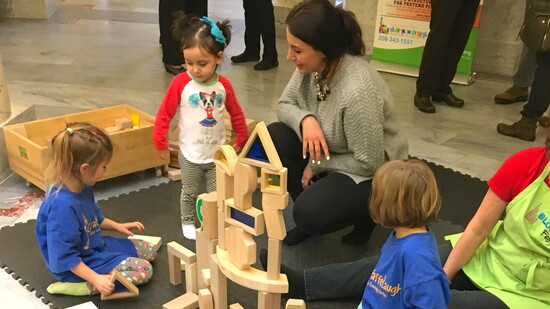
“Children are born to learn” is a core belief of the Boise-based team behind BLOCK Fest®, and anyone who has watched a young child with a pile of blocks has likely seen that learning unfold in real time.
A tower goes up. A tower falls down. Moments later, it rises again.
What may look like simple play is often much more. As children stack, balance, sort, build, and imagine, they are developing skills that will serve them long after the blocks are put away. Problem solving, communication, hand-eye coordination, creativity, and persistence all begin taking shape through experiences that feel more like fun than formal learning.
Parents and trusted adults play an important role in that process. Making time for block play, asking open-ended questions, and following a child's imagination can transform an ordinary afternoon into a meaningful learning experience. Questions such as “What are you building?” or “What happens next?” encourage children to think, communicate, and explore new ideas.
Those principles are at the heart of BLOCK Fest®, a research-based interactive exhibit developed through the University of Idaho's Parents as Teachers Demonstration Project. The program introduces families to the educational value of block play while encouraging children and adults to learn together through hands-on experiences.
“BLOCK Fest® was developed to provide an interactive block-building experience for young children ages 8 months to 8 years and their parents,” says Patricia Kempthorne, former Idaho First Lady and founder of Twiga Foundation, home of BLOCK Fest®. “BLOCK Fest® also supports parents and children to form an emotional bond during the learning experience.”
Research behind the program found that children progress through several stages of block play, from simply exploring blocks to building structures, creating enclosures, and constructing bridges and arches. Along the way, they develop early math, science, language, and social skills.
Perhaps that is why blocks have remained a childhood staple for generations. Long before children encounter classrooms, tests, and homework, they are already learning about the world—one block at a time.
Children build more than towers with blocks—they build confidence, creativity, and problem-solving skills