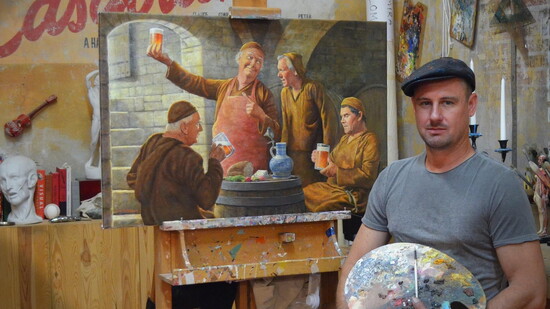
Before language, there were images, marks on stone, gestures across surfaces carrying meaning when words could not. In the work of muralist Lee Casbeer, that lineage persists as a living practice, his walls holding memory and asking a community to see itself, past and present, within a shared frame.
Casbeer’s murals unfold like cinematic stills, figures leaning into one another, gestures mid-action, light falling across a face just long enough to suggest what came before and after. Each composition extends beyond the wall, part of a larger unfolding story.
“I’m always excited about some kind of storytelling or narrative aspect,” he says, describing the instinct that has guided his work from childhood. Even as a young artist, drawing was never about isolated objects, but scenes, what people were doing, how they moved, what they might be thinking.
The Artist Who Left to Return
There is a particular rhythm to Casbeer’s path, one familiar in artistic tradition. Some artists remain rooted, deepening the soil of a single place. Others leave, gathering knowledge and perspective before returning home transformed.
At age 20, Casbeer moved to Italy, spending five formative years immersed in a culture where art is embedded in daily life, across ceilings and walls. In frescoed rooms and centuries-old villas, he encountered a tradition of narrative painting used to commemorate what mattered.
Distance clarified his relationship to Texas, revealing the layered narratives of the Hill Country as rich, complex and worthy of preservation.
Murals as Cultural Memory
In a region like the Texas Hill Country, where history remains close to the surface, murals serve a particular role. They are not static illustrations of the past, but active bridges between generations.
One of the most resonant examples is Casbeer’s depiction of the treaty between the Comanche and John O. Meusebach, a foundational moment in Fredericksburg’s history and one of the longest-standing unbroken treaties in the United States. Originally created for The Treaty House, the mural has been reimagined and installed at Altstadt Brewery, ensuring its continued presence. In this gesture, the work mirrors the treaty itself, enduring and carried forward.
Casbeer approaches each project with the sensibility of both historian and storyteller. His research extends beyond dates and events into texture, the weight of a handmade object, the fall of light, the details that transform a scene from generic to specific. The smallest elements can carry the greatest meaning.
This attention is not decorative, it is interpretive, asking viewers to reconsider what might otherwise be overlooked, the labor embedded in daily life, the humanity within historical figures, the continuity between past and present.
That continuity becomes especially visible through one of his most distinctive approaches, using contemporary models to inhabit historical scenes. Local residents appear as settlers, laborers or figures from earlier eras, collapsing time and making history immediate.
The effect is subtle but powerful, the past is no longer distant, it is recognizable, it is here.
The Cinematic Eye
There is an undeniable cinematic quality to Casbeer’s work, shaped in part by his admiration for narrative painters like Norman Rockwell and filmmakers such as Francis Ford Coppola, along with cinematographer Caleb Deschanel.
He draws inspiration from film, works like “All the Pretty Horses”, where landscape, light and human drama merge into something immersive.
Composition, for Casbeer, is less about formula and more about intuition refined through practice. He builds scenes through a process not unlike filmmaking, casting models from people around him, staging moments and selecting the frame that holds the greatest narrative tension.
A successful mural does not tell everything, it suggests enough to invite curiosity, allowing the viewer to step inside.
Stories Worth Telling
At the heart of Casbeer’s practice lies a question: what makes a story worth telling?
The answer is neither purely historical nor imaginative, but lives in the intersection of the two - where fact, interpretation and human experience converge.
He is drawn to stories of transformation, particularly those rooted in Texas history. Figures like Herman Lehmann, a German boy captured and raised by Native American tribes before returning to settler society, embody a profound cultural and personal evolution.
“I think people need to remember. They need to have a connection with their past in this way,” Casbeer says.
That sense of responsibility, to memory, to place, to those who came before, defines his role as an artist. He is not merely depicting history; he is translating it.
Looking Forward
In an age saturated with digital imagery, the hand-painted mural retains a unique power. It is physical, enduring and rooted in place. It cannot be scrolled past. It must be encountered. In this way, the mural is never finished but continues to evolve through the imagination of the community.
Casbeer’s future work continues to draw from stories of migration, identity and transformation. Influenced by the novel “Lonesome Dove” and the writings of J. Frank Dobie, his work remains rooted in the intersection of folklore, landscape and lived experience.
Fifty years from now, when someone stands before one of his murals, Casbeer’s hope is simple. Not that they admire the technique - though they may - but that they look closer, ask questions and recognize, within the painted surface, how meaning is carried through image, and in it, find something of themselves.
Amy Tucker is an artist and writer, and owner of Art Ranch Fredericksburg.
Lee currently lives in Fredericksburg. In 1999, he and Matt founded their mural painting company, LMC Murals & Fine Art, based out of Fredericksburg, Texas. Their work can be found in corporate and private collections around the United States, Europe and the Middle East. Lee is represented by RoGallery in New York City, New York and the Adobe Western Art Gallery in Dallas, Texas.
Lee and Matt's works can be found at:
LeeCasbeer.com
Lmcmurals.com
Public murals by Lee & Matt can be seen in many local establishments including:
Vereins Kirche, Alstadt Brewery, Altdorf Biergarten, Java Ranch, The Emigrant Inn, Parts Unknown and more.