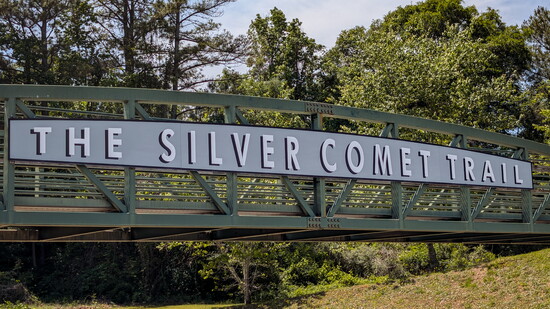
In the heart of Cobb County, a ribbon of smooth pavement stretches westward, cutting a path through dense pine forests and over soaring trestles. This is the Silver Comet Trail, a hallmark of North Georgia’s outdoor culture and a testament to the power of community-focused urban planning. What was once the corridor for the glamorous Silver Comet passenger train is now a beloved rail-trail, offering an unparalleled escape for families, athletes, and nature lovers alike. It provides a gateway to the outdoors, turning a historic transit line into a modern sanctuary for the entire region.
The name "Silver Comet" carries the weight of mid-century nostalgia. From 1947 until 1969, this same path was the artery for a luxury streamliner that zipped between New York and Birmingham. It was the height of rail elegance, featuring stainless steel cars, mahogany paneled diners, and the excitement of a 1,100 mile journey. For many small Georgia towns along the route, the sight of the gleaming silver train was a daily connection to the world beyond the woods. However, as the 1960s drew to a close, the rise of the interstate system and commercial airlines silenced the rails. By 1989, the tracks were pulled up, leaving a literal scar through the landscape that many feared would become a forgotten, overgrown wasteland.
The transformation from abandoned ruins to a community cornerstone began in 1992. The Georgia Department of Transportation purchased the right-of-way, and local leaders in Smyrna recognized the potential to preserve this historic corridor for something new. Instead of allowing the path to be subdivided or lost, they envisioned a continuous park that would connect neighborhoods and counties. When the first section opened in Smyrna in 1998, it wasn't just a new sidewalk; it was the reclamation of a piece of local history. Today, the 61.5 mile trail stands as a living museum where the original grading and massive trestles now support neighbors and bicycles instead of locomotives.
Beyond its history, the trail has become a vital fixture for the community’s daily life. It serves as a rare, car-free corridor that allows for a collective pause from the surrounding suburban developments. The path’s design ensures a level of quiet consistency, and because it follows the original railroad grade, the incline is minimal, allowing the landscape to take center stage. For the families who live nearby, the trail is a familiar extension of their own neighborhoods, a place where the focus shifts from the rush of the workday to the steady rhythm of the outdoors. It provides a sense of stillness in a rapidly growing region, offering miles of preserved green space that remains shielded from the noise of traffic. The Silver Comet Trail honors its past by remaining a journey rather than just a destination. It reminds us that while the era of luxury rail travel has passed, the need for a common path to connect our geography and its residents is more enduring than ever. In Smyrna, the trail is not just a park; it is a permanent piece of our shared heritage.