Josh Miller knows his way around a kitchen. He’s worked for nearly every major food publication in Birmingham — from Taste of the South and Cooking Light to Food & Wine and The Pioneer Woman — and even helped launch Southern Cast Iron. Now he’s the senior food editor at Southern Living.
When he became close friends with someone who avoids gluten for medical reasons, he took it as a personal mission. She shouldn’t have to give up macaroni and cheese, pie, brownies — the good stuff. The challenge, and eventually the fun, was figuring out how to recreate those classics without sacrificing flavor. To his surprise, a few turned out even better.
It began with small experiments and a moment of revelation. “Once I figured out I could use gluten-free flour in a pie crust application, it opened up to sweet and savory things,” he says. “Savory galettes, sweet ones, tomato pies… it was a big victory.” The crust carried a thin, flaky texture he loved. “It’s a little more crumbly than a traditional gluten crust,” he says, “but it still functions, cuts, and serves — and it’s still delicious.”
Brownies were next — and they became the signature success story. Miller dug into trusted recipes (“You’ve got to love Barefoot Contessa, Ina Garten, she just never fails,” he says) and started testing. Almond flour gave him great flavor, but it fell apart. Gluten-free all-purpose flour brought structure. “Almond flour is delicious, but it’s crumbly,” he says. “The gluten-free flour ended up making a better brownie.” People’s reactions have been a mixture of shock and delight. “I’m telling you — these brownies make people reconsider their life choices.”
People avoiding gluten often assume their favorite dishes are gone for good. “They think they’ll never have real macaroni and cheese again,” he says. “Then they taste it and say, ‘Wait… this is gluten-free?’”
He understands why expectations sink. Gluten-free flours are expensive. Time is short. Most home cooks are feeding families and doing their best. “They deny themselves good food because they’re taking care of everyone else,” he says.
But removing gluten doesn’t have to mean removing pleasure. Miller found that once you stop chasing perfect replicas, you start to see what works beautifully on its own.
Sometimes that means choosing what never needed gluten anyway. “Panna cotta is silky, rich, gorgeous — and there’s not a glutinous thing anywhere near it,” he says. Top it with balsamic strawberries, and it becomes restaurant-level impressive with almost no effort.
Sometimes it means rethinking texture. His now-famous salad crunch — gluten-free panko toasted with butter, spices, and parmesan — has sparked joy around many tables. “It makes this savory, crispy, crumbled-crouton situation,” he says. “People light up when they realize they can still have ‘the crunch.’”
Cooking gluten-free has also given Miller a hosting tool he can rely on. “It’s a nice skill set to have in your repertoire so you can extend another level of hospitality to those who avoid gluten by preference or necessity,” he says. “People feel cared for when they realize you made something they can really enjoy.”
When he’s cooking for mixed groups, he simply stages the workflow to make things easier. Gluten-free components come first. And when a recipe tastes identical, he serves the gluten-free version to everyone. “The pasta quality has gotten so good that it doesn’t make a difference,” he says. “Honestly, the gluten-free mac and cheese is as good as the regular. Maybe better.”
At home, Miller often hears Ina Garten’s voice in his head: never make something for company you haven’t tried at least once. “I did not ascribe to that for the first 15 years of my adult life, because I always saw entertaining as a chance to flex,” he laughs. “Kind of like how you clean your house better for company than you do for yourself.”
Over time, his thinking shifted. “Entertaining used to be a big thing,” he says. “I think the world is moving away from that and more toward hosting. Hosting feels like family. It feels like friends. It is intimate, it’s casual, it’s forgiving.”
To him, that’s the real goal. “People just want to get together and have a good time,” he says. “A really good lasagna is just as great as a fancy crown roast. If you make good food, it doesn’t matter how fancy or fussy it is. People are just appreciative you’re taking the time to cook for them.”
He recommends starting small, practicing a dish, and then welcoming others into your home to try it.
“You will have a much better time hosting if you take the pressure off yourself,” he says. “When you cook from a place of confidence, you can host from a place of calm.”
And that’s when a simple meal becomes something everyone remembers.
Here are a couple of Miller’s favorite gluten-free dishes to bring to your own table.
Roasted Winter Vegetable Galette
This recipe makes enough for two galettes, but the dough freezes beautifully. I recommend making the dough and freezing one disk for later. If you choose that path, cut the filling recipe below in half.
Makes 2 galettes
For the crust:
2 cups gluten-free flour, plus more for dusting
¼ cup finely grated Parmesan cheese
1 Tbsp. sugar
2 tsp. kosher salt
1 tsp. garlic powder
1/8 tsp. cayenne pepper
2 sticks unsalted butter, cubed
7 Tbsp. ice water
For the filling:
2 (8 oz.) logs goat cheese, softened
1 Tbsp. fresh thyme leaves, plus more for garnish
2 tsp. garlic powder
1/2 tsp. ground black pepper
6 medium-size red and gold beets, roasted and peeled (see tip)
1 egg
1/2 cup grated Parmesan cheese
To make the crust: Stir together dry ingredients in a medium bowl. Add butter pieces; toss to coat. Transfer flour-butter mixture to a food processor fitted with the blade attachment. Pulse until butter is the size of small peas, about 20 times. With machine running, add water all at once, then pulse until the dough just comes together (it will be very crumbly). Dust a work surface with gluten-free flour; dump out dough and knead briefly until combined. Divide in half and form each half into a disk. Cover tightly with plastic wrap and refrigerate 30 minutes.
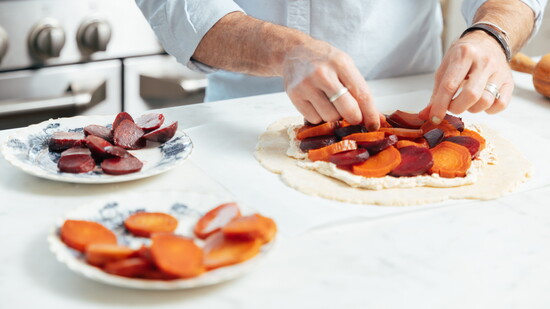
To make the filling and assemble the galette: Stir together goat cheese, thyme, garlic powder, and pepper in a bowl until smooth and spreadable; set aside. Remove dough from refrigerator; roll each disk into an 11-inch circle on individual sheets of parchment paper. Spread half of filling on each dough circle, leaving a 1-inch border. Cut beets into roughly ¼ inch slices; shingle over goat cheese, overlapping slices slightly. Use parchment to fold edges of dough up to encase the filling, letting dough crease and overlap (press together any cracks). Brush edges with beaten egg; sprinkle ¼ cup Parmesan over each. Transfer unbaked pies on their parchment paper to baking sheets; bake at 450°F until edges are golden brown, about 25 minutes. Let cool 15 minutes; garnish with thyme, if desired.
Cooking Tip
To roast beets, wrap tightly in foil; bake at 400°F until barely tender, about 45 minutes.
Sea Salt Caramel Gluten-Free Brownies
I make these regularly—they’re always a big hit. If you don’t need so many, cut the amounts in half and bake the batter in a 9x9-inch pan, increasing the time to 30 to 35 minutes.
Makes about 2 dozen
6 large eggs
2 sticks salted butter, melted and cooled slightly
3 cups sugar
¼ cup hot brewed coffee
2 tsp. vanilla extract
1 ½ cups gluten-free flour
1 ½ cups Dutch-process cocoa
2 tsp. baking powder
1 tsp. kosher salt
2 cups dark chocolate chips
1 ½ cups dark chocolate-covered sea salt caramels, chopped
Flaky sea salt, for garnish
Preheat oven to 350°F. In a large bowl, whisk together eggs, melted butter, sugar, coffee, and vanilla until smooth. Whisk together flour, cocoa, baking powder, and salt; stir into batter until just combined. Fold in chocolate chips. Line bottom and sides of a rimmed baking sheet with foil; spray generously with cooking spray. Top with parchment and spray again. Pour batter into pan, spreading in an even layer. Sprinkle chopped caramels over batter. Bake until a pick comes out clean, about 25 minutes. Garnish with flaky sea salt. Let cool 30 minutes before serving for easier slicing.
Serving Tip
Gluten-free baked goods tend to be more crumbly than their glutinous counterparts. Slice and serve with extra care.
"If you make good food, it doesn’t matter how fancy or fussy it is."
Gluten-Free Salad Crunch
Shake this savory topping over any salad for a nice savory crunch.
Makes about 3 cups
1 stick salted butter
2 tsp. smoked paprika
1 tsp. kosher salt
1 tsp. garlic powder
1 (12-oz.) container gluten-free panko breadcrumbs
1 ½ cups grated Parmesan
Melt butter in a skillet over medium heat. Add paprika, salt, and garlic powder; cook, stirring occasionally, 2 to 3 minutes. Stir in panko until coated. Cook, stirring often, until panko is lightly toasted, about 5 minutes. Remove from heat; stir in Parmesan until combined. Let cool completely before serving. Store in an airtight container up to 2 weeks.