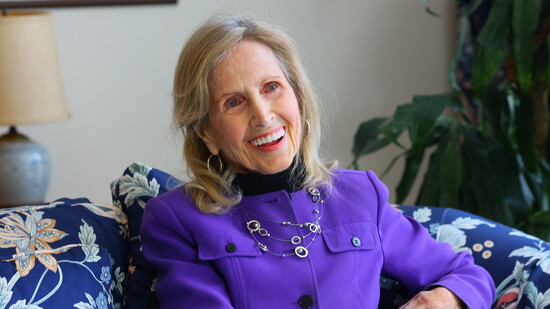
"I'm Connie Morella, and I approve this message."
She smiles and laughs when she says it, not as a rehearsed slogan or a closing line, but as a reflection of a life shaped by purpose, perseverance, and people. The words feel lighter in her voice, grounding the phrase in genuine appreciation. Connie Morella often describes herself as a "lucky gal," and after listening to her story, it is hard not to agree. But luck, in her case, has never stood alone. It has always been paired with intention, discipline, and a willingness to show up.
The first in her family to attend college, Morella's early life was defined by curiosity and determination. Education opened doors for her, but it also sharpened her awareness of who was still being left behind. She began her professional life as an educator at Montgomery College, where she saw firsthand how access to education, mentorship, and opportunity could alter the course of a life. Long before conversations about equity became mainstream, she was living it, advocating for fairness in classrooms and institutions that quietly shape the future.
From those early years, a clear throughline emerged: the conviction that opportunity should never be limited by gender, background, or circumstance. Teaching was more than a profession. It was preparation. It trained her to listen carefully, to explain complex ideas clearly, and to respect differing perspectives. These skills would later define her leadership style and her ability to build trust across communities.
That belief carried her into advocacy and community leadership, beginning with the Montgomery County Commission for Women. There, she and her colleagues asked questions others had overlooked. Who is missing from leadership roles in education, construction, and public life? Why are certain voices absent from decision-making tables? The answers were not always comfortable, but they were necessary. As Morella often says, "It was the women's movement that put the movement into me." Advocacy became action, and action gradually became a calling.
Her journey, however, was far from inevitable or easy. Early setbacks tested her resolve. For many, such disappointments might have signaled an ending. For her, they marked a beginning. The lesson she draws from that experience remains central to her message, especially for young people and young women: losing is not failure. It is information. It is preparation. Resilience is built not in moments of applause, but in moments of disappointment, when one decides whether to step away or step forward.
Throughout her years of leadership and public service, she became known for something increasingly rare: trust across differences. People from all backgrounds felt heard. The reason was simple. She listened. Her guiding principle, "Listen, learn, and lead," was not rhetorical. Listening, she insists, must always come first. Only by understanding lived experiences, family pressures, economic realities, and local concerns can leaders craft solutions that truly serve communities.
Her legacy reflects that philosophy. She championed initiatives supporting safety, dignity, women's health research, science and technology advancement, and cultural preservation. She played a meaningful role in efforts that strengthened research institutions and helped bring long-envisioned cultural landmarks to life in Washington, D.C. What ties these accomplishments together is patience. Change is rarely instant. It unfolds through sustained effort, collaboration, and a belief that progress, even slow progress, is worth pursuing.
She is candid about the challenges facing communities today. Division, she believes, has weakened not just institutions, but relationships. People no longer spend enough time truly knowing one another. Her prescription is both simple and profound: build relationships, stay curious, and relearn one another's humanity. We have far more in common than what divides us.
That belief extends beyond leadership into culture, especially the arts. A lifelong lover of music, painting, and visual storytelling, Morella speaks passionately about the arts as essential, not expendable. Art tells truths that statistics cannot. It supports mental health, fosters critical thinking, and helps people understand themselves and one another. She calls it medicine, delivered without a prescription.
Today, Connie Morella remains deeply engaged as an educator, a community advocate, and a convener of thoughtful dialogue. Her legacy is not defined solely by titles or milestones, but by the example she set. Show up. Listen deeply. Bring others with you. Don't lose sight of why you started. Because leadership does not begin with authority. It begins with listening.
Note: Content for this piece was drawn from an original interview conducted by Arianna Ross of Story Tapestries. Rooted in a thoughtful conversation, the editorial offers authentic insight into Connie Morella’s legacy and impact. Story Tapestries honored Connie Morella with the 2025 Maryland Gala National Connie Morella Changemaker Award, named in her honor to recognize her lifelong dedication to education, community, and public service, as well as her trailblazing career.
Losing is not failure. It is information. It is preparation. She often notes that resilience is built not in moments of applause, but in moments of disappointment, when one decides whether to step away or step forward.