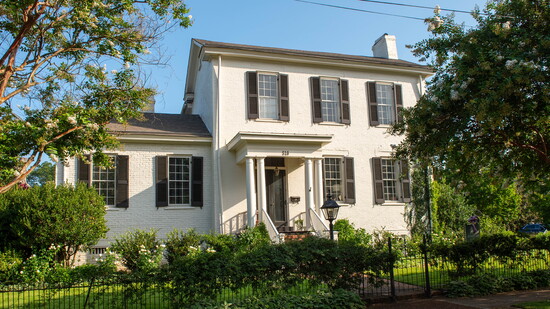
If neighborhoods released a best-dressed list, the Twickenham Historic District would be inducted into the fashion hall of fame. The streets of this tree-lined district are home to some of Alabama's most iconic historic houses, representing American architectural styles from the early 1800s to the present day. Amidst a backdrop of stately Greek Revival, fanciful Victorian, and rambling Mid-Century Modern homes, one architectural style is clearly a standout.
The Little Black Dress of the Twickenham Historic District is the Federal style, whose classically inspired lines were tailor-made for the early American Republic. Federal-style houses embody timeless fashion. Like any good wardrobe staple, they can be updated and dressed up as styles change. In Twickenham, their adaptability is especially evident in the work of George Steele, a Virginia native, builder, and self-taught architect whose work left a lasting mark on the Huntsville landscape.
Steele likely developed his building and design skills by apprenticing with accomplished builders in Virginia. In his early career, formal architectural training programs were limited in the United States, so he trained his eye with architectural plan books and style guides. After moving to Huntsville around 1820, he purchased land, established a brickyard, and built his first Huntsville house, his own on Randolph Avenue.
Steele stepped into an aspirational community that cultivated its intellectual and cultural potential . Anne Newport Royal, a travel writer who published Letters from Alabama on Various Subjects, gave an overview of Huntsville life: “The Town has 260 houses, principally built of brick, a bank, court house and market house, large square in the center with twelve stores around it. The workmanship is the best I have ever seen in all the states; and several of the houses are 3 stories high and very large. The citizens are gay, polite, hospitable, and live in great splendor.” Town leaders organized Alabama's first library in 1818 and constructed a playhouse for travelling theatre troupes in the early 1820s.
Steele's early Federal-style houses gave Huntsville a go-to look: a classic cut that could be modified and accessorized as the town prospered. The homes began as side hall structures—two stories, with one room on each story, connected by an entrance hall and staircase on one side. The windows and entry door were symmetrical and perfectly aligned, giving the façade clean, well-balanced lines. As a family's wealth increased, owners could expand their homes, adding a new wing that mirrored the arrangement of the original structure. (Photo: Feeney-Barber-Stanfield House; interior staircase & trim)
Steele's 1835 visit to Charlottesville, Virginia brought Greek Revival-style architecture to Huntsville. Steele drew upon Thomas Jefferson's University of Virginia as inspiration for three major projects he designed and built in the 1830s: the First Alabama Bank Building, now the First National Bank Building, on Huntsville's west side square; the second Madison County Courthouse, demolished in 1913; and the Thomas Bibb House on Williams Avenue. (A photo or plan of bank building, or does everyone know it)
What did Federal homeowners do when Greek Revival-style became all the rage? They accessorized! Since both designs were inspired by classical traditions, their basic shapes were very similar—boxy, symmetrical, and balanced. Throughout the 1840s and 1850s, George Steele became quite adept at updating Federal-style homes with Greek Revival details. A portico here! Bold columns there! And the Little Black Dress was ready for another season. (Photo: Steele House)
Federal and Greek Revival restraint soon gave way to Victorian exuberance and ornamentation. Looking to the medieval period for inspiration, architects threw out the rulebook of traditional design and created fanciful buildings with turrets, bay windows, and wraparound porches with lacy, decorative trim.
Greek Revival porches gave Federal-style houses more dimension, and Victorian flourishes softened the formality of the traditional designs. A beautiful illustration of how these three styles complement one another is the house designed by George Steele for Preston Yeatman in 1828.
Like other homes built for wealthy Huntsvillians in the 1820s, the residence began as a simple, Federal-style side hall. It received a significant makeover in 1855 with the addition of the matching wing and Greek Revival porch. A few decades later, the porch received a Victorian-Italianate update with decorative brackets, delicate scrollwork, and the curvilinear staircase.
Those with an eye for fashion will find the sidewalks of Twickenham as appealing as the runways of New York. Here, the timelessness of George Steele steals the show, with his classic cut that goes with anything.
Photos:
Feeney-Barber-Stanfield House
Caption:
A classic side-hall house designed by George Steele for George Feeney around 1825. The two-room, two-story house with an entrance and staircase to the side was an elegant starter home for Huntsville's well-to-do residents. The stucco was added in the 1920s.
Photo:
Steele House
Caption:
George Steele's first Little Black Dress, which he designed in 1823 for his family. The original, Federal-style side hall house received a makeover in 1830s with the addition of a one-story wing and Greek Revival porch.
Photo: Yeatman
Caption
The welcoming Yeatman House on Adams Street shows the evolution of a side hall house to a center hall house that encompasses design elements from the Federal, Greek Revival, and Victorian period.