They arrived 27 days apart. A female calf, Wini, born Feb. 9 to 5-year-old Tana, and a male, Archie, born March 8 to 11-year-old Betty White — two wobbly-legged newcomers who have brought Longneck Manor's giraffe herd to nine and given the Texas Hill Country something genuinely worth clearing your Saturday for.
But spend more than five minutes with Heather Crocker, executive director of the Fredericksburg wildlife destination, and it becomes clear fast: the babies are the headline, not the whole story.
"You need to catch somebody's attention so that they're motivated to listen to you, or to come here," Crocker said. "And then you can give them the message."
That message — conservation as a lived experience, not a lecture — powers everything at Longneck Manor, the AZA-accredited nonprofit sitting just 12 miles from Fredericksburg's Main Street. It is, in the best possible way, far more than a place to feed a giraffe.
A Vision Born in the Field
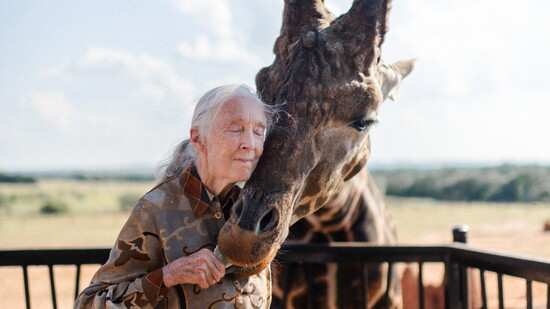
Longneck Manor was founded by Rick Barongi, a wildlife conservationist who started as a keeper and rose to the highest levels of zoo leadership, including Director of the Houston Zoo for 18 years, and played a pivotal role in designing Disney's Animal Kingdom. Along the way, he built close relationships with some of the most important figures in global conservation, among them the late Dr. Jane Goodall, who visited Longneck Manor just nine days before her death and whose endorsement the facility still carries.
"His name and his reputation really helped us catapult a program from an idea on paper into reality," Crocker said. "Renowned conservation experts and hands-on people — they answer his phone call. And that's a really big deal."
What Barongi started with a barn and five animals has grown into something that defies easy categorization. Today, nine giraffes share the property with three Southern white rhinos — all males, all seven years old, and every bit as captivating as their taller neighbors. Crocker likes to ask guests a simple question: how many people on the face of the planet can say they've touched a white rhino horn?
Longneck Manor is, technically, a zoo, but guests don't experience it that way. Tours are capped at roughly 12 people, encounters are unhurried, and every visit is curated to create not just a memory, but a genuine shift in perspective. Staff doesn't read from a script — they dig in, answer every question, and follow the conversation wherever it leads.
"When you see a giraffe in a book, it's wonderful, but it doesn't necessarily resonate the same way as if you're one-on-one, face to face with one in a really intimate setting," Crocker said. "We hope that when you leave, you've also gotten the message behind why we do this."
Small but Mighty
What makes Longneck Manor unusual isn't just its intimacy — it's the institutional rigor it maintains at that scale. The facility holds the same AZA accreditation as the Houston Zoo, making it the smallest AZA-accredited facility in North America. The Houston Zoo spans hundreds of acres and is home to thousands of animals and employees. Longneck Manor took those same operating standards and scaled them to a property run by eight animal keepers and three hospitality staff.
All of Longneck Manor's animals participate in the Species Survival Program, a coordinated network that tracks genetics across AZA institutions to guide breeding recommendations. Animals move between accredited facilities based on scientific need and are never bought or sold.
"We micro'd their operating standards down to a facility our size," Crocker said. "For a small and new facility to achieve that level of accreditation is really something."
Where Kids Come to Learn
Two new giraffe calves give spring and summer visitors a rare window: watching young animals navigate their earliest weeks in a setting small enough to feel genuinely personal. But Longneck Manor is increasingly focused on what happens after the tour ends and how early that education can begin to take root.
Last year, the facility launched its first structured children's programs under a newly hired director of education. Tower Tales brings children as young as three for a story hour centered on African animals, arts and crafts, and a snack — capped at just six children at a time. A homeschool program designed for students roughly 8 to 13, built to satisfy science curriculum requirements, runs as a six-week series and filled almost immediately, drawing families from as far as Dripping Springs and Marble Falls. Both, Crocker says, are just the beginning.
"I don't want to put out an interaction that's less than 100 percent," she said. "So we start small and then grow."
The goal is accessibility — making conservation education available to families who may never book an overnight stay, and building a generation of young people who leave not just with a great photo, but with a genuine reason to care about what is happening to these species in the wild.
Luxury With a Purpose — and a Horizon Full of Promise
From the beginning, Crocker recognized that the experience surrounding the animals had to match the animals themselves. She pushed Barongi to treat Longneck Manor as a luxury brand. One where every detail, from the landscaping to the overnight accommodations, reflects the same intention as the animal care.
"People who are going to spend this kind of money to come here are going to be very used to a certain level of accommodation," Crocker said. "Or they will have saved for six months to be here. And this needs to be amazing for them."
The model is deliberate: a for-profit hospitality side funds the nonprofit conservation foundation, allowing the facility to direct more to wildlife efforts in the field without compromise. Guests can pair a guided tour with a stay in one of the property's limited luxury accommodations — a natural anchor for a Hill Country weekend, with the Fredericksburg wine trail minutes away. Overnight guests enjoy full concierge services and private stargazing evenings with charcuterie and wine, courtesy of their collaboration with nearby Rhinory 90, a South African-themed winery whose white rhino program makes it a fitting partner.
And the future looks richer still. A new rhino barn is currently under construction, which will allow Longneck Manor to introduce female Southern white rhinos for the first time — with calves a real possibility by the end of 2027. Beyond that, Barongi has his sights set on okapi, one of Africa's most visually stunning and elusive animals, with tapir also on the horizon. On the strength of the facility's reputation and Barongi's relationships within the global conservation community, Crocker says the question isn't whether those animals will come. It's simply a matter of when.
Nine giraffes, three rhinos, and a herd of possibilities. Longneck Manor is just getting started.
Tours run daily at 11 a.m., with an additional 2 p.m. tour on Fridays through Sundays. Limited overnight accommodations are available. For information or reservations, visit www.longneckmanor.com.
"If you can bring somebody in and they can touch a rhino and feed a giraffe, you're going to make an impact. It's going to make them care about what is happening with these particular species and be more motivated to do something about it."