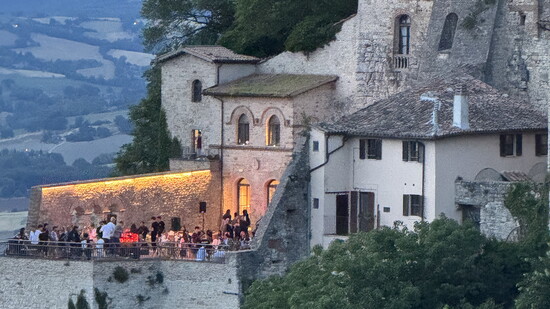
As second-generation Italians, Debora and Vin Rosa grew up surrounded by the language, food, and traditions of their heritage. Debora’s family traces its roots to Gravina di Puglia and Pescara, while Vin’s family comes from Calabria. Both were fortunate to obtain Italian citizenship through their grandparents—an inheritance that would eventually shape the rhythm of their adult lives in ways they never imagined.
Debora traveled to Italy often as a child with her parents, Mario DeCarlo and Frances Sacco, visiting cousins and absorbing the culture firsthand. But it wasn’t until their honeymoon thirty-three years ago that the couple discovered the hilltop town that would quietly become part of their identity.
Their friend Jerry Salvati, a prominent New York fashion photographer whose work appeared in publications like Town & Country, Vogue, and Glamour, had purchased property just outside the medieval town of Todi. He asked the newlyweds to stop by and take photos of his home while it was under construction.
That simple favor turned into something much bigger.
Through yearly visits with Jerry and his family, Debora and Vin fell in love with the beauty of Todi—the stone streets, the rolling countryside, the sense of history layered into every corner. Over time, the town became their permanent vacation destination and, eventually, a place where friendships deepened and routines formed.
At first, life in Todi felt welcoming but reserved. The locals were kind, yet there was a subtle distance. It was clear—they were stranieri, foreigners—and relationships would take time.
Debora, naturally outgoing, made it her mission to connect. Despite language barriers, she found ways to communicate warmth and goodwill, and slowly, those efforts paid off.
Across the street from their apartment sat a small family-run restaurant. Over the years, that restaurant became their gathering place. When Debora and Vin contracted COVID during one visit and were confined indoors, that same family delivered homemade soup to their door every single day.
“That’s when you realize you’re no longer just visitors,” Vin says. “You’re part of the family.”
Their circle continued to grow. Debora and a neighbor eventually created a Facebook group called Friends of Todi to help English-speaking residents and visitors stay informed about local events. Today, the group has grown to more than 2,000 members.
They joke that Debora could run for mayor—if only her Italian were better.
Lessons No One Tells You
Living part-time in another country comes with surprises—especially when navigating construction or renovations. One of the biggest lessons they learned was the importance of trust.
“In Italy, everything runs through relationships,” Vin explains. Central to that process is the geometra, a uniquely Italian professional who serves as project manager, technical advisor, and liaison with the local municipality. A geometra oversees permits, coordinates contractors, manages documentation, and ensures work complies with local regulations.
It’s not something most foreigners fully understand at the outset—but having the right person guiding the process can make all the difference.
Some lessons arrive in more dramatic fashion.
Like the time their family excursion, with daughters Erin and Katie, attempted to drive into Florence.
Their hotel was located just one street from the Duomo—an ideal location on paper. But their GPS guided them straight into a pedestrian-only zone, down a street so narrow it felt more like a hallway than a road.
People walked alongside their car. Walls closed in. Voices rose.
Inside the vehicle, everyone shouted directions at once.
Overwhelmed, Debora jumped out and walked ahead to find help navigating the final stretch.
Meanwhile, the girls folded in the side mirrors, and Vin carefully inched the car forward through the crowd.
They all reached the hotel at the exact same moment.
Lesson learned: A GPS in Italy assumes you drive like a local—with nerves of steel.
Of all their adventures in Italy, one story still makes them laugh—and perfectly captures the unpredictable charm of life abroad.
An elderly neighbor, Maria Grazia, mentioned that her godson was selling his car. The timing felt serendipitous. The couple had been considering getting a vehicle for local trips, and the price seemed unusually good.
The car—a 1997 Opel Corsa—had been sitting in a garage down the block but was in excellent condition, with only about 30,000 miles on it. They took it for a test drive and were impressed by how well it handled.
Without hesitation, they agreed to buy it.
Paperwork was signed. Hands were shaken. They proudly drove their new treasure straight to the Piazza del Popolo to meet friends for a Christmas concert.
During intermission, they couldn’t resist sharing the news.
“We just bought a car!” Vin announced proudly.
Their friend Leslie paused, smiled, and asked a simple question.
“Does it have air conditioning?”
Debora and Vin looked at each other.
Silence.
“Don’t they all come with air conditioning?” Vin finally asked.
Leslie shook her head. “Not necessarily.”
Debora immediately shifted the spotlight.
“You didn’t ask?” she said.
Vin scrambled to defend himself.
“The poor guy had a stroke,” he replied. “How was I supposed to ask about the air conditioning?”
Without missing a beat, Debora delivered the line that still ends the story every time:
“It was probably heat stroke.”
For Debora and Vin, Todi often feels like stepping back into another era—something reminiscent of growing up in the 1960s.
There is a gentleness in daily life. A slower pace. A visible respect for elders and children alike. Families remain close, often living within walking distance of one another across generations.
Community is not scheduled. It simply happens.
Older men gather for coffee and conversation. Neighbors pause to chat in the street. Shopkeepers remember your name.
“It reminds us of what life used to feel like,” Debora says. “More connected. More human.”
Their lives now unfold across two landscapes.
In Connecticut, they live in a rural setting surrounded by gardens and open space. In Italy, they are immersed in an ancient city of stone alleys and centuries-old buildings.
Each place offers something the other cannot.
And yes—there are moments when they feel pulled in both directions.
“When we’re in Connecticut, we miss Italy,” Vin says.
“When we’re in Italy, we miss Connecticut.”
Over time, they’ve come to see that tension not as a conflict, but as a privilege.
Would They Do It All Over Again?
After more than thirty years of returning to Todi—often three times a year for month-long stays—the answer comes easily.
Absolutely.
They may never relocate permanently. Part of the magic, they believe, lies in the rhythm of returning—the anticipation, the reunion, the familiar unfolding of daily life in a place that feels both foreign and deeply known.
“The culture, the food, the pace of life,” Vin says.
“There’s something truly special about Italy.”
And after decades of visits, friendships, and memories, one thing is certain:
Italy is no longer just a destination.
It’s Familia.
Living part-time in another country comes with surprises—especially when navigating construction or renovations. One of the biggest lessons they learned was the importance of trust.
“That’s when you realize you’re no longer just visitors,” Vin says. “You’re part of the family.”