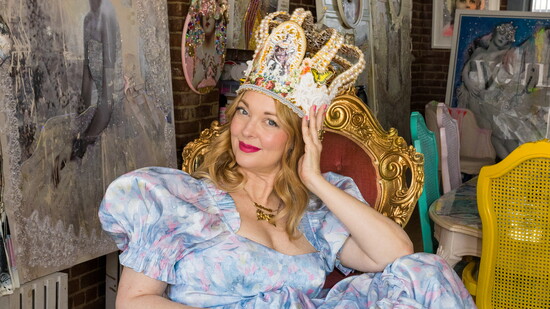
Step inside Hollywould Studios and it’s immediately clear — this isn’t a space that holds back. Different colors, fabrics, and textures fill the place, leaving no corner untouched. Located along Main Street in Boonton, this vibrant studio is part gallery, part workspace, reflecting the brilliant mind behind it all: artist and owner Holly Suzanne Rader.
This year marks a major milestone for the studio. “I started in 2016, so now it’s my tenth anniversary,” she said.
Rader's path into art began in what she describes as a “hyper-creative” childhood, where even her bedroom walls became an evolving collage. After studying painting at the undergraduate and graduate levels, including time at the Savannah College of Art and Design (SCAD), she moved beyond traditional artistry, developing a signature mixed-media style that incorporates vintage imagery, layered materials and intricate embellishments.
Today, her studio is more than a place to create. Rader has built a space that invites others in, building a community rooted in self-expression and imagination.
What led you to art and opening your studio in Boonton?
“I’ve always been an artist. My parents saw that and put me in art school. I went the traditional route as a portrait painter in oil, with a minor in dance — there's a lot of that influence in my art, like ballerinas, tutus, tulle.
Going to grad school was more about deciding what you could make that would shake the art world and how you were going to stand out. It's where I found my style.”
How did you transition into collaging?
“I studied abroad in France, and that's when I stopped painting portraits and started painting things that represent the human being, specifically women. When I graduated, I was ready to do something different.
Most of the women I use in my art are portraits from the silent film era or are fairly unknown. I like older faces and ones with more mystery because I'm interested in putting my own spin on them.”
What does your process look like?
“My materials come from everywhere — art supplies stores, antique stores — and I have a bead supplier I rely heavily on. I buy everything from kids’ craft beads to fine crystals.
I also pre-paint a lot of my papers with spray paint or splatter paint. I’m rarely painting directly on canvas. That way I have more freedom with composition and arrangement.”
What does a typical day in your studio look like?
“I'm working on my own art or my commissions. I have a gallery in New Orleans that represents me. I have a showing in September that I am getting ready for. That's what I do Monday through Thursday.
Friday through Sunday I’m open to the public. Sometimes people come in, sometimes they don't. Workshops are booked privately.”
Your work blends fashion and art — how do you see the relationship between the two?
“I’ve always loved fashion, but I didn't want to be a part of the circus.
I grew up watching runway shows with my mom, and I was more interested in the colors, textures, patterns, and the artistry. I wanted to express myself without having to worry about sewing technology, sizing, or creating a wearable collection.”
Where did the name “Hollywould” come from?
“Well, I’m Holly, and it’s a play on Hollywood. I tend to pick early actresses, but I also have moxie. I don't hold back, so ‘would’ makes sense.
I also wanted to brand myself so I could sell my art online. For my logo, I wrote in white paint on a piece of black paper lying on the floor. Even the paint drips and splatter are authentic.”
How did teaching become part of your work?
“I started teaching down the shore in Neptune, and then I moved up here. I taught kids first, and then the adults wanted to do it too. But there is no difference in my teaching style. I talk to the kids the same way I talk to the adults. The kids need less help than the adults, I find.”
What inspired you to start creating art zines (small, self-published booklets)?
“In the ‘90s we made them in high school before the internet. That's how we got our art out there. This winter, it was a bit dead, and I needed to do something to bring awareness not just to me but the whole Main Street of Boonton. We’re a community that helps each other.
I have a high schooler that works for me, and she is the music editor; she makes playlists that go on it. We feature the bookstore next door, and she’ll recommend books. I have a friend who's a poet, and she submits her poetry. I’ve had another local artist submit their artwork. I self-publish it so I can put in what I want.”
What might surprise people about your creative process?
“I sit and stare a lot. It's not a glamorous process — it's a lot of mundane work. When I'm making art, it's a complete mess because I can't be concerned when I’m cutting paper to pick up the scraps because I work fast.”
What has been the most rewarding part of your career?
“Inspiring other artists to pursue this as a career. I've had a couple of kids go to SCAD after interning with me. Just seeing that is a full-circle moment, being an example for them.
There are a lot of artists trying to do this full-time; I don't ever see it as competition. I see it as we need more.”
What do you hope people take away from your work and your studio?
“That it's possible to be a female entrepreneur making a living from creating art. I want people to take away that this isn't a hobby — this is what I do. I make what I want to see, and if others get it, they get it.”
“I’ve always been an artist. My parents saw that and put me in art school."
"Most of the women I use are portraits from the silent film era or are fairly unknown. I like older faces with more mystery because I'm interested in putting my own spin on them.”