Libraries across the Lincolnway area have quietly evolved into something far greater than many residents remember. While books remain central, today’s libraries serve as creative studios, learning hubs, community gathering spaces, and gateways to opportunity. In Frankfort, Manhattan, Mokena, and New Lenox, local libraries reflect the unique needs of their communities while sharing a common purpose: connecting people to information, resources, and one another.
At the Frankfort Public Library District, that connection often spans generations. Families who once attended storytime as children now return with their own kids, while newcomers discover the library for the first time. Director Amanda Kowalcze sees this mix as a sign of the library’s reach and relevance. “We have patrons who have grown up coming to the Library who are now attending our youth programs with their own children,” she says. Alongside that continuity is impressive access. As part of a consortium of 101 libraries, Frankfort cardholders can explore millions of items, from physical materials to a digital collection that circulates at a remarkably high rate for a library its size.
Frankfort’s approach extends beyond its walls. Outreach programs take library services to parks, schools, and assisted living facilities, reinforcing the idea that the library belongs to the entire community. Amanda emphasizes that while formats and tools may change, the mission remains steady. “The role of libraries has always been to connect people to resources, to connect people to information, and to connect people to people,” she says.
That idea of connection as a cornerstone is echoed in Manhattan and Elwood, where the Manhattan-Elwood Public Library serves as a welcoming space for residents of all ages. Executive Director Marcy Juarez describes the library as “a welcoming place for people to meet, play, learn, and stay informed.” From toddler playrooms and storytimes to Nintendo Switch tournaments, crafts, and weekly senior meetups, the library functions as a social and educational hub.
For many patrons, the library plays a particularly meaningful role during times of transition. Residents who are new to the area or entering a new stage of life often find both resources and community there. Juarez points out that libraries remain one of the few spaces where people can gather freely. “Communities need spaces where everyone is welcome and you can be there for free,” she says. That openness extends to preserving the past as well. Through a partnership with the Manhattan Historical Society and the University of Illinois, the library digitized editions of the Manhattan American newspaper dating back to 1919, ensuring local history remains accessible for future generations.
In Mokena, the public library continues to strengthen its role as a cultural and educational anchor. Director Cathy Palmer describes it as “the literary, technology, and cultural hub of the community,” designed to support learning, creativity, and connection at every stage of life. Beyond books, patrons can access digital learning platforms, advanced technology like 3D printers and laser cutters, and an extensive Library of Things that includes tools, instruments, cameras, and even telescopes.
The library’s impact is sometimes quiet but deeply felt. A Little Free Pantry located outside the building provides food and toiletries around the clock, offering dignity and support to those experiencing difficult moments. Palmer notes that many residents are surprised by just how much value is packed into a single library card. “Once people discover what’s available, they’re often amazed by how much value their library card provides,” she says. Looking ahead, Cathy sees libraries continuing to serve as what she calls the “third place,” a gathering space where education, technology, and human connection intersect.
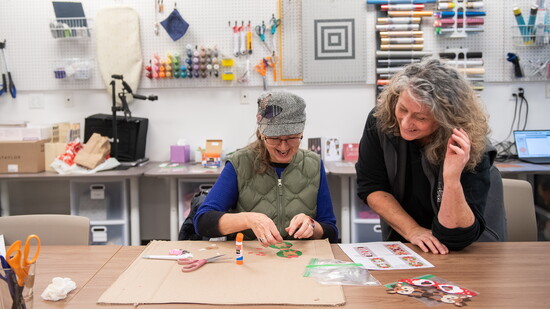
That blend of innovation and belonging is especially visible at the New Lenox Public Library, where creativity and responsiveness guide nearly every decision. Executive Director Michelle Krooswyk describes the library as “a welcoming, energetic hub where people of all ages feel a sense of belonging.” The library’s Studio space has become a standout feature, offering hands-on tools such as 3D printing, laser cutting, sewing, and audio recording equipment. During the recent holiday season, demand was so high that staff had to limit daily 3D print requests to ensure equitable access. “People are always surprised by the wide range of hands-on, creative opportunities available,” Michelle says.
Community feedback plays a central role in how New Lenox evolves. Through surveys and focus groups, residents helped shape the library’s new strategic plan, which centers on Community, Connection, and Convenience. Expanded evening and weekend programming, flexible meeting spaces, improved digital access, and easier navigation both in the building and online reflect the realities of busy households and working professionals. Michelle notes that collaboration is key. “We all know that we are stronger and smarter if we work together, not against each other,” she says, pointing to partnerships with schools, the Park District, preschools, and local organizations.
While services and spaces vary across communities, a shared thread runs through all four libraries. They support early literacy and lifelong learning, preserve local stories, and quietly close the digital divide by offering technology access and guidance. They strengthen local economies by helping residents build skills, search for jobs, and explore new ideas. Perhaps most importantly, they remain open, welcoming places where everyone belongs.
Across Lincolnway, libraries continue to invest in people without asking anything in return. Whether through a child’s first library card, a creative project brought to life, or a simple moment of connection, these spaces remind us why loving your library means loving your community.