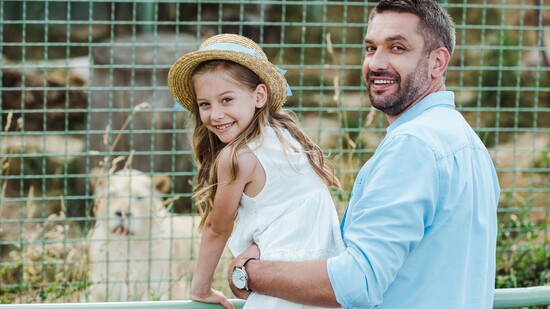
Father’s Day gives us one day each year to celebrate dads. But what does it really mean to be a father today?
Here in the Ramapo Valley, where family life unfolds through packed school calendars, carpools, evenings at the field and weekends spent together around town, the answer feels different than it once did. In communities like Franklin Lakes, Oakland, Wyckoff and Mahwah, fatherhood is often visible not in grand declarations, but in the steady rhythms of daily life—the dad coaching from the sidelines, helping with homework at the kitchen counter or showing up for one more school event after a long workday.
For generations, fatherhood was defined by one word: provider. A good dad worked hard, kept the lights on and put food on the table. Love was measured in sacrifice, long hours and responsibility. For many families, that role mattered deeply. It still does. But it never told the whole story.
The third Sunday in June became officially recognized as Father’s Day in 1972 under President Richard Nixon, nearly six decades after Mother’s Day became a national holiday in 1914. That timing says a great deal about how American culture long viewed parenting. Mothers were associated with care, nurturing and daily presence. Fathers were more often tied to work, discipline and financial support.
That division only became more pronounced through industrialization, when men increasingly left home for factory jobs and wage work instead of laboring alongside family. Later, wars pulled even more fathers away. World War I, World War II, the Korean War and the Vietnam War sent hundreds of thousands of American men overseas, reinforcing the idea that a father’s greatest contribution often happened somewhere beyond the walls of home.
For much of the 20th century, that model shaped the American household. Mothers were expected to raise children. Fathers were expected to support them financially. Even as family structures evolved and expectations shifted, many of those assumptions lingered.
But today, parenting looks very different.
In most households, both parents work. Women build careers, run businesses and contribute significantly to family income. Fathers are no longer defined only by earning power, yet many systems still treat mothers as the default parent. Schools often call mom first. Moms are still more likely to carry the invisible work of family life: the scheduling, the mental checklists, the birthday gifts, the doctor appointments and the emotional temperature of the house.
For families in the Ramapo Valley, where life can feel both full and fast-moving, that imbalance can feel familiar. These are communities where parents juggle demanding jobs, active kids and the desire to stay connected in the middle of it all. And within that reality, many fathers are navigating an in-between space. They are expected to be more involved than previous generations, but the culture does not always make room for them to be fully seen that way.
Still, the shift is happening in meaningful ways. Modern fatherhood is becoming less about being the distant breadwinner and more about being present.
It is the dad at pickup. The one who knows the pediatrician’s name, packs the sports bag, handles bedtime or texts the group chat about a schedule change. It is the father who knows which child is nervous about the test, which one forgot a water bottle and which one just needs five extra minutes of undivided attention. It is not about big, heroic moments. It is about consistency. It is about showing up.
That kind of presence matters deeply, especially in a place like the Ramapo Valley, where family life is built in small moments. Whether it is weekends at the ballpark, afternoons at the lake, hikes on local trails or unhurried meals together close to home, fatherhood here is not just about providing a childhood. It is about being part of it.
Maybe that is why the image of fatherhood is changing. Strength no longer has to look distant or silent. Leadership at home does not have to mean standing apart. More and more, it looks like attentiveness, flexibility and emotional presence. It looks like fathers who are not only supporting their families, but actively participating in the everyday work of loving them well.
So maybe this Father’s Day, the conversation shifts a little. Maybe we celebrate dads not only for how hard they work, but for how they show up. Not just for the pressure they carry, but for the memories they help create.
That is also what makes local Father’s Day traditions feel meaningful when they are rooted in time together. A hike at Ramapo Valley County Reservation, an afternoon at Van Saun County Park or a family meal close to home all reflect the same idea. The destination is not really the point. The time spent together is.
Maybe that is what modern fatherhood asks of men most: not perfection, not performance and not just provision, but presence.
Modern fatherhood is becoming less about being the distant breadwinner and more about being present.