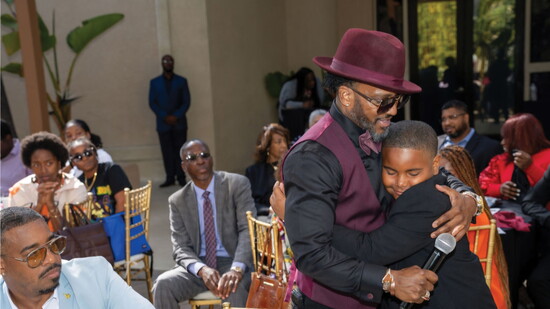
There's a word Sean Rector uses when he talks about his life — navigate. He says it the way someone does who has had to learn, early and often, that the terrain is rarely what you expected and the map is rarely yours to draw. From the streets of Harlem to the hills of rural Pennsylvania, from a castaway beach in the Marquesas Islands to the classrooms of South Central Los Angeles — Sean has spent his life finding a way through.
Harlem Roots
Sean was born in the heart of Harlem at Sydenham Hospital in 1971 — an era in New York City marked by urban decay, rising crime and economic decline. Raised by LaVerne Rector, a single mother who put herself through Bronx Community College, Sean spent his early years bouncing between Harlem and the Bronx, absorbing two worlds at once.
Much of his early childhood was spent with a neighbor he called Abuela — Carmela Apoyo — who cared for him while his mother attended classes. Spending so much time in a Spanish-speaking household, he became bilingual at a young age — so fluent that neighbors assumed he was Dominican. As he fondly remembers, his years in the Bronx were full of novelas, lucha libre and Café Bustelo.
He also grew up immersed in the rich culture of Harlem — the Apollo Theater, Dapper Dan and the birth of hip hop — breakdancing in ciphers, pop-locking in the street, and coming of age in an era that would later become the stuff of legend. "I grew up always in the sense of culture," he says. "That was Harlem."
The Milton Hershey School Years
In 1985, everything changed. Sean’s mother sat him down and asked what he thought about boarding school. LaVerne learned about Milton Hershey School, a K-12 residential school in Hershey, Pennsylvania, from a friend and saw an opportunity for her son that she knew she couldn’t provide on her own. Through the Deed of Trust left by the chocolate magnate and his wife, Catherine, MHS provides tuition, housing and life-changing opportunities at no cost for children from low-income families.
Sean agreed to take the admissions test, but his young mind was already made up that he wasn’t going anywhere.
Milton Hershey School called with the news that he had been accepted that fall, and despite Sean’s pushback, he was pulled from the performing arts school he was attending in Manhattan and enrolled at MHS in October of 1985 as a ninth grader.
It was not a graceful goodbye. "Y'all don't love me," he remembers telling his mother and uncle as they dropped him off at his new residence at student home Southfield. But he stayed — all four years of high school — and he thrived. What the experience gave him, aside from a top-tier education and many lifelong friendships, was something he still draws on: the ability to walk into any room, read it, adapt and hold his ground without losing himself.
Survival Mode
He came to Los Angeles in 1999 as an actor, having earned his stripes in New York theater, including a stint at the Roundabout Theatre on Broadway alongside the legendary Bill Irwin. He found a $213-a-month studio in Hollywood, across the street from Paramount, and pieced together a life — telemarketing, work at a youth homeless shelter and auditions. He picked up substitute teaching to fill the gaps, landing at John Muir Middle School in South Central, where he discovered something unexpected: he was good at it, and the kids needed him. When a veteran teacher abandoned the particularly difficult class Sean had been covering — apparently without warning — he stepped in.
Then “Survivor” called.
In 2001, just weeks after September 11, Sean flew to the Marquesas Islands to compete on the fourth season of the CBS reality phenomenon. He arrived as a teacher — with only his Bible as his luxury item — and left as a pioneer.
Sean navigated the game with a combination of strategy, humor and the kind of social intelligence forged over years of being the outsider in unfamiliar rooms. When conventional wisdom said his game was finished, he engineered what is now recognized as the first successful power shift in “Survivor” history, flipping three votes and blindsiding the alliance that thought they had him. He won two cars — a feat that still stands across all 50 seasons of the show.
He made it to day 36 when he was finally voted off the island, finishing in fifth place.
Still in pursuit of an acting career, Sean went home hoping to secure some solid gigs after being a fan favorite on the No. 6 most-watched show on TV that season. Unfortunately, the industry wasn’t so kind to reality stars in those early days of the genre, and the experience backfired on him. Meetings with the heads of Viacom and Showtime, a holding deal, face time with Bruce Willis — it all materialized and then evaporated. Sean returned to his classroom and watched the industry move on without him. He kept teaching. He kept coaching. He kept showing up for the kids.
From Boys to Men
Out of those teaching years, something organic and enduring grew. Starting with a group of about 40 to 50 boys from rival neighborhoods, Sean built the program that would eventually become the Boys to Men Enrichment Program.
The model was demanding in practice: you want to play ball, you must first learn to wear a shirt and tie. You learn to tie it yourself, then you teach another kid to tie his. You read the “Autobiography of Malcolm X.” You learn the four pillars — faith, integrity, culture and commitment. You memorize “The Man Is,” a poem every young man must recite to graduate.
Boys to Men eventually became the flagship program for The T.Y.M.E. Foundation, a 501(c)(3) nonprofit Sean founded in 2005, based in Long Beach. At its core, the mission is straightforward: develop positive young male and (and now also female) leaders to prevent the rise in gang affiliation, juvenile crime and high dropout rates. Through its culturally competent programming, The T.Y.M.E. Foundation offers tutoring, extracurricular activities and counseling — with the goal that every young person who comes through leaves valuing education, standing taller in their confidence and carrying a more hopeful vision of their future.
The program grew steadily through John Muir for nearly two decades — City Hall took notice, the LA Times covered it, and Mayor Antonio Villaraigosa personally visited the school and sat with Sean's boys. Then, when community investment funds began flowing into districts across LA in the wake of 2020, The T.Y.M.E. Foundation was ready. Today, the program operates across 13 to 15 LAUSD schools — bringing its curriculum of accountability, leadership and culture to the classrooms that need it most.
Family and Fatherhood
He met his fiancée, Maggie — a fellow educator who is now an assistant principal — while they were both teaching at John Muir. When she was pregnant with their daughter, Amaya, they went looking for a place to plant roots together. In 2016, that search ended in Long Beach. "I never thought I'd live below the 10 freeway," he laughed.
Fatherhood, for Sean, has never been separate from the work — it has always been woven into it. Many of the young people who come through The T.Y.M.E. Foundation are being raised by single mothers just as he was, and his programs instill the lessons often passed down by fathers.
His son Noah, from a previous relationship, has had the privilege of benefiting from his father's lessons both at home and in the field. From the time he was a baby, Noah was there alongside his father, present in the rooms where boys learned to tie ties, recite poetry and become men. When he was old enough, he became a participant in the program himself. Today, at 22 years old, Noah is a staff member, helping his father run the very program he grew up in.
Sean has always had a heart for service, and, as the saying goes, charity begins at home. Maggie is a founding board member of The T.Y.M.E. Foundation and continues to serve today. Amaya, 9 years old and watching it all, is growing up in a household where service isn't something that happens elsewhere — it's how the family moves through the world.
What's Next
These days, Sean is stepping back into a wider light on his own terms. He's featured in a new book on “Survivor Legends,” due May 12, with 10 pages to his name — more than most winners in the volume received. And after a recent journey to Ecuador with a group of former “Survivor” contestants — a plant medicine retreat that he describes as a spiritual reckoning — he seems settled in a way that can't be performed.
Mentoring youth still remains Sean’s top priority. Over the past 25 years, he has touched the lives of more than 20,000 young people, and he has no intention of stopping there. What began as a temporary assignment has become his life’s work.
"God has to remove you from what you think you want to see if you're worthy," he says. Sean has been removed, tested, overlooked and underestimated more times than seems fair. What he has built in the meantime is proof enough of the answer.