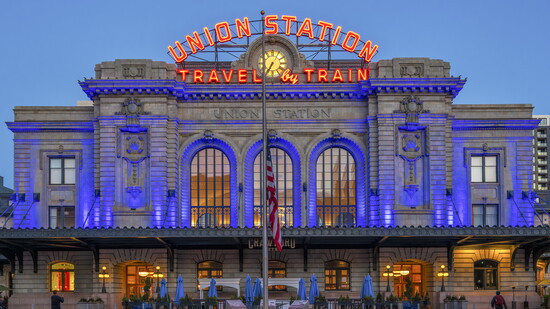
If you spend enough time in Denver, you eventually end up at Union Station.
It's where people meet friends downtown, grab coffee between errands, wait out the weather, or sit in the Great Hall with nowhere urgent to be. On any given afternoon, the station fills with commuters, tourists, office workers, hotel guests, families, and travelers trying to stretch a little more time before heading somewhere else.
Union Station has become one of Denver's few true shared spaces - a place that still feels open to everyone in a city often divided by neighborhood, routine, or lifestyle. Whatever else is happening in Denver, people eventually pass through here.
There's been some confusion recently about whether Union Station itself is celebrating a 150th anniversary. Not exactly. Colorado turns 150 in 2026, and because the station is so tied to Denver's growth, the timelines blur together. The original depot opened in the 1880s, and after a fire damaged much of the structure, the current station was rebuilt in 1914.
Still, most people's connection to Union Station has very little to do with dates.
What makes the station work is that it still feels genuinely lived in. That sounds obvious for a train station, but it's surprisingly uncommon. In many cities, historic stations become polished attractions that people admire more than they actually use. Union Station avoided that fate.
The architecture still carries the grandeur of the railroad era - soaring ceilings, tall arched windows, chandeliers, terrazzo floors, and the glowing "Travel by Train" sign facing Wynkoop Street. But that formality is balanced by something looser and more everyday. Suitcases clatter across the floor at all hours. Someone is always lingering over coffee longer than intended. Travelers fall asleep in chairs while waiting for delayed departures. Groups stop mid-conversation trying to figure out where they're supposed to go next.
The 2014 redevelopment transformed the surrounding neighborhood, bringing hotels, restaurants, offices, and new apartment buildings into what became one of Denver's busiest districts. But Union Station itself never crossed into feeling overly exclusive or carefully curated. You don't need a reservation, a train ticket, or even much of a reason to spend time there. It works equally well as a meeting place, workspace, shortcut through downtown, or temporary shelter from rain and snow.
In a city changing as quickly as Denver, that kind of consistency stands out.
In many ways, that atmosphere is exactly why Union Station fits so naturally within the modern gentleman aesthetic. Traditional gentleman style has never been only about clothing - it's about presentation, composure, craftsmanship, and carrying yourself with intention. The station reflects those same qualities. Its architecture values permanence over trends. Its pace encourages patience over urgency. Even the smallest details - brass fixtures worn smooth over time, tailored coats moving through the Great Hall, leather bags resting beside café tables - contribute to a feeling of understated sophistication that feels increasingly rare in modern cities.
At this point, Union Station feels less defined by transportation or history than by rhythm. It has become part of Denver's everyday movement - familiar, active, slightly chaotic, and still woven into the way the city functions. In a place growing and changing as fast as Denver, that kind of permanence matters.
Article by Meredith Cole
Photography by Michael Ryno
Originally published in Mile High City Lifestyle