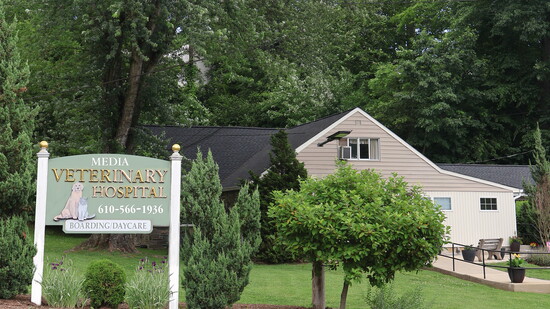
Our pets give us unconditional love, and when they seem sick or not quite themselves, we want the best care possible. For more than 65 years, Media Veterinary Hospital (MVH) has been serving our community. We spoke with the hospital’s Medical Director, Dr. Marcie Wynkoop DiPaulo, about her journey and passion for helping our beloved animal companions.
Why did you choose to become a veterinarian?
I was that typical five-year-old little girl that said she wanted to be a veterinarian when she grew up, and my plan never wavered. What started as a love of animals, grew into a love of science, medicine, and innovation. The veterinary field was that perfect combination.
What was your journey to becoming a VMD and the Medical Director at MVD?
I went to Villanova University for my bachelor’s degree in Biology. I then attended the University of Pennsylvania School of Veterinary Medicine. After graduation, I interviewed at many hospitals and ultimately decided to start my career at Media Veterinary Hospital. Dr. Menghetti mentored me, and when he retired in 2015 I became the Medical Director. I have been at Media Vet for the past 19 years. The staff, patients, and clients truly feel like home to me.
Could you tell us a story that particularly touched you?
At my graduation from Villanova, one of my biology professors presented me with a small gift. The gesture was an unexpected surprise. It was a book by Anna Quindlen called A Short Guide to a Happy Life. It was about enjoying the journey and not just the destination. This meant a lot to me at a time in my life when it felt like every step taken had a laser focus on the destination of getting my veterinary degree. It is so important for young, driven professionals to keep their goals in sight while remembering to stop, look around, and enjoy the journey. This book still serves as my “North Star” in many aspects of my life. To this day I don’t know if my professor gave gifts to many students, or what made her choose me, but this small gesture meant so much to me.
What should pet owners remember/know?
Two important things you can do for your pet at home are keeping them lean and taking care of their teeth. Approximately 59% of dogs and 61% of cats in the US are overweight. A study in dogs found that maintaining a lean, healthy weight can extend their lifespan by almost 2 years. Obesity is associated with increased risk of arthritis, diabetes, pancreatitis, heart and breathing issues, as well as systemic inflammation. Many of us bond with our pets by loving them with food, but we can swap some treats for carrots or green beans.
Dogs and cats are very good at hiding oral pain. Periodontal disease has been associated with heart disease, kidney disease, and liver changes. Dental disease can be a source of chronic inflammation in the body. Many owners don’t even notice subtle changes at home until they are surprised to how much better their pet seems after a professional dental procedure. Pets can have increased energy, better appetites, more interest in interacting with their environment, and improved grooming (in cats) after dental procedures. I try to do at least one thing each day at home for my pets’ teeth, whether that be teeth brushing (the gold standard) or giving them a dental chew.
Could you tell us a work story that particularly touched you?
One-story that comes to mind was an elderly chihuahua that presented for a spontaneous chronic corneal epithelial defect. This little patient was particularly “spicy” and difficult to handle. He would try to bite anyone that came near his face including his owner. Treatment for his ulcer entailed a debridement procedure that we did in the office followed by eye drops multiple times per day at home. The owner lived alone and simply could not apply the drops without getting bit. Distraught, the owner was worried about treatment at home. If the eye didn’t heal, then he would be at risk of losing the eye. He also had other health concerns that made him an anesthetic risk for surgery. We devised a plan with the owner. She dropped him off every morning at the office and picked him up 12 hours later every evening. He stayed with us all day at the office, and we applied his eye drops multiple times per day. This went on for weeks, but the dedication of the owner and the staff paid off! The little guy kept his eye, it healed well, and he didn’t need to undergo surgery. We cheered when he was cleared at his last recheck appointment.
What services does the hospital offer?
We offer healthcare to dogs and cats from pediatrics to geriatrics. We offer preventive wellness care, medical and diagnostic care (including on-site and reference laboratory capabilities), imaging (digital radiography and dental radiography), both soft tissue and dental surgery, bathing, pain management, and end-of-life care.
What are a few things owners may not know about their pet?
Did you know a dog’s nose print is unique to them just like our fingerprints? Tail wagging in a dog does not automatically mean the dog is happy. Dogs will wag their tails when they are excited, nervous, or ready to engage or interact with another animal or human. Adult cats do not typically meow to other cats. Meowing developed primarily as a way to communicate with humans. Purring doesn’t just mean the cat is content; they can also purr when stressed, scared, or in pain. A cat’s purr has a low frequency vibration between 25-150 Hz. This frequency can stimulate tissue regeneration, reduce pain, and build or repair bone density.
How do you and your staff feel about your patients?
My staff and I truly love our patients. Your pets are the number one reason we get up and go to work in the morning. I wish pet parents knew just how excited we are to see familiar names on our schedule. We review cases, we worry about them, we wonder how they are doing, and we miss them when they move or pass away. We hold them in our thoughts even after you leave the exam room. For me, the most meaningful part of my work is being by your side for the entirety of your pet's life, guiding you through the complexities of the end-of-life stage, and seeing your family again with that new puppy or kitten.
Can you tell us something we may not know about you?
Outside of veterinary medicine, you will either find me supporting my daughters at a volleyball court or a track meet. I enjoy reading as well as going to museums, concerts, and Phillies games. I love to travel, when I can. I have a menagerie of pets at home: 3 dogs, 1 cat, 2 chinchillas, 1 rabbit, and backyard poultry.
Anything else you’d like to share?
Lastly, I’d like to share that I am a proud Media resident. I have lived here for the past 17 years, and my husband is a DELCO native. In fact, my husband and I met at the Media 5 Mile Race many years ago. Media is such a great community and has much to offer. I think my children are so fortunate to grow up here. You may just see us some evening at Dining Under the Stars!
Note from Editor:
Your pets won’t tell you if they are sick.. but there are signs. As an owner, you can be able to decipher when things “aren’t right.” Please share them with your vet to see if you need to schedule an appointment. As a dog groomer since I was 18, I see the signs – and I ask the owner. The owners (you) know the truth and can help us figure out what is wrong.
Two important things you can do for your pet at home are keeping them lean and taking care of their teeth