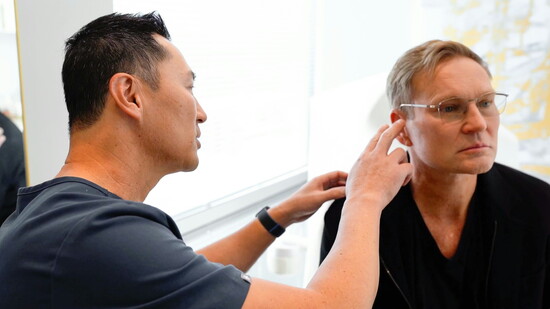
Dr. Anthony Admire does not speak like someone chasing trends.
For a surgeon whose work has earned national recognition, whose Scottsdale and Arcadia practice attracts patients from across the country, and whose Instagram following has climbed into six figures, he is strikingly calm. Measured. Thoughtful. Almost quiet in the way truly confident people can be.
Maybe that comes from the operating room. Maybe it comes from golf. Maybe it comes from being raised by a military father in a home where discipline, manners, and work ethic were not suggestions. Or maybe it started even earlier, with a story that began in South Korea.
“My sister and I were at an orphanage in South Korea,” he says. “My adoptive parents were American-born, both born and raised on farms in Indiana. My dad was in the Army at the time, stationed in South Korea.”
His parents first saw his sister. She was six, one of the older children in the orphanage, and female, a combination that made adoption less likely in that culture at the time. Then they learned she had a younger brother.
“We were a package deal,” he says.
So at four years old, Anthony came to the United States with his sister, first to Indiana to meet their new family, then eventually to Arizona, where his father retired from the military and settled in Tucson.
“I’m a Tucson kid,” he says.
His childhood was strict, but loving. His parents entertained often, filling the house with adults, conversation, expectations, and structure.
“It was my sister and I and 100 adults,” he says. “We knew how to interact with adults. It really fostered our maturation and being able to speak to whomever, saying yes sir, yes ma’am.”
They also worked. Cleaning golf clubs. Picking up golf balls. Pulling weeds. Learning early that nothing was handed over without effort.
That golf course became part of him. Before medicine, before plastic surgery, before national acclaim, Admire wanted to be a professional golfer. He was good, but not quite good enough. He jokes that he may have peaked as a freshman in high school.
Then life shifted.
“My mom passed away when she was 43 years old,” he says. “She died of a ruptured brain aneurysm. I was about 13 years old. You see your mom on the way to school, and you come home, and she’s not there.”
He did not understand what had happened. So he started asking questions. About the body. About medicine. About how something invisible could change everything in a day.
“I would say that’s when I started thinking about medicine in general,” he says. “Not necessarily plastic surgery, but I wanted to know how the body works.”
Plastic surgery came later, during medical school at the University of Arizona, when he rotated with a surgeon named Dr. Kian Samimi.
“What I loved most about him was his calm demeanor and how he was around patients,” Admire says. “How confident and poised he was in the OR. He never raised his voice to anyone.”
It is hard not to hear Admire describing himself.
His own path began with long nights and trauma calls, taking care of facial fractures, hand injuries, and late-night accidents in emergency rooms. He opened his own practice in 2007 without bank loans, building slowly, patient by patient.
“I was taking a lot of ER call, trauma call,” he says. “You have to pay the bills. I really did it all on my own.”
Today, Admire is best known for facial rejuvenation, particularly advanced facelift surgery. He performs roughly 120 facelifts a year, and he believes the category has entered what he calls “the golden age of the facelift.”
“There used to be a taboo,” he says. “People would come in saying, ‘I don’t want to look like Kenny Rogers. I don’t want to look like Burt Reynolds.’ Those people didn’t look like themselves after surgery.”
That fear, he says, kept many people away. But the conversation has changed.
“Now the trend is more natural,” he says. “Sometimes you don’t even know. Did they have a facelift? Did they not? They just look refreshed. That’s really what I’m after.”
His patients are not asking to look 25 again. They are asking to look like themselves, only rested, lifted, healthier, and more aligned with how they feel.
“They just want to look 10 years younger, 15 years younger,” he says. “A younger, better version of themselves.”
The public may think of a facelift as simply pulling the face tighter, but Admire is quick to explain how much the field has evolved. His work focuses on the deeper structure of the face, including the SMAS, a supportive layer of tissue he compares to a hammock.
“Once that tissue starts to age, it stretches,” he says. “That’s where a lot of the sagging in the face comes from.”
His specialty, the extended deep plane facelift, is more technically involved because it works within deeper facial layers where muscles, ligaments, and nerves must be carefully navigated.
“Everyone says they do the deep plane because now that’s a catchy term,” he says. “But it’s definitely more involved. There’s more technical skill to it.”
The goal is longevity, not a quick pull.
“Nothing is permanent,” he says. “Even bone is impermanent. But how the tissue is elevated and how it’s suspended, those are the things that give long-lasting results.”
For many patients, that means 10 to 15 years.
But Admire is also clear that surgery is only part of the picture. The future of aging well, he says, starts much earlier and has as much to do with skin quality as it does with surgical technique.
“If an 18-, 19-, 20-year-old came into my office and had something done in our skin clinic every single month for their whole life, they probably would never need a facelift,” he says.
The treatment he points to first is broadband light, or BBL, which he says can help reverse visible signs of aging in the skin.
“It’s not red light. It’s not even a laser,” he says. “There are studies that show it reverses the signs of aging in the skin.”
Then there is sunscreen, which he mentions like a commandment.
“Sunscreen every single day,” he says. “Regardless of whether the sun’s out or not.”
He knows because he learned the hard way.
“I remember my mom dropping me off at the golf course at 7 a.m. and picking me up at 7 p.m.,” he says. “I’d play 36 holes and not even use sunscreen. A lot of times not even a hat.”
In Arizona, he says, the environment matters. Sun damage, age spots, texture changes, laxity, and skin cancer risks all become part of the aging conversation.
“The sun really does more to age the skin than anything else,” he says.
And then there is the Ozempic era.
Admire says GLP-1 medications have changed the aesthetic landscape almost overnight, especially for the face.
“We’re seeing that a ton,” he says. “Patients have lost 40, 50, 60 pounds, and their faces are deflated. Not only does the skin get saggy, but they lose all that weight in the middle.”
That volume loss has contributed, he believes, to the renewed demand for facelifts. People may feel healthier and lighter, but their face can suddenly look older.
The other major shift? Men.
“Ten years ago, maybe 1 percent of facelift patients were men,” Admire says. “Now it’s probably 5 percent. It’s still low, but going from 1 to 5 percent, with as many facelifts as I do, is a lot.”
Men often start smaller, he says, with eyelid surgery.
“The eyelids start to sag. Extra skin hangs over the upper eyelid, sometimes obscuring vision. They may have bags in the lower lids. Those are home runs when it comes to male facial surgery.”
But the neck is often what bothers them most.
“They’re okay with a few wrinkles,” he says. “They’re okay with a few deep lines. But it’s really the neck that bothers them.”
Their biggest concern is usually scars.
“Especially men,” he says. “Where are my scars going to be?”
Good surgery, he explains, is not just about the lift. It is about incision placement, preserving hairlines, protecting sideburns, hiding scars in the contours around the ears, and making sure the result does not announce itself.
“No one wants their sideburns shifted into their ear,” he says.
For Admire, the best work is not obvious. It does not distort. It does not chase a celebrity face. It respects anatomy, timing, proportion, and restraint.
“I don’t think you should look for your surgeon on TikTok,” he says.
Instead, he believes patients should look for experience, confidence, calm, and a surgeon who is not performing for the internet.
“I have a calmness about me,” he says. “I’m kind of in my Zen, in my element during surgery. There’s no throwing things. It’s a very tranquil environment.”
No coffee before surgery, either. Some procedures keep him in the OR for six hours straight, and he prefers not to take breaks. The music is usually soothing. Chris Stapleton. A little Maroon 5. Sometimes country.
Outside of work, golf still grounds him. So does his wife. So does their mini goldendoodle.
But inside the operating room, his life story seems to come full circle: the child who crossed continents, the boy raised with military discipline, the teenager who lost his mother and wanted to understand the body, the young doctor who admired a surgeon’s quiet confidence, and the Scottsdale specialist now helping redefine what modern facial rejuvenation can look like.
Not frozen. Not pulled. Not someone else’s face.
Just restored.
As Dr. Admire puts it, the goal is simple: “I love enhancing facial harmony while preserving individuality, an approach that has become a hallmark of my work."
“We were a package deal. I came to the U.S. with my sister at four years old, and everything from there shaped who I am today.”
“You see your mom before school, and then you come home and she’s not there. That’s when I started asking how the body works and why things happen.”