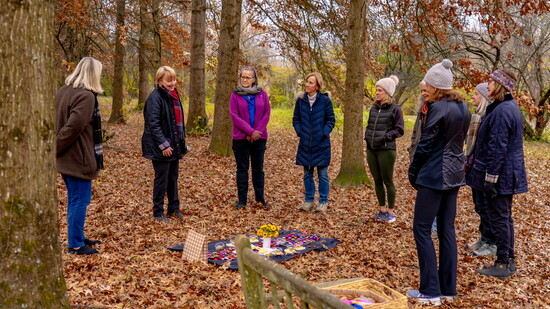
Forest bathing, or “Shinrin-yoku,” may be a concept that is new to many — but it is also one steeped in tradition, lending a natural practice to any journey of healing and wellness. Forest Therapy Guide Pam Lowe Cho, Greater Cincinnati resident and Principal of Forest Bathing & Garden Design, LLC, was happy to field questions on the subject.
Q: How long have you been part of the Greater Cincinnati community, and why is it special to you?
A: I grew up in Terrace Park, so Cincinnati has always felt like home. One of my greatest joys is walking the trails along the Ohio River with my husband and exploring the incredible parks throughout our region. My dad still lives in our family home in Terrace Park, so we’re often walking familiar trails in that area. It’s a constant reminder of why our community is so special.
Q: What is your personal definition of forest bathing?
A: Forest bathing is the practice of reducing stress by mindfully immersing yourself in a natural environment like a forest, park or backyard. I guide groups of 6-12 people in parks on easy trails, stopping for meditation, nature poetry, quiet reflection and a ceremonial tea.
Q: What do you see as the most important benefits of forest bathing?
A: There’s been extensive research on forest bathing since it originated in Japan in the 1980s. During my training with the Association of Nature and Forest Therapy (ANFT) in Phoenix, as well as in Japan and South Korea, I’ve seen firsthand how forest bathing can help relax our minds and bodies. Physically, forest bathing has been shown to reduce stress hormones, lower blood pressure and pulse rates, boost immunity and enhance sleep. Mentally, forest bathing has been shown to decrease anxiety and depression, increase attention, creativity and cognitive clarity.
Q: What led you to begin sharing forest bathing with others?
A: I spent 15 years as a corporate executive—including time at The White House—and I’ve run my executive coaching practice, Trek Executive Coaching, for the past 16 years. During the pandemic, I began inviting clients outdoors. We’d walk on a trail or meet at a picnic table, and the impact was immediate. People opened up and conversations flowed more freely. Clients can work with me and my business partner Wimberg Landscaping to create a meditation garden in their own backyard for ongoing wellbeing practices
Humans lived and worked outdoors for hundreds of thousands of years; it’s only in the last 200 years that we moved into insulated boxes—houses, offices, cars. Our bodies crave nature, and the more time we spend outdoors, the more our nervous systems relax.
Q: Can you share a bit about the history of forest bathing?
A: Forest bathing originated in Japan in the 1980s as part of a public health initiative in response to an increase in chronic physical and mental health conditions as Japan became a more industrialized and urbanized country. The idea was simple: reconnect people with nature and the forest to restore balance.
Join Forest Therapy Guide Pam Lowe Cho on a meditative tour through a local forest. Certified by the Association of Nature & Forest Therapy (ANFT), she leads forest bathing walks for friends, families and colleagues in Greater Cincinnati parks and nature centers. She also offers presentations including the history, science and personal stories behind the practice of Shinrin-yoku.
Pam Lowe Cho | 513.702.3750 | pam@trekcoaching.com | @FBGardenDesign | TrekCoaching.com
Many thanks to our guest forest bathers: Amy Stoehr, Nancy Hopkins-Greene, Nip Becker, Diane Little, Susan Raftery, Patty Green, Debbie Siegert and Mary Dunning.