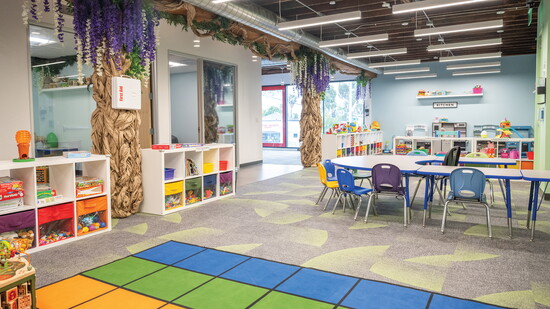
On the corner of Willow Street and California Avenue, Autism Spectrum Therapies (AST) has turned an office space into an inviting learning center for autistic children.
This past March, the center expanded to a newly remodeled second floor, adding more areas for children to play and learn. The space now includes eight themed rooms, such as ocean and space, along with group areas so sessions feel fun and inviting.
For Brandon Whitfield, senior regional director who started working at AST in 2009, the heart of this work is in stories like his first client. The boy arrived wearing gloves to protect his hands, which he bit relentlessly. With time and many sessions, he no longer needed them.
“Being able to work with him and build a relationship and see that progress,” Brandon says, “[It] was really the selling point for me to say, hey, this is the career that I really want.”
For more than 20 years, AST has supported autistic individuals and their families, providing applied behavior analysis (ABA) in homes, schools, communities and centers across the country.
He notes that while the staff has different backgrounds, they share a strong connection to Long Beach.
“Everybody that works here is local,” he says. “So there’s a local touch and care that goes to the treatment here because we are from the neighborhood, and so we care about the patients that we treat because they’re our neighbors.”
He believes a mix of experience, neighborhood roots and evolving practice is what sets AST apart from other providers. The organization shifted from traditional ABA therapy, which focused on drills and compliance, to more person-centered, assent-based care.
The staff pays close attention to how children show comfort and choice, especially when they do not use spoken language.
“It’s a level of, you know, making sure that the child is comfortable with what we’re doing, and making sure that we’re being very mindful of the various signs that a child may display to make sure that we know that they’re comfortable with us moving forward,” he says.
Therapists look for signs such as eye contact, leaning in, or reaching for a toy as cues that a child wants to keep going. He also emphasizes that this includes knowing when to stop.
“The moment that a child withdraws their assent, we stop with our treatment and we work to regain assent,” Brandon says.
This approach relies on regular check-ins and open conversations between families, supervisors and the behavior technicians who work with the children each day.
“It's really the communication — I think it's very important to go back and forth between all of us in like a little circle, and we try to keep each other updated as much as we can,” says Edith Dinarte, lead behavior technician.
Cristina Contreras, center director, joined AST in 2019 as a behavior technician (BT) and realized the job felt like a calling.
“I was able to figure out that this is what I loved to do, and I stayed,” she says.
The center’s culture is built on compassion for staff, children and families, and ABA therapy helps children build the skills for greater independence. Cristina points out that many parents share a simple goal for their children: independence, friendships and a happy life.
One of her favorite parts of working at the center is seeing that growth happen in real time.
“When we have goals around social skills or engaging with peers, you get to see them create friends and see them blossom as little humans — and it’s so wonderful,” she says.
Some of her most meaningful memories are what AST calls graduations, when a child and family no longer need services.
“I have had the luxury and the pleasure of having graduated a few clients,” she says. “... we have worked on their plan, we have met their goals, and the family and us have come to an agreement where we don’t believe services are needed anymore, and it’s such a wonderful experience.”
Each child gets a certificate of completion and a final session.
“We say, you know, we work to put ourselves out of work because our goal is that you don’t need us anymore,” Cristina says.
For BTs who have walked alongside those families for months or years, little moments can be just as powerful.
“A small moment would be seeing a child light up after months of radio silence and not wanting to see me, to then lighting up when they see me,” says AshleyTailor Thomas, a BT at the center. “Anything I do, I do it with love, and I know kids can read love.”
For more information on services offered at AST or to explore career opportunities, visit autismtherapies.com