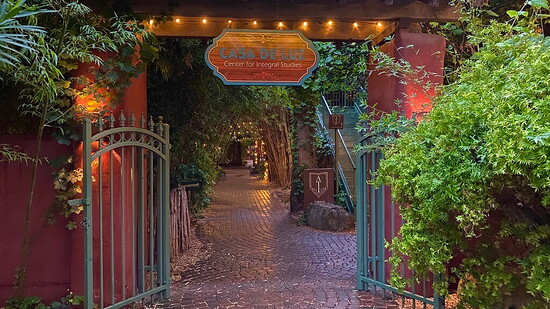
Tucked beneath the canopy of Barton Springs Road, Casa de Luz has quietly nourished Austinites for more than three decades. The nonprofit community center and macrobiotic restaurant isn’t simply a place to eat — it’s a living experiment in how food, environment, and connection can sustain collective wellbeing.
The daily menu at Casa de Luz adheres to a simple principle: whole, seasonal, plant-based ingredients, prepared with care and intention. Each meal includes soup, grains, legumes, vegetables, sauces made from local nuts or seeds, and pickled elements for balance. There are no processed oils or refined sugars, and everything, from sea salt harvested from Utah’s Great Salt Lake to produce grown by small organic farms, is chosen for its vitality. The result is humble food designed to heal rather than indulge.
At the center of its mission, the Ayurvedic Proverb is key: “When diet is wrong, medicine is of no use. When diet is correct, medicine is of no need.”
Founder Eduardo “Wayo” Longoria-Kowalski describes Casa de Luz as a “church of connection,” a place where nourishment begins long before the first bite.
“We’re connecting with the microbiome, the soil, and one another,” he said. “Wholly — or holy — plant nutrition is about honoring that relationship.”
Guests dine communally at long and circular wooden tables, often beside strangers who soon become friends. The dining hall hums with quiet conversation, creating an atmosphere that feels more like a family gathering than a restaurant.
That sense of connection extends beyond the kitchen. The Casa de Luz Village includes yoga and movement studios, an apothecary, holistic practitioners, and classrooms that host cooking classes, mindfulness workshops, and community gatherings. Many of Austin’s wellness leaders and schools trace their origins to this compound, which operates entirely as a nonprofit to preserve its mission rather than for profit motives.
For many visitors, the experience is transformative. Meals are nutrient-dense yet deceptively simple — an intentional harmony of flavors and textures that encourages mindfulness and gratitude.
“We’re not here to advertise or convince anyone,” Longoria-Kowalski said. “When people are ready, they find us.”
Regulars describe renewed energy, improved health, and a deeper sense of peace that comes from eating clean, balanced meals prepared without excess or ego.
“I love their motto that they are a beacon for connection to food, community, and ourselves," shared a recent guest. “They derive their essential fatty acids from freshly ground seeds and nuts, creating sauces and dressings that not only nourish the body but also honor the wholeness of the plants themselves. I like the communal dining experience that fosters human connection.”
Casa de Luz’s model proves that nourishment is as much about community and consciousness as it is about ingredients. By embracing whole-plant nutrition and mindful eating, this Austin landmark invites guests to rediscover the simple truth that health, connection, and gratitude grow from the same soil.
“We’re not here to advertise or convince anyone. When people are ready, they find us.”