James Castle never left Idaho. He didn't need to. The world he needed was right there — in the scraps of cardboard, the soot from the woodstove, the salvaged paper and string scattered across a property in Boise's Collister neighborhood. He turned all of it into art that now hangs in museums across three continents. Not bad for a self-taught deaf farmer who never learned to read.
This September, that same house welcomes someone who has traveled a very different road.
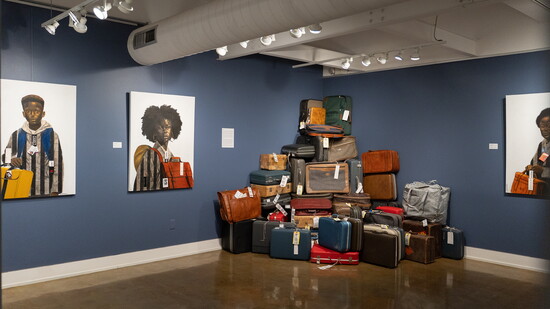
Oluwatobi Adewumi was born in Nigeria. He now lives in McNeil, Arkansas. His work — layered mixed media portraits and paintings built from charcoal, acrylic, and the kind of objects most people overlook — explores what happens to identity when you cross borders. Luggage. Immigration documents, tags, and personal archival materials. Textiles. Cultural artifacts. In Adewumi's hands, these aren't props. They're memory made visible.
His work has been exhibited in museums and galleries across the United States, where he explores migration, identity, memory, and belonging through portraiture and installation.
From September 1 through October 31, Adewumi is in residence at the James Castle House, creating new work inspired by the history of James Castle, Boise, and the surrounding community, and sharing his creative process with the Boise community through open studios, workshops, and public presentations. The residency is designed around exchange — not just between the artist and the space, but between the artist and the people who show up curious.
The connection to Castle feels less like a curatorial decision and more like an inevitability. Both artists built visual languages out of necessity. Castle, unable to communicate conventionally, turned his immediate surroundings into a rigorous daily practice of observation and invention. Adewumi does something similar — recovering and reimagining stories that have been overlooked, misrepresented, or quietly erased. "With every piece of art I create," he writes, "I tell a story — one that offers a voice, a perspective, and a reimagined history."
His portraits don't let you look away. The figures are layered, hybrid, caught somewhere between realism and abstraction — faces that carry more than one story at once. He works primarily in charcoal and acrylic, materials he describes as tools for conveying emotions that resist easy translation. Hope. Resilience. Vulnerability. The particular weight of being somewhere new while carrying somewhere else entirely.
Boise doesn't always think of itself as a city with a complex relationship to migration and belonging. But it is, and it's becoming more so. Residencies like this one are part of how a community learns to see itself more fully — not through a lecture, but through the work of someone willing to spend two months here, making art, opening their door, and starting a conversation.
The James Castle House has always been good at that. It's not a museum in the traditional sense. It's a place where something is still happening.
This fall, what's happening is worth showing up for.
Visit tobiadewumi.com to learn more. Public engagement opportunities at jamescastlehouse.org.