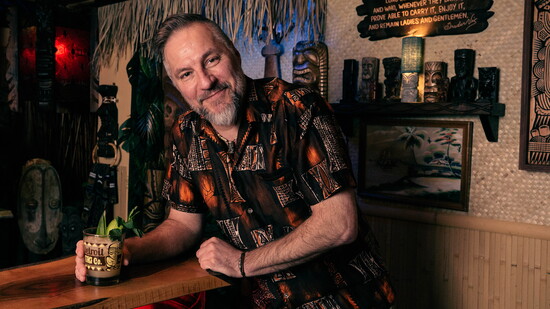
Somewhere in Eastern Market, there was a tiki Don Peterka was never meant to own.
He spotted it at an antique store maybe ten years ago. It was cement, not carved wood, weathered to a green-gray patina from decades of shade and rain.
He loved it immediately—but someone had already bought it. So Don went home and scoured the internet, chasing expired auction listings and dead-end searches. He never found it again.
What he found instead was a forum where people taught each other to carve their own.
That's where Detroit Tiki Co. begins: with a specific, irreplaceable object that got away, and a man who turned that loss into the tiki world’s gain.
Don Peterka grew up in Livonia, close enough to Chin's Restaurant that those towering tiki statues out front made an impression. He was drawn to mid-century things too, like the open-air Wonderland Mall with its unusual fountains and architectural details. He describes himself as almost nostalgic for times he never lived through. “Maybe,” Don suggests, “when you surround yourself with those things from the past, you create your own fantasy island.”
He became a graphic designer and cartoonist. But the tiki idea stayed filed somewhere in the back of his mind.
Then COVID shut everything down, his employer furloughed him… and suddenly he had the time.
He started small: little cement figures cast in his basement, and sold via a card table at the Royal Oak Flea Market. He sold enough to think it might work.
He went back. He got better. He developed a process: carving into wet cement, adding detail as it hardened, then casting molds so that each design could be reproduced without being identical. Each piece is stained individually, each one slightly different.
The molding process, he says, is like making a soufflé: you don't know how it's going to come out until it's done, and by then it's too late to fix anything. So Don takes his time.
Tikiphiles, collectors, and basement-bar curators have given his work an overwhelmingly enthusiastic reception. Sven Kirsten, author of the tiki lover's bible The Book of Tiki, has praised his figures. Spike Marble, a California-based tiki influencer with a substantial following, still features a tri-figure lamp of Don’s in his weekly videos.
When Don posted his latest creation, a shrunken-head tiki torch, before a Chicago show, it drew a thousand likes and a flood of I need one comments. "I'm almost like, this is surreal," he says. "When you're surrounded by your art, you kind of get blind to it. And then something like that happens."
Don draws his inspiration from the Marquesas Islands — French Polynesia — where the aesthetic runs more primitive and less ornamental than the tiki styles most people recognize. He won't make what the community calls a 'party tiki,' with the human nose, big teeth, and cigar. He wants his pieces to look like you'd stumble onto them in a jungle, or find them in a yard where they'd been sitting since 1962.
After all, that moss on the Eastern Market tiki wasn't just decay. It was proof.
That spirit of authenticity is in everything Don creates.
His wife Betty — a trained jeweler who also makes tiki-inspired pieces for the line — handles the shipping operation at home, and the sales floor at shows. Don credits Betty with keeping him from going off-script with customers. "I'm the worst self-promoter,” Don admits. “I'm just not that kind of guy. So I just let the work promote for me."
But he eloquently explains the couple’s guiding business philosophy: "I know how I want to be treated."
Detroit tiki culture, he'll tell you, has a complicated history. The city once had some of the Midwest's finest Polynesian bars, like the Mauna Loa, the Chin Tiki, and Club Bali. One by one, they shuttered, their contents scattered to estate sales and attics. Both of Detroit's remaining tiki bars, Lost River and Mutiny, have recently closed as well.
What survived has gone underground, literally, into the basement bars of devoted collectors. Don's work lives in many of those basements. (Not to mention a tiki bar in Boston, a collector's shelf in Chicago… It’s known nationally and internationally.)
Why basements? Real tiki bars, Don tells me, have no windows. The drinks, the bird sounds on a loop, the tapa cloth on the walls — it only works as a complete world. Daylight breaks the spell. "You don't want any outside," he says. "This is the tiki environment."
He still holds his day job: graphic design, where other people tell him when the work’s finished, and he saves his own version just to have it. At 59, he's candid that if that job disappeared, he wouldn't go looking for another one. With his queue of customers, he wouldn’t have to.
"I always thought I'd do this when I retired," he says. He pauses. "I just didn't wait that long."
I ask Don what he wants someone to feel when they put up a piece of his in their basement, in their backyard. Don pauses, and then says, “I want them to feel the same way as when they first saw them. Every time they look at them.”
That’s the standard. Make something that people hold onto.
Something that earns its moss.
You’ll find Detroit Tiki Co. (detroittikico.com) at area tiki shows and markets throughout the year