Some resorts win travelers over with sheer newness. Mauna Kea Beach Hotel does it with something harder to manufacture: a sense of place.
The hotel has occupied one of the most beautiful stretches of the Kohala Coast since 1965. Its recent renovation refreshed nearly every part of the experience, yet the property still feels connected to its original character.
Here are 10 reasons Mauna Kea Beach Hotel remains one of the Big Island’s best places to stay.
1. Kauna‘oa Bay is dreamy.
The property sits along Kauna‘oa Bay, a sweeping crescent of powdery white sand and crystal-clear water calm enough for swimming.
Chairs are positioned close to the shoreline, and complimentary kayaks, snorkels, paddleboards and boogie boards make it easy to spend the entire day near the water.
2. The Manta Rays are majestic.
After sunset, Manta Point comes alive.
Giant manta rays glide through the illuminated water just offshore, turning, swooping and rising toward the surface as they feed. Their wingspans can be enormous, yet they move with an unexpected elegance.
And the viewing process? Seamless. There is no need to board a boat or get in the water. Guests gather along the shoreline and viewing areas near Manta restaurant, watching from land as the rays move through the bay below.
3. Hau Tree is the cliché beach bar.
Hau Tree sits beside the sand and there is nothing overly formal about it. The ocean provides the soundtrack, and the view reaches across the bay. It recalls an earlier style of Hawaiian resort travel when a beach restaurant was designed for long lunches and mai tais.
In the evening, the space becomes Hau Tree Cantina, serving contemporary regional Mexican dishes. Few things feel more like vacation than staying at the beach through sunset with no reason to go inside for dinner.
4. The newly renovated accommodations are A+.
The redesigned rooms and suites are polished without losing their sense of ease. Natural colors and textures keep the attention on the landscape, while large windows and private lanais bring the outdoors into the room.
Standard accommodations are unusually generous, ranging from approximately 589 to 880 square feet when the lanai is included. The 10 suites range from about 1,252 to 1,610 square feet, offering ample space for families.
The details are intentional: Fili D’oro linens, L’Occitane bath products, garment steamers, kitchenettes, and nightly turndown service.
5. The hotel still has soul.
Mauna Kea was created by Laurance S. Rockefeller and originally designed by Skidmore, Owings and Merrill. More than 60 years later, its low-profile architecture still feels remarkably modern.
An important collection of Pacific, Asian and Polynesian art is displayed throughout the resort rather than confined to a gallery. Complimentary art tours reveal details that could otherwise be easily missed.
The renovation respected this history. It polished the hotel without turning it into an interchangeable luxury resort.
6. The pools are perfect.
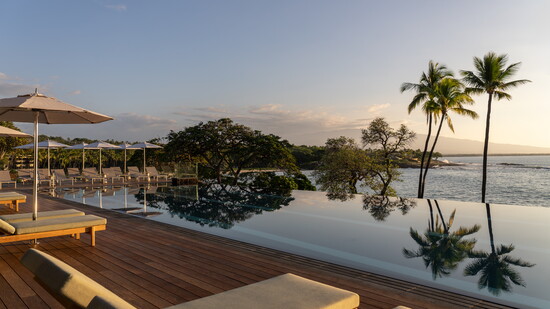
The renovated family pool remains a lively gathering place, but the new adults-only infinity pool offers a completely different experience.
The 25-meter lap pool sits above the ocean, creating the impression that the water continues directly into the Pacific.
7. There's also a new spa.
The new 22,000-square-foot spa is one of the strongest additions to the property.
Its 11 open-air treatment rooms connect the experience to the island’s climate and landscape. Couples suites include private lanais, outdoor showers, soaking tubs and garden space, creating the feeling of a secluded retreat within the resort.
Separate purification gardens feature steam rooms, saunas, plunge experiences and soaking pools, while a coed wellness deck includes a vitality pool and hot tub.
8. Evenings are fun.
Sunset tends to draw guests toward Copper Bar, where cocktails, sushi and flatbreads are served with panoramic ocean views. Live music and hula add to the vibe.
Manta offers a more polished dinner experience, with an open-air dining room and menus shaped by Hawaii’s farms, waters and the resort’s chef’s garden.
9. Golf. Enough said.
The resort’s golf course is one of the most recognizable in Hawaii. Originally designed by Robert Trent Jones Sr., it has since been updated by Rees Jones and renovated by Robert Trent Jones Jr., making it the first course shaped by three generations of the same legendary golf family.
The Seaside Racquet Club offers nine oceanfront tennis courts and eight pickleball courts. Cultural programming includes lei-making, hula, Hawaiian crafts, music and art tours. A daily children’s club gives younger guests their own activities while granting parents solo time.
10. It feels like vacation.
Mauna Kea’s setting is extraordinary, but the service gives the hotel its personality.
Arrival begins with a flower lei, chilled towel and tropical juice. Throughout the stay, the hospitality feels warm and intuitive rather than rehearsed. Staff members share the property’s history with genuine affection, remember small preferences and help create the feeling that guests have returned to a familiar place, even on a first visit.
There is no mandatory resort fee, and many activities are complimentary.
There are newer resorts along the Kohala Coast. There are flashier ones, too. Few, however, can offer this beach, this history and manta rays dancing offshore after dinner.
maunakearesort.com