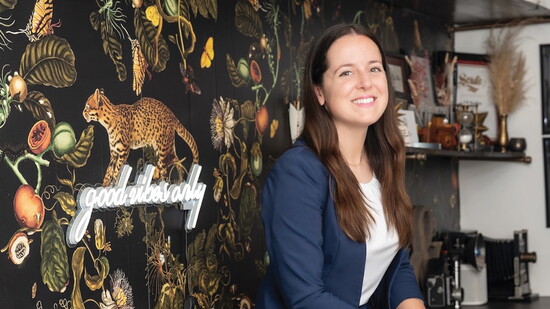
When Wendy Brown’s father died in 2023, her family had a trust. On paper, they were prepared. In practice, they were anything but.
“There were no instructions, no conversations — nothing prior,” she recalls. “Just a document that no one really knew how to read except the attorney.” The trust protected her mother from capital gains taxes when the house was sold. But what to do with her father’s antiques collection, what he wanted done with his remains — none of that had ever been discussed.
“It’s important to have the document,” Wendy says. “But it’s also important to understand how to execute it.”
She built her practice around that gap. This year, Wendy opened Brown Legacy Law, PC on Orange Avenue in California Heights — a return to the Long Beach neighborhood where she grew up and across the street from where her grandmother’s realty firm once stood.
After graduating from the University of San Diego School of Law in 2019 and being admitted to the State Bar of California in 2020, her legal career path wound through criminal defense and veterans’ advocacy before settling into estate planning.
“Once I did argue for a living, I was like, I’m way too burnt out for this.”
Estate planning, she realized, was closer to what she already did as a logistics officer in the California Army National Guard — projecting scenarios, building contingencies and guiding people through situations they’d rather not think about. She has served since 2013, including two deployments to the Middle East and is currently transitioning to the Army Reserve as a JAG officer.
Wendy is direct about why people procrastinate with estate planning. “It’s uncomfortable to think about your mortality. My dad was that way — which is exactly why we never had those conversations.” She says it with warmth rather than bitterness, but the point lands: his discomfort cost the family in ways no trust document could fix.
She also pushes back on the idea that estate planning is just for the wealthy. In California, a home left through a will alone goes through probate — a court process with fees of about 5% of the estate’s value. On a $1 million Long Beach home, that’s roughly $50,000 off the top before an heir sees a dollar.
A trust bypasses probate and preserves the step-up in basis, a tax provision that can save heirs tens of thousands more on a future sale. “Trusts are one of the only ways the middle class has to pass on generational wealth right now,” she says.
Beyond the mechanics, Wendy focuses on the human factors that an attorney is uniquely positioned to catch. Co-trusteeships between siblings that seem fine today can collapse into deadlock when parents are gone. “Equal” distributions between children aren’t always fair.
“When family members die, people start acting weird,” she says. “Parents say, ‘My son would never do that.’ Well, he’s never experienced you dying. We have to prepare for that.”
Outside the office, Wendy is an active member of the Estate Planning and Trust Council of Long Beach. She is also an avid hiker and enjoys camping in scenic places like Yosemite National Park. At home, she shares her schedule with Donner — a 4-year-old Doberman-husky-cattle dog mix who, she says, is firmly in charge.
Asked what her father would think of Brown Legacy Law, she laughs. “He wasn’t sentimental. He’d probably just say, ‘I knew you’d do that.’”
And that, for Wendy, is enough.