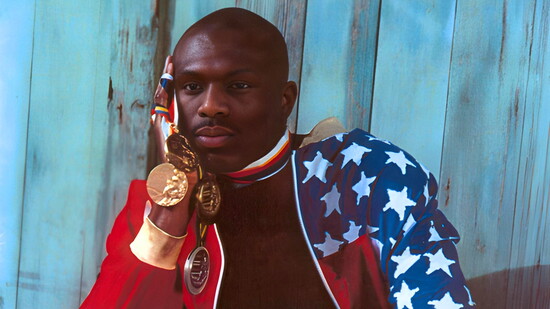
At 19, most people are still discovering who they are. Not Steve Lewis! Steve was becoming one of the best in the world.
At the 1988 Seoul Olympics, the UCLA freshman shocked expectations by winning the 400 meters, then added a second gold medal as part of the 4x400-meter relay team. Four years later, after illness and setbacks nearly derailed his career, he returned to the Olympic stage in Barcelona to win silver in the 400 and another relay gold.
But when Lewis looks back, he doesn’t begin with medals. He begins with a moment.
“Coming down the home stretch. That’s kind of what sticks out because I was not expected to be there and lead the charge for the Americans,” he said. “I remember coming off the curve into the home stretch and I'm in the front. All sorts of thoughts flashed in my head.”
Those thoughts weren’t connected to fame or records. They were all about family.
“My mother was in the bleachers, and my grandfather was [there] so I was just thinking about where I grew up,” he said. “Wow, am I going to win this thing?”
When he crossed the line, he still wasn’t sure he had won.
“I’m looking with my coach John Smith… looking up at the Jumbotron, at the big screen. Did I win? Did I win?” he recalled. “Then it hit me. I won.”
He took his victory lap toward the backstretch where his family was seated. “[My mom’s] in tears. My grandfather’s in tears. It was surreal. It was an incredible moment.”
That moment carried deeper meaning because his grandfather’s journey to watching Steve compete at the Seoul Olympics had once seemed impossible. Lewis said his grandfather fought in the Korean War and was wounded on the battlefield, believing he might not make it home. After surviving, he swore never to return. Decades later, he did—not as a soldier, but as the proud grandfather of an Olympic finalist watching him win gold in Seoul.
Lewis credits that breakthrough not only to talent, but to what he calls a “lion mentality.” “I grew up in the inner city and had to be tough and resilient. A single parent household. My mother was basically the head of the household. My father was not there so I grew up having to go out and prove myself.”
That background became fuel for his passion. “I was the underdog. I was a young kid. I’ll show you. I’ll prove you wrong.”
Then came the philosophy that still guides him today. “There was nothing more that I was going to do when I got to that starting line that was going to make me perform any better… so let me go out there and do my best.”
He did more than that. Lewis ran what he calls “the perfect race,” setting a world junior record (U20) that stands today, nearly four decades later.
Success, Lewis says, never eliminates pressure. It simply changes it. “There’s pressure even when you succeed because you have to overcome something to be successful,” he said. “It’s just how you deal with that stress and pressure that really kind of defines who you are.”
After the highs of 1988 came injuries, and then in 1990, he became seriously ill. “I was sick for about a year. We couldn’t figure out what was going on with me,” he said. “I was a shell of my previous self. I lost a lot of weight… I thought it was over for me.”
Unable to train and unsure if he would ever return to competition, Lewis leaned on family, teammates, and patience. Then, almost as suddenly as it began, the illness lifted. “I got stronger and as suddenly as this illness came upon me, it just went away.”
He fought his way back onto the 1992 Olympic team. “I made the ’92 team and went back and tried to defend my title. I took second that day, but it was okay. I was happy to be there and be that successful.” He also helped the U.S. team break another world record in the relay and earned his third gold medal.
Today, Lewis channels the same competitive fire where he sells orthopedic robotics at Stryker. “Winning is winning,” he said. “I want to be successful and doing the best at what you're setting out to do.”
The setting has changed. The mindset has not. “There’s a saying: The five P’s: Proper preparation prevents poor performance. If you fail to prepare, prepare to fail.” Whether it was stepping onto a track or into a boardroom, Lewis says preparation remains the separator. “Stay ready, so you don't have to get ready. It’s a mindset.”
At home, Lewis measures success differently. He and his wife, Tamala, raised two daughters. Because his own father was absent, he was determined to be present. “I just wanted to make sure that I was there for them,” he said. “Everything that I do… I’m thinking about them… just trying to make sure that they're set up to be successful.”
Now a longtime Redondo Beach resident, Lewis embraces the lifestyle of the South Bay. “Living by the water. The people. The activities. The weather,” he said. “We ride the bike on the boardwalk. It’s just very active.” It’s a fitting home for someone who has always been in motion.
If Lewis could leave one message for young athletes—or anyone chasing a dream—it would sound familiar to anyone who has followed his journey. “Hardship is just part of life. Nothing is guaranteed.” But pressure, he believes, can become something powerful. “Like a diamond… all that pressure being coal, that’s how diamonds are formed.”
Then he offers the kind of wisdom earned over decades of peaks and valleys. “You gotta go through it to get to it.”
For Lewis, the lesson has always been the same: stay focused, trust preparation, and remain poised under pressure.
“I remember coming off the curve into the home stretch and I'm in the front. All sorts of thoughts flashed in my head.”
“There’s a saying: The five P’s: Proper preparation prevents poor performance. If you fail to prepare, prepare to fail.”