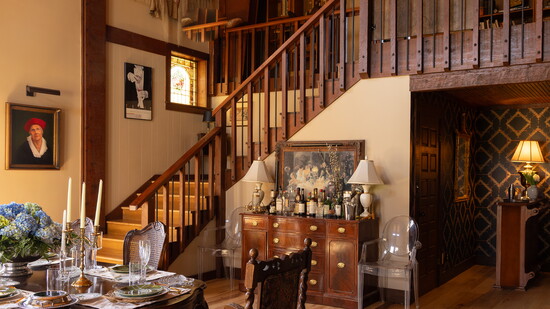
When Bronwyn Spain was a little girl, she couldn't explain why her grandmother's house made her feel like she never wanted to leave while the fluorescent-lit school room made her want to crawl out of her skin. She just knew. Warm light, rich colors, and a sense of intention would settle her completely. Beige walls, commercial flooring, and sound bouncing off hard surfaces would do the opposite. She didn't have the language for it yet, but she was reading rooms the way most people read faces.
It wasn't until a psychology of design course at the University of Oklahoma that everything connected. "There are colors that make people want to linger in a space," she says, "and there's a lighting pattern that can help people feel more comfortable." She suddenly realized the instinct she'd carried since childhood had a science behind it, and a career ahead of it.
After graduating with a degree in Interior Design from OU, Bronwyn worked briefly at a residential firm in Tulsa before a detour into real estate and then, at just 23, a leap into designing Spain Ranch, the nationally recognized wedding venue. "I thought 'I'm diving into the abyss,'" she recalls of those early days, with no support staff and no experience in the wedding industry. Over the next decade, she served as creative director, designing everything from the venues to the branding and marketing. The work earned national recognition, including an AIA award, a Tulsa People Magazine cover, and features in Cup of Jo, Green Wedding Shoes, and The Venue Report. But through it all, the work that filled her up most was always the design itself. "Branding and social media drain me," she says. "Whereas I'm working right now on eight different projects and I'm like, 'Give me more.' It fills me up."
That clarity led to Studio Bronwyn, her return to the work she'd loved from the beginning: interior design.
Today, Bronwyn takes on residential and commercial projects in Tulsa and New York City, from mid-century renovations to postmodern apartments to traditional homes. There is no signature style, and she prefers it that way. What ties her work together isn't a look. It's a philosophy. She designs on feeling: asking clients psychology-driven questions about how they live, what colors draw them in, and what makes a space feel like theirs. Her goal is that nothing in the finished home feels contrived. "I love a home that feels purposeful and collected," she says.
Bronwyn believes great design should feel effortless at every stage, from first conversation to final installation, building her client relationships around proactive communication and transparency so the process itself never becomes a source of stress. "If the home feels effortless," she says, "they're going to be more comfortable in it."
She is also intentional about designing with permanence in mind over what's popular at the moment. "I don't design homes for trends because I want longevity," she says. "I don't want a client to have to hire me again in 10 years when everything looks outdated."
Bronwyn credits some of her strengths and intuition as a designer to qualities she believes women bring naturally to creative work: the ability to juggle multiple projects, a gift for clear and consistent communication, and a nurturing instinct that quietly elevates every design decision. As a mother, she thinks through the daily rhythms of living in a space, anticipating details others might overlook. It's a perspective that turns good design into design that actually works for the people living in it.
Her perspective has also fueled her ambitions beyond Tulsa. A love affair with New York City that began over a decade ago has grown into a second market for Studio Bronwyn, with projects underway in Manhattan. "I am in love with that city," she says.
Bronwyn Spain built a career on something most designers study but few truly possess: an instinct for how a space makes a person feel. From a little girl who couldn't sit still in the wrong room to a designer whose projects now span two cities, that gift has been her compass. Today, with many projects on her desk and a studio that bears her name, the work fills her cup. "I love what I do," she says, "and feel lucky I get to do it."