Rob Youngren, 51 Computer Scientist
What first drew you to the Iditarod Trail Invitational?
When I began ultra-running in the mid-1990s, I discovered winter ultras through Ultrarunning Magazine. Races like the Susitna 100 and the seemingly impossible Iditasport Extreme (300+ miles) and Impossible (~1000 miles) felt completely out of reach. Still, I followed them closely, studying race reports, gear choices, and layering strategies. Over time, as I took on bigger challenges, the idea no longer felt impossible. Without realizing it, I was preparing for the Iditarod Trail Invitational. In 2020, I finally raced, and finished, the 350-mile route to McGrath.
The Iditarod Trail is only passable for a brief winter window, crossing frozen rivers, swamps, and even sea ice. The race covers 350 or 1000 miles from Knik Lake toward Nome, using only human power—foot, ski, or bike. There’s no required gear list, so athletes must rely on experience to carry what’s needed to survive extreme cold, often below -40°F. It’s widely considered a “post-graduate” winter ultra, demanding resilience, preparation, and self-reliance in one of the harshest environments on Earth.
Walk us through the moment you realized how demanding the race would be.
Things got “real” my first year at the ITI almost right away. From the various qualifying events to earn my slot at ITI, I’d grown accustomed to traversing groomed, flat, trails where I could mindlessly plod away at a strong hiking pace for hours without any issues. The Iditarod trail is not flat and it is definitely not a highly manicured route like what I was used to. Instead, after the first hour Out There, it began to snow heavily and would only cease snowing for short periods over the next 8 days of the race. The new snow made the trail extremely soft and difficult to navigate, and the constant soft trail conditions forced me into using snow shoes for almost the duration of the 350 mile race.
The physical demands of the race quickly wear you down but the mental aspects are even more demanding. Once you’re forced to plod along in snow shoes, you quickly start doing the mental calculus and realize you’re going to be Out There a long time, and whatever optimistic time table you’d originally put together was now torched. But all you can do is keep moving forward!
What does a typical day look like during the race?
Ideally a day on the trail starts with a pre-dawn wake-up call and quickly breaking down my sleep system and and going for a run to get warm. Then it’s pretty much an uninterrupted 16-18 hour day of hiking along the snowy trail hauling a 40lb+ anchor with everything I need to survive. Around midnight I start looking for somehere to camp; preferably somewhere among the alder trees or on the leeward side of a hill. Fortunately, most nights, if I had paced myself right, I could make it to an official race checkpoint where I had the opportunity to sleep in a shared cabin or maybe even a real bed! Timing is everything though.
What was the most challenging moment you faced on the trail?
I’ve traveled the Iditarod Trail twice, but my toughest moment came in 2023 while crossing the Alaska Range. After falling behind pace, I had no choice but to push forward through a ground blizzard toward Rainy Pass or risk missing a cutoff. Winds reached 30–40 mph, the trail disappeared beneath blowing snow, and racers around me began dropping out due to illness. Soon, I was completely alone.
Hours into the climb, a powerful gust knocked me down and tore away my hat. It was my best protection against the cold. Shaken and exposed, I had no choice but to keep moving because stopping in those conditions could be deadly. Eventually, doubt set in, and I turned back to quit the race.
Then, out of nowhere, two cyclists emerged from the storm. One told me, “If you turn around now, your race is over.” It was exactly what I needed to hear, so I turned forward again, reached Rainy Pass, and found calm on the other side...a hard-earned reminder to keep going.
What goes through your mind during the long, quiet stretches of a race like this?
I always have A LOT of internal dialog going in my head, so stretches like these it’s just more of the same. One of my roles as a principal computer scientist for Simulation Technologies, Inc (SIMTECH) is a software developer. I’m always thinking of better ways to improve the analysis tools I develop and maintain. It wouldn’t be too uncommon for me to pause to record a few ideas even while out on the trail... But mostly I’m continuing to go through the mental checklist to make sure there isn’t some issue I need to manage at the moment.
How do you prepare in the months leading up to the Iditarod Trail Invitational?
Coming from Alabama I’m uniquely winter challenged when it comes to preparing for any winter ultra. Some of the best advice I’d ever received was to purposefully put myself in as extremely bad weather conditions. Learning to be comfortable while being uncomfortable would help prepare me to handle the mental aspects of the ITI and other, far less formidable, races. Since there is no way to practice pulling a sled with all my gear for miles and miles on snow trails, I go for the next best thing; rucking or dragging a tire around. Hiking with a 60+lb pack up and down hills really helps prepare my body physically for the rigors of the Iditarod Trail. Dragging a heavy tire around also helps dial in sled harness comfort and rigging. But there is nothing like training in the deep cold and snow, so if it’s possible, I’ll try and use a short winter ultra as a last minute training event to dial in gear, winter camping techniques, etc… before the big dance.
What do you see for the future of your racing endeavors?
The building of progressively more and more difficult challenges has shaped me into a more efficient and experienced ultra athlete. The downside of these ever escalating challenges is that it’s very difficult to get excited about challenges you once thought nearly impossible to finish. Like a drug, the only way to feel that endorphin high is to go bigger, attempt a challenge that’s even more scary than the last one. However, this behavior is unsustainable; something must give eventually. I still have the fire and dream to one day hike the entire Iditarod Trail to Nome BUT I’m constantly fighting those burn out demons and anxiety that comes before such a MONUMENTAL challenge. So I honestly don’t know what’s next for me. I know I’ve changed a lot since I attempted my first winter ultra (and failed) over two decades ago. While I do have a lot more confidence, experience and wisdom and know I could successfully and safely make it to Nome, I also have deep fear and anxiety that I’ll make a poor decision or face a deadly scenario that could have permanent or life ending consequences. Hiking the Iditarod trail is a foolish endeavor. It’s estimated that there have been 55-65 finishes (many by the same individuals) out of around 110-140 foot racers who’ve attempted to hike to Nome. Those are sobering numbers and I’m just not certain I can (or should try again) add to that list. So in the meantime, I’m going to focus on gaining some more winter camping experience in as extreme conditions as possible and tackle some shorter winter ultras to earn redemption, including the infamous Arrowhead Winter Ultra, a 135 mile race in Northern Minnesota in January that I’m currently 0-2 at!
Ken Smith, 59 Director of Economic Development
What prompted you to pursue endurance sports?
I’ve always loved the call of adventure and being outdoors. Just being in nature makes
me feel alive and reminds me of the beautiful world around us. Endurance events have
been an extension of that desire for adventure and an opportunity to challenge myself
to see how far I can go.
How did going through a major life change (thyroid cancer) influence your
decision to push your limits?
Being diagnosed with cancer was definitely a major life event for me. Once the initial
shock wore off, I was able to view it as an opportunity to focus on what is important in
life, your friends, your family and your health. I started doing triathlons as way to join a
community and to stay fit and healthy as I recovered from the effects of the cancer.
What is it about the Ironman level of competition that keeps drawing you back?
I’ve met some of the best friends of my life doing triathlons, and we push and
encourage each other to continuously reach higher and higher goals. In Ironman,
it’s not necessarily about winning, it’s about setting and facing a challenge that
might be out of reach. I may not be the youngest or fastest athlete in the race,
but the sense of accomplishment when you see the finish line is amazing
motivation knowing you have achieved a goal many people don’t even try.
Of all the races you’ve done, which one tested you the most?
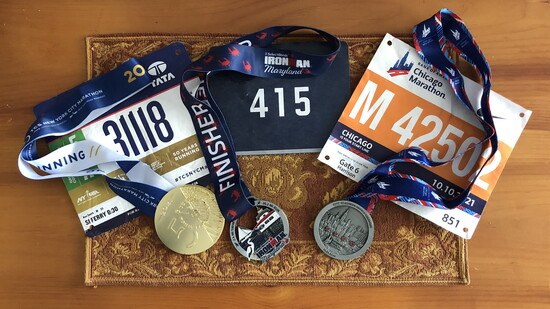
Ironman Maryland is an incredible race near Washington DC. To start the race, you
swim 2 ½ miles in the Chesapeake Bay, but the morning of the race we woke up to
swarms of jellyfish in the bay. Overcoming obstacles is one of the keys to success in
endurance sports and in life, but swimming through thousands of jellyfish that day was
definitely a test I will never forget!
How did summiting Mount Kilimanjaro compare to competing in an Ironman?
Climbing to the top of Mount Kilimanjaro is one of the most epic adventures I have been on. The raw and natural beauty of the African wilderness is something everyone should experience. We were on the mountain for eight days, climbing to a height of 19,300’. This was as much a mental challenge as a physical one,
where success is not guaranteed and danger is very real. As with Ironman,
setting and achieving big goals brings a huge sense of accomplishment, and it’s
also a team effort with much support along the way.
In those moments when your body is telling you to stop, what keeps you going?
Living life without a thyroid is a constant reminder that the body is fragile. I’ve tried my
best to be an example to show that you can do anything you set your mind to. I enjoy
the opportunity to talk with people who have just learned they may have thyroid cancer
and are scared about the path forward. Knowing I can tell them that I didn’t stop is
incredible motivation for me to keep going so that I can be an example and
encouragement for others.
What does your training routine look like?
Training with friends is always the best. The ability to ride bikes on Redstone Arsenal on
the weekends is a great benefit of living in Huntsville. Long runs are usually on
Saturday mornings either on Monte Sano or up and over Cecil Ashburn. We also swim
in Guntersville with a stop for Mexican food afterward. When training for Mount
Kilimanjaro, I found the steepest trails in Huntsville and spent one night doing 5 hours of
stair repeats on the steps at Big Spring Park. People from the restaurant even came out
to see what I was doing since they had been watching the whole time.
What’s next for you, and how far do you still want to push your limits?
I am always open to whatever life brings next. Whether that is climbing the next
mountain or hiking across Spain, I want to enjoy the adventure and the people along the
way. I think I will continue to explore and push my boundaries for as long as I am able
and am definitely looking forward to whatever that next adventure may be.
Olly Orton, 47 Real Estate Developer
What first drew you into ultramarathon running?
I hated running most of my life until age 38, when a shoulder injury pushed me to try it differently. Friends showed me trail running and that going slow was okay. I fell in love with the woods and movement. I’d never run more than seven miles, but one day I got lost and ran 14. That sparked curiosity about my limits. I soon completed a 50K and a 40-miler. Ultrarunning became about testing not just my body, but my mind. It taught me resilience—proving I can push further than I think, both on the trail and in everyday life with my family.
What is it that you like about the 100 mile distance?
50Ks are a hard effort I enjoy, but they don’t truly test my mind. I rarely feel the urge to quit at that distance. At 50 miles or 100K, that thought might surface briefly, but it fades, and I can still function the next day. What really draws me in are multi-day stage races, where you commit to long distances day after day as your body steadily breaks down. That’s where the real mental challenge lives. After finishing my first 100-miler and wanting more, I searched for tougher races and found the Dragon’s Back in Wales—a six-day, coast-to-coast traverse. Since then, I’ve chased or created similar challenges with friends.
What's going through your mind that keeps you moving forward?
Deep into an endurance effort, your body and mind will push you to stop—through pain, doubt, or negative thoughts. How that shows up is different for everyone, but the pull to quit is universal. What helps me is narrowing my focus to the present. Sometimes that’s the next aid station, the next mile, or just the next few steps. In one race, I imagined a line a few steps ahead, ran to it, then moved it forward again—I did that for over an hour. In endurance running, like in life, breaking things into small, manageable pieces makes almost anything possible.
What does training for a long race?
There’s no “typical” training for a 100-miler. Some people run 50–100 miles a week, but with a job and family, I keep it to three days a week, adding a fourth about six weeks out. Because of that, my training is very specific. I work with a coach, and every run is structured—warm-up, steady efforts, strides, sprints, and “Zen running,” which is just a smooth, sustainable pace for a few hours. I also train for race conditions—heat, cold, elevation, technical terrain, even carrying a pack. And I prioritize eating and sleeping, since recovery is key to making the training work.
What continues to motivate you to take on these extreme distances, and what goals are still on your list?
Curiosity keeps me chasing new challenges to see how far I can push my body and mind, and whether I can get faster and tougher with age. It’s also just fun. I get to explore beautiful places with adventurous friends, and the trail running community is incredibly supportive.
I’m especially excited for Lucky 7’s—just me and a friend running mountains across the Southeast, day after day. No start or finish lines, no audience—just running and seeing what we’re capable of.