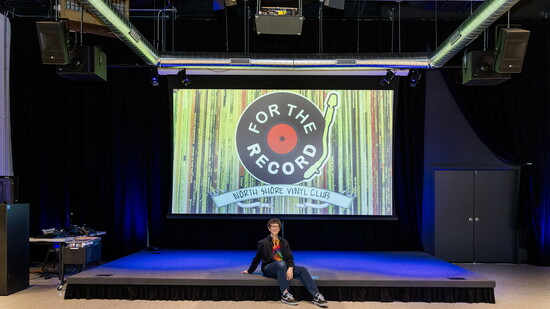
It started, as many good things do, in a basement. Sixteen years old, a dartboard on the wall, a record spinning—Chicago blues, maybe Zeppelin. The exact track doesn’t matter. What matters is how it sounded. For Howard Scharf, those hours spent in the Keogh brothers’ Wilmette basement weren’t just formative—they were sacred.
Now, decades later, Scharf leans back on a caramel leather couch inside For The Record, his private listening lounge in Northfield. The couch invites conversation, or maybe contemplation. A tie-dye shirt glows beneath his black overshirt. Behind him, portraits of Mike Bloomfield, Jeff Tweedy and Muddy Waters hang in a row—the kind of wall that feels equal parts shrine and mixtape. His smile hints at quiet satisfaction. The setting is serene, but the story hums like feedback caught mid-note.
For The Record isn’t a bar, and it isn’t a club in the typical sense. It’s a space for people who still believe in listening. “I wanted a place where sound mattered,” Scharf says. “Where people could slow down and actually hear.”
He traces that impulse directly to those basement sessions with Brian and John Keogh. “John had this incredible vinyl collection,” he says. “He wasn’t just a fan, he was a student of music. Brian and I hung out for hours—absorbing, listening, learning. That basement was our first listening room.”
Years later, he built one of his own. For The Record is what happens when adolescent awe grows up but never fades. Open three or four nights a month, it draws around 60 members from 50 households—people bound not by exclusivity, but by curiosity.
“We want people to be good listeners while here,” Scharf says. “That’s really the only etiquette. Just respect the sound.”
The Shape of Sound
The first thing that hits you inside the lounge isn’t the volume—it’s the clarity. Scharf worked with TC Furlong, a veteran Chicago sound engineer, to tune the room. A Meyer Sound system hums with precision; acoustic panels soak up sharpness. A Technics SL-1500C turntable and a custom Rega Planar 3 handles the vinyl, while a Lumin streamer manages high-resolution digital playback. On certain nights, a full cinematic screen turns the space into a private theater.
It’s a sonic environment meant to slow time down. Lighting is low. Chairs cluster conversationally, not in rows. “I’ve been to too many venues where you’re stuck behind someone’s head,” Scharf says. “That will never happen here.”
The club’s small scale helps. There’s no bar, no drink minimum, no staff hustling through. Members bring their own wine or whiskey, and when there’s food, it’s catered by local chefs for a fixed price. Cards are kept on file; there’s nothing to buy, no transaction interrupting the moment. “You just show up, sit down and tune in,” he says.
BYO Vinyl, BYO Vibe
Scharf insists that the club belongs as much to its members as to him. “We really encourage BYO vinyl,” he says. “I love when people bring records they care about.”
Every gathering has its own shape. Some nights are quiet listening sessions; others bring in live performances. Recent guests include Marcus Rezak, Garry Burnside, Mud Morganfield and Soul Commitments. Most shows are free for members. “We’re a bargain,” Scharf says. “And I think we provide good bang for the buck.”
That sense of shared discovery often sparks new events. “Some gigs have happened because of members,” he adds. “Jerry Joseph came because one of our members knew him, reached out and made it happen.”
The Vault
Behind a door near the back sits the club’s vinyl vault: a wood-framed alcove lined with more than 3,500 albums. The bulk of it came from John Keogh, the same friend whose Wilmette basement first inspired Scharf. When he finally invited the Keogh brothers to see what he had built, he didn’t prepare them.
“I walked them in, showed them the space, and their jaws dropped,” he says. “But when I opened the vinyl room, they were gone. They started picking up records right away. It was like being reunited with old friends from grade school.”
He pauses, remembering. “That’s what a vinyl collection is. It’s deeply personal. You build relationships with records. You know who wrote the songs, who played on them. You learn the drummers, the songwriters. It opens new doors. I don’t think people feel that way about downloads or playlists. Records are different.”
The walls echo that reverence. Posters of Cream, Jack White and Béla Fleck hang alongside a tie-dyed tapestry, creating a palette that feels half psychedelic, half midcentury salon. The room is eclectic—proof that Scharf isn’t curating for nostalgia, but for continuity.
Listening as Connection
For all the technical precision, For The Record isn’t really about equipment. It’s about attention.
Scharf calls himself an introvert, someone who finds comfort in record stores more than in crowds. “Introverts like me spend a lot of time in dusty bins,” he says, laughing. “So it can be hard finding like-minded people. I want to bring them here—to connect with people who are deep into the groove. I’d love to see them sitting around talking about trivial things, like a hi-hat sound or a mix. That’s the fun stuff. That’s what brings it to life.”
There’s a rhythm to the nights here, an unspoken tempo that shifts with the music. Sometimes an R&B record plays while people sip bourbon and talk. Other nights, when the lights dip lower, the sound expands and the room vibrates. “You don’t get shushed all night like some places,” Scharf says. “You just get the right crowd.”
He’s not chasing scale. Membership will stay capped to keep the balance right. “It’s not about secrecy,” he says. “It’s about curating an experience.”
A Collector’s Heart
When asked what albums he’d want on a desert island, Scharf laughs. “That’s a horrible question,” he teases, but plays along: Allman Brothers “Live at Fillmore,” B.B. King’s “L.A. Midnight,” Grateful Dead’s “Wake of the Flood.” Then more come to mind—Miles Davis’ “Legendary Prestige Quintet Sessions,” David Bromberg’s first album, Mike Bloomfield’s “Analine.”
Each one, a memory. Each one, a portal.
He admits he’s a moody listener. Some nights it’s folk, others it’s blues or Americana. What matters most is the depth. “If you’re a vinyl collector,” he says, “you’ve gone down the rabbit hole because you’re dying to discover new things. You digest that information and develop a relationship with a record. That’s what opens new doors.”
Scharf’s club, in its quiet way, is built on that philosophy—the belief that in slowing down to listen, you can hear more than just sound. You can hear history, friendship, even the echo of a Wilmette basement where three teenage boys once discovered the power of a spinning record.
And if you’re lucky enough to find yourself there now, you’ll feel it too.
More at: fortherecordnsvc.com