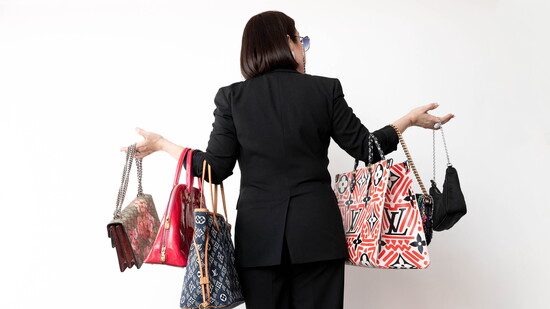
Ana Piña didn’t grow up with much, but her grandma and mom lived by the mindset that, no matter the circumstances, you always had to look your best. So, they thrifted, spending a good deal of time inside Goodwill and Salvation Army.
Once, her mom, Esthela Gniot, even answered an ad in the newspaper that a woman in Paradise Valley was selling off her daughter Jenny’s clothes. Gniot bought the whole lot and exchanged numbers with Jenny’s mom. From then on, whenever Jenny outgrew things, Piña got them.
“I went to school with these fantastic clothes,” Piña recalls. “I loved it because I had these beautiful things and I didn't need, you know, to be very wealthy to obtain a beautiful look.”
Gniot owned a bridal store, and Piña often accompanied her on merchandising trips to Los Angeles. She often found herself mentally redecorating and imagining how she’d run her mother’s store if it were her own.
Piña’s dreams for the future included pursuing a career in fashion and attending the University of Arizona. But at 19, she was diagnosed with cancer—Ewing sarcoma—and spent a year undergoing chemotherapy and radiation treatment.
“By the time I was done, I was just turning 21, and I had no idea what I wanted to do anymore,” she says. “Going through all of that just changed so much.”
Unsure of her path forward, Piña enrolled in cosmetology school with her cousin.
Months later, Piña faced another life twist: she was pregnant, despite being told she wouldn’t be able to have children after cancer treatment. In a whirlwind, Piña became a mother, a wife, and a hairdresser.
By 25, she was divorced and raising three children on her own. She put her “miracle babies” first, raising them with the same scrappy determination her mother had modeled.
“I always worked around my kids’ schedule,” she says, choosing jobs that “allowed me to be home right after school and have weekends off.”
When Piña was 34, at the funeral of an old high school friend, she ran into another former classmate from typing class: Alex Piña. They married a year later in 2014 and later welcomed two more children together.
Though her life felt full, Piña was deeply unhappy in her office job. Her husband encouraged her to quit.
“I have no idea what I’m going to do, but it’s got to be better than this,” she remembers thinking.
On her last day, the couple went to lunch. Beforehand, she stopped by a women’s consignment shop to pick up a check. A “Help Wanted” sign hung in the window. She half-joked that maybe she should apply—it might not pay well, but at least she’d be happy.
Her husband had a different thought. “Why don’t you own a place like this?”
She thought of her lifelong love of thrifting and consigning and the shop she’d been designing in her head since childhood. Still, she hesitated.
As a single mom, she stifled her dream for so long that it seemed impossible.
We have savings, her husband reminded her.
In November of 2024, the couple signed a commercial lease for a 2,000-square-foot space in their beloved Ahwatukee community.
Piña relied on her resourcefulness to furnish it, sourcing pieces from Facebook Marketplace and stocking inventory from her own closet, as well as her mom's and her daughter’s.
On opening day in March 2025, Piña stared at the empty display cases meant for higher-end items and worried how she’d ever fill them.
She needn’t worry.
Since The Posh Revival’s launch, the Ahwatukee community has rallied behind her.
Her customers have even become like a sisterhood to her. When she fell ill for a month with pneumonia, the women she’d met only recently volunteered to cover shifts—unpaid. Others drop off flowers or treats for her children on hard days.
“People I just met in the last year,” she says in a tone mixed with gratitude and disbelief.
Perhaps they respond to the warmth she leads with.
“I would rather be remembered as a kind woman than a super successful businesswoman,” she shares. “You can be both, but at the core of it, if I can’t be kind, then I don’t care how successful I am.”
At the Posh Revival, she wants customers to feel as though they’ve wandered into a friend’s house to borrow something.
When you feel confident in what you’re wearing, it can make your whole day, she says—to capture that, you shouldn’t have to sacrifice your grocery or gas money.
The store offers cash for most clothing, and consignment for higher-end pieces, always factoring in what consignors hope to earn. They stock sizes 0-16, with hopes of adding more plus sizes.
In 2025, Phoenix New Times named the Posh Revival as the city’s best women’s consignment shop–not bad for a store less than a year old.
Although Piña loves upcycling high-end brands, it’s never been about fashion alone. It’s the courage to pursue a dream. And build a community of supportive women while doing it.
She’s a reminder that reviving old dreams is possible, even when life presents you with decades of setbacks.
"I would rather be remembered as a kind woman than a super successful businesswoman. You can be both, but at the core of it, if I can't be kind, then I don't care how successful I am."