The wind is a character in Erica Zador’s story.
Not metaphorically. Literally. The kind of wind that rips across the Great Plains with enough force to rearrange your mood—and, if you’re unlucky, your car.
In Erica’s Kansas childhood, growing up 27 miles from the nearest town, tumbleweeds weren't charming symbols of the Old West. They were the wind’s weapons, rolling behemoths capable of serious damage.
But somehow, in that chaos, she found a symbol that made sense of her own origin story.
“Sixty million years old,” Erica says of the Plains. “It was underwater. It was a sea. So it’s a very special soil type and just a special, special place. I get so much inspiration from those wide-open spaces.”
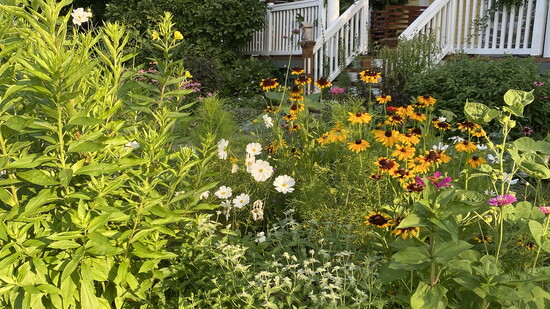
Today, as the founder of Tumbleweed Garden Consulting and a landscape architect with Friends of the Rouge, Erica brings that prairie sensibility to backyards, rain gardens, and community projects across Metro Detroit. Her mission? Help people see their little patch of earth not as a status symbol to be manicured, but as a living ecosystem they can restore.
Erica didn't start out as a gardener. She was a sculptor, who fit in with "the weirdos, the freaks, and the French" in Kansas, and dreamed of making it in New York. But when she made it to the Big Apple, it wasn't the art scene that captured her. It was the gardens.
"In New York, when you're an artist, you're competing with everybody. I was broke.” she says. "But I got into gardening, and it just clicked. I was remembering these plants naturally. I loved the physicality of it, the temporal part—sculpture in time, you know? Color, seasons, all of it."
Back then, she was doing Brooklyn backyards, and terraces on skyscrapers. The work reconnected her to Kansas in ways she didn't expect. "A lot of my projects in grad school were based on Great Plains aesthetics," she says. "That naturalistic look is my jam."
Erica doesn't hate lawns; she has kids, so she gets it. But she wants people to understand what traditional landscaping really is: a relic of status, inherited from English estates and Versailles, where massive lawns signaled wealth and power.
“That’s why it became this thing where you're a 'conscientious community member' if you keep it trim and perfect,” Erica explains. “But lawns aren't native. They contribute to flooding, they wipe out biodiversity. In my lifetime, 40% of bird populations have declined. That's a direct result of not having diversity in our environments."
So that’s what she’s doing: adding diversity to backyards. Erica says even a postcard-sized patch can directly affect something that's in crisis. Pollinators, native insects, birds up the food chain are all depending on what you choose to plant or not plant.
"You don't have to eliminate your lawn," she says. "Just reduce it. Cut it by a quarter. That alone is huge."
The most common fear she hears? "People think it's too much work." But Erica calls herself a lazy gardener. Once you establish native plants suited to your conditions—"right plant, right place," she calls it—the maintenance drops dramatically. No weekly mowing. No fertilizers, herbicides, or pesticides. Just one spring cleanup when nighttime temps hit 50 degrees for a week, and you're done.
"With traditional landscapes, you're constantly trimming, nipping, tucking," she says. "A naturalistic garden? You can let it be."
For someone with an artist's heart, Erica's definition of beauty has evolved.
"Things that actually work and function? That's beautiful," she says. "It's supporting something way beyond us."
She even gets philosophical about it. Humans evolved to notice flowers as signals, because six weeks after they bloom, there's fruit to eat. Our brains are hardwired to pay attention. "If you're depressed, one of those indicators is you stop thinking flowers are beautiful," she notes.
So maybe, she suggests, if we learn to see ecological function as beautiful, if we shift from ornament to purpose, we’re evolving again.
“Things that have a succession,” she says. “Things that seed out and you don’t have a lot of control over but actually work and function—that is beautiful. Because it’s supporting something that’s way beyond us.”
A garden, in that light, isn’t a personal statement. It’s participation.
Erica's work with Friends of the Rouge demonstrates that sense of participation. Erica works with stormwater systems—meaning she sees the hidden plumbing of cities. In many Detroit neighborhoods, stormwater and sewage share the same combined sewer system. That’s why, in big storms, basements can back up, and overflow can end up in the Detroit River.
Rain gardens can be game-changers.
On Detroit’s west side, Friends of the Rouge installed a rain garden at LaNita’s Memorial Garden. The flooding that had plagued the surrounding area stopped.
“One rain garden,” Erica says. “That’s all it took. Massive flooding. One rain garden. Done.”
At the Detroit Zen Center in Hamtramck, the approach is more layered. Through the Sacred Grounds Program—a partnership between Friends of the Rouge, the National Wildlife Federation, and the Sierra Club—stormwater is managed at multiple levels: a green roof, rain barrels, and a peace garden that includes a rain garden designed by Erica.
Different strategies. Same principle. Same result.
If every house in a square mile had a rain garden? The cumulative impact would be enormous. That's Erica's vision: not grand municipal projects (though she'd love to consult for those too), but everyday people taking small but powerful actions in their own yards.
If Erica had to distill everything into a single idea, it's this: "Put your heart in it first. Check it with reality. Put your heart in it again. At some point, the mind gets quiet. You know it's done."
It's the artist talking, the sculptor who never stopped making things; she just changed her materials to soil and stems and seasons.
That's Erica Zador: a Kansas kid helping Detroiters see their gardens for what they really are: small, powerful piece of a 60-million-year-old story.
And you get to write the next chapter.
Learn more: Tumbleweed Garden Consulting offers ecological landscape design and consulting for residential and community projects. You can reach Erica at tumbleweed.ro@gmail.com or 971-242-9783. For rain garden resources, visit Friends of the Rouge at rouge.org