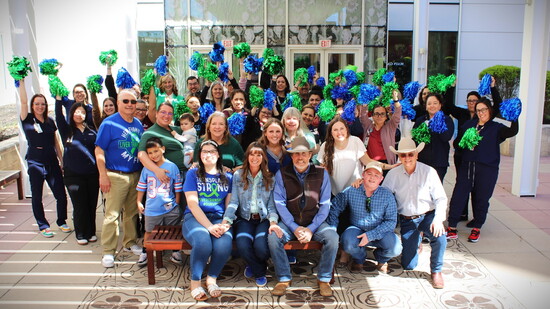
Until the summer two years ago, Billy and Shannon Massie were living healthy, normal lives. Two years later, though, one is a liver transplant recipient, the other is a living donor, and countless others have been impacted by their story. Today, three families are thriving and are connected in a way none of them could have predicted.
In June of 2024, Billy was diagnosed with Alpha-1 Antitrypsin Deficiency, a condition that caused damage to his liver. Told by physicians that he needed to be put on the transplant list, their family was biding their time while grappling with the notion of organ donation. “In order to receive this gift of life, somebody’s life will end,” Shannon explains soberly. “That is a really hard thing to wrestle with.” After doing some research, they learned about the Transplant Institute at University Hospital in San Antonio, which works with living donors.
Around the same time, Billy scheduled an appointment with a local audiologist after experiencing unrelated hearing problems. Seeking a second opinion, he found Rachel Higginbotham’s practice and later realized that he and Shannon had met her years earlier at Currey Creek Church. Quickly, Rachel noticed that Billy looked unwell. “His skin was very yellow,” she recalls. “After several questions, I got to the heart of it: there was something wrong with his liver, but they weren’t sure what yet. I said, ‘That’s so funny because just last week I applied to be a donor.’ And in a very silly Billy fashion, he said, ‘Well, if it doesn’t work out with the other person...’”
As it turned out, Rachel’s original recipient relocated to Arizona to pursue treatment through the Mayo Clinic, suddenly leaving her available for another match. “I felt like God was putting this opportunity on my heart,” she recalls. “I’ve got a liver, and I’m willing to do this.” So, on Christmas Day 2024, Billy and Shannon received the call: “You’re next.”
Rachel and Billy completed the final stages of testing as surgeons determined they were an excellent match based on blood type, liver volume, and body size. Rachel approached the experience with a level of enthusiasm that Shannon still laughs about today. Before surgery, Rachel asked nurses if they could take a photograph of her liver during the procedure. She even watched liver transplant surgeries online beforehand.
Rachel chose April for the surgery so she could prepare her business and family for the recovery time away from work. When the surgery was complete, doctors had removed roughly 60 percent of Rachel’s liver and transplanted it into Billy. Rachel was discharged after about four and a half days, while Billy remained hospitalized for 18 days as doctors monitored for rejection. Rachel’s recovery progressed faster, though it was still physically exhausting at times, and she returned to work part-time within a few weeks while balancing life with the support of her husband and three young boys. Much of the liver’s functional recovery happens within the first several weeks, though regeneration continues for months after.
The friendship between the families deepened during recovery. Shannon supported Rachel through the transplant process, and that care would be returned as Rachel came alongside Shannon when she decided to become a living donor herself. Through shared packing lists, favorite snacks, and evening stays, the two formed an unbreakable friendship.
“My instant thought was, ‘Yes! He can have mine!’” Shannon remembers during Billy’s original diagnosis. But because they weren’t compatible matches, Shannon hoped to help another recipient. So after Billy recovered, Shannon continued through the donor evaluation process herself. “We had been blessed so abundantly by Rachel’s gift,” she explained. “As soon as I was able and as soon as Billy was healthy enough, I was ready to donate as well.”
In late 2025, University Hospital found Shannon a match. She underwent surgery in December, where Rachel showed up “bright-eyed and bushy-tailed” before dawn with coffee for Billy.
“They told me that it would be up to the recipient, whether or not they wanted to meet me,” Shannon says. “And of course, that’s fine. They’ve gotten the best part of me, and that’s all that matters.”
That meeting did happen. The recipient had written letters she wanted to share with Shannon in person, so hospital staff organized the reveal in a garden at University Hospital, where the families—the Massies, Higginbothams, and their new friends—had the opportunity to meet one another for the first time. “Walking through this on both sides is eye-opening,” Shannon says. “Sitting in the waiting rooms, you know that every single person in there is fighting for their life. They’re waiting for their turn. That broke my heart and gave me inspiration. I’m going to give in any way I possibly can.”
Now, more than a year after Billy’s transplant, life has largely returned to normal. The donors were surprised by how quickly daily life resumed after such a major surgery. Physicians kept Shannon in the hospital for about four days, making sure everything was functioning properly.
“The toughest thing is feeling so tired. Your body has been through a lot, and it’s just zapping,” she says. “But most respond quickly, and those who are working behind a desk are back in action in two or three weeks.”
The bonds formed through living liver donation have continued long after the recovery process. Rachel and her husband recently traveled to Scotland for her 40th birthday. Shannon texts regularly with her recipient and is planning a summer barbecue with the recipient’s family in Del Rio. When people see Billy and Rachel together, they often joke that the two seem like siblings.
“We laugh about it,” Shannon says. “They’re tied by a liver now.”
(for page 5)
SIDEBAR (190):
About Living Donor Donation
Living organ donation allows healthy individuals to donate a kidney or a portion of their liver to someone in need of a transplant. People can live full lives with only one kidney, and—unlike most organs—the liver is able to regenerate, allowing both donor and recipient livers to regain full function after surgery. Living donation can significantly reduce transplant wait times and give patients an alternative to waiting for a deceased donor match. According to the Texas Department of State Health Services, nearly 10,000 Texans are currently waiting for life-saving transplants.
The University Health Transplant Institute in San Antonio offers living kidney and liver donor programs, including paired donation programs for incompatible matches. The institute guides donors through medical evaluations, surgery, and recovery while emphasizing donor safety and long-term health. The program’s nationally recognized “Champion for Life” initiative trains family members and advocates to help patients share their stories and connect with potential donors. The program has received national recognition from Donate Life America for expanding awareness surrounding living organ donation.
dshs.texas.gov/living-organ-donation-texas | universityhealth.com/services/transplant-care/living-donation
“I felt like God was putting this opportunity on my heart. I’ve got a liver, and I’m willing to do this.” —Rachel Higginbotham
“Sitting in the waiting rooms, you know that every single one in there is fighting for their life… I’m going to give in any way I possibly can.” —Shannon Massie