Travel often begins with intention, but the most memorable journeys tend to unfold from the unexpected. Mine began in Paris, where a fabric-buying trip for my work as a fashion designer created a gap—an unclaimed window of possibility. I wanted to fill it with a destination I would not typically choose, something layered with imagination, history, and perhaps a trace of the uncanny.
My cousin, Orion, a seasoned global traveler at just thirty, offered suggestions with the ease of someone choosing from a well-thumbed atlas. Egypt was mentioned. A lesser-known African town made the list. But then he paused and said, almost mischievously, “You know what would be fascinating? Romania. But we can’t go without your mom. She would never forgive us.”
He was right. Romania had lived for decades on my mother’s personal bucket list. At seventy, she remains fully devoted to a genre most people enjoy only seasonally: monster romance. Frankenstein, Dracula, mysterious forests, immortal love—if the story contains a creature with a heartbeat problem, she is captivated. Romania, to her, was not merely a destination; it was a long-held dream.
When we called and told her the plan, she needed no convincing. We booked nothing—no hotels, no dining reservations, no structured agenda. Orion rented a car, and we committed ourselves to traveling freely, guided only by curiosity and the promise that each day would reveal itself on its own terms.
Our flight landed in Bucharest at two in the morning. With no accommodations arranged, we checked into a hostel—my first. It was a setting that aligned almost too perfectly with my preconceptions of Romania: slightly eerie, faintly mysterious, and shadowed just enough to feel cinematic. My mother was delighted. I was… more alert. But dawn arrived, and with it, a country that immediately subverted every stereotype.
Peleș Castle: A Fairytale in Mountain Light
Our first destination was Peleș Castle, an architectural jewel set in the Carpathian foothills. Constructed for King Carol I and completed in the late 19th century, Peleș was the first European castle fully powered by electricity. Even without stepping inside, its ornate exterior and alpine surroundings introduced us to a Romania richer, softer, and far more romantic than the pop-culture images that precede it.
Leaving Sinaia, we passed a billboard for the filming location of Wednesday’s Nevermore Academy. As someone who doesn’t gravitate towards monsters but does appreciate a well-crafted gothic heroine, I could not resist the detour. Standing before the real structure used in Season 1, I felt Romania beginning to work its quiet spell.
Bran Castle: Where Myth and Reality Converge
That evening, we arrived at the place my mother had longed to see for most of her life: Bran Castle, widely known as Dracula’s Castle. Watching her approach its stone walls was like witnessing a reunion between a person and a story that had shaped them.
Bran Castle’s connection to Bram Stoker is more literary than literal. Stoker never visited Romania; he based his description on travelers’ accounts and sketches. Still, the association endures, strengthened by the shadow of Vlad Țepeș—Vlad the Impaler—whose strict, often brutal rule in the 15th century has fueled legends for centuries.
What surprised me was not the castle’s dramatic silhouette but the effect it had on my mother. Romania revealed parts of her that had never fully aligned in my mind: her love of bears, her fascination with forests, her affinity for iron-rich foods, her attraction to folklore and wild landscapes. In Romania, these traits were not eccentric—they were understood.
We lingered until dusk, then found a restaurant overlooking the castle. Together, we shared a bottle of red wine so vividly colored it appeared to glow. It was one of those rare meals where time feels suspended, held quietly between history and present, myth and reality.
The Carpathians: A Road Through Clouds and Fear
The next morning, our journey carried us into the Carpathian Mountains via the Transfăgărășan Road—an engineering marvel and, as Top Gear once declared, one of the most spectacular roads in the world. Spectacular, yes. Serene, absolutely not.
At over 7,000 feet above sea level, the road twists along cliffs with unapologetic sharpness. Fog closed in quickly. Rain followed. Guardrails were optional. My mother and Orion—kindred spirits in their appetite for adventure—admired the scenery while I held my breath and weighed my chances of survival. At one point, Orion asked if I would rather drive or walk. I told him, truthfully, that I would take my chances with the bears.
And bears, as it turned out, were indeed nearby. We saw one—a magnificent, enormous presence on the edge of the road. My mother, a lifelong bear enthusiast, leaned forward as if she hoped to introduce herself. We locked the doors.
We also passed a man selling wild boar meat from a roadside stall perched improbably close to the forest. The coexistence of the vendor and the bears remains a mystery I cannot explain.
By the time we descended from the mountains, relief washed over me like grace. But the fear was worth the beauty. The Carpathians are breathtaking—vast, ancient, and cinematic in a way that silences the mind.
Castelul de Valeut: A Fairytale Made Real
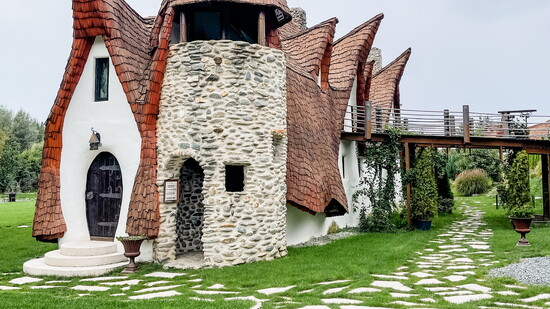
Our next lodging was a treasure beyond anything we expected: a private castle, Castelul de Valeut, tucked beneath the Carpathians beside a willow tree dipping into a small stream. The setting was serene, almost enchanted. The estate hosts only twenty-eight guests, and every detail felt intentional, timeless, and built to honor the landscape surrounding it.
Dinner was served in a storybook-like mushroom cottage. I ordered rose petal tea, delicate and fragrant, and it felt entirely at home in a place where nothing seemed rushed or ordinary. We loved it enough to return for breakfast the next morning.
Sibiu: A City of Watching Eyes and Whispered Legends
From there, we traveled to Sibiu—a town that instantly charmed us with its pastel squares, Baroque architecture, and cultural vibrancy. Ballet dancers performed in Piața Mare. Musicians filled the air. Artisans lined the medieval streets with handcrafted goods.
Sibiu is known for its “eyes”—arched attic windows that resemble watchful eyelids. These openings, designed for ventilation centuries ago, earned the city a reputation for always observing, always knowing. Their presence adds an uncanny beauty to the skyline.
Just outside Sibiu lies what many believe to be the burial site of Vlad Țepeș’s son—a fact that only deepens its sense of legend. By day, Sibiu felt like a fairytale; by night, a place of whispered stories preserved in stone.
Bucharest & the Final Hours
We returned to Bucharest for our final day, where we explored the Palace of the Parliament, a monumental reminder of Romania’s complex communist past. A festival filled the streets with music and color, a reminder of the country’s vibrancy and resilience.
To conclude our journey, we spent an afternoon at Therme Bucharest, one of the largest wellness complexes in Europe. With thermal pools, saunas themed after global regions, red-light therapy rooms, and mineral baths, it felt like stepping into a world designed for restoration. It was an elegant ending to a week defined by spontaneity.
What Romania Offered
Romania was nothing like I expected. It was not the caricature portrayed in animated films, nor was it confined to old tales of vampires and mist. It was warm, generous, grounded, and deeply connected to its geography and folklore. Its people were quietly kind. Its landscapes were dramatic and healing. Its food—rich, hearty, and unapologetically abundant—kept our iron levels high and spirits even higher.
Most meaningful of all was the time spent with my mother and cousin—unrushed, unscheduled, and unfiltered. Each day unfolded naturally, guided by the road, the weather, and our own sense of wonder. Without a rigid itinerary, we allowed Romania the space to surprise us.
The next time you feel the pull to travel, consider choosing a place you never expected to love. Leave room for discovery. Trust the detours. And if you ever need inspiration—or someone with the courage to drive through a mountain in a storm—ask Orion. My mother will be ready, too.
Romania, thank you for the magic, the mystery, and the memories. We will return.
You know what would be fascinating? Romania. But we can’t go without your mom. She would never forgive us.
That evening, we arrived at the place my mother had longed to see for most of her life: Bran Castle, widely known as Dracula’s Castle.