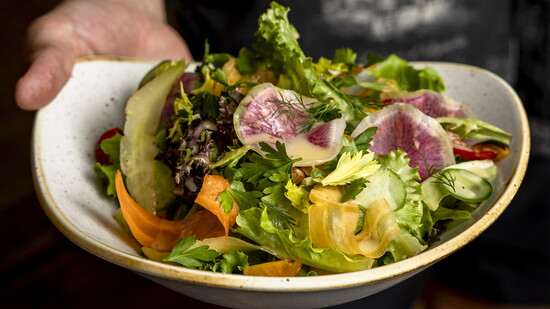
Palm Beach County’s dining scene may be defined by polished rooms, ambitious menus and hard-to-get reservations, but some of its most important relationships begin miles from the dining room.
For local chefs and farmers, what lands on the plate depends on conversations happening weeks—or months—earlier: what is growing, what is coming into season and what a kitchen can commit to buying. Those relationships can shape a menu. For a family farm, they can also help determine whether there is another season.
Swank Specialty Produce helped establish that connection locally through chef collaborations and communal farm dinners. Across the county, smaller growers have built their own networks with restaurants, resorts and caterers—relationships based as much on trust and flexibility as what happens to be ready for harvest.
At Holman’s Harvest in Loxahatchee, the path into farming began much closer to home. Liza Holman, a physical therapist, and her husband, Marty, a mechanical engineer, bought the property from her relatives in 2013. Soon afterward, their infant son became seriously ill with an E. coli infection, she recalls, prompting the couple to grow more of their own food. Surplus went to friends and family before eggs and avocados began opening restaurant doors.
An early supporter was Michael Hackman, co-owner and executive chef of Aioli, the scratch bakery and café in West Palm Beach. “I admired their drive to create something for their family,” he says. He features their eggs and microgreens in daily specials. “Items are pricier, but the quality is better.”
Liza still makes deliveries herself, asking chefs what works and what they would like her to grow. At Angle, inside Eau Palm Beach Resort & Spa, chef Matthew Gale says Holman’s supplies eggs and microgreens year-round and experiments with crops he requests. At the resort’s Breeze Ocean Kitchen, chef Michael D’Onofrio incorporates the farm’s seasonal produce into dishes as availability allows.
Gale uses carrot tops for pesto or garnishes, finding value in the whole ingredient. “A carrot tastes like a carrot,” he says. “It’s got some sweetness, a little bit of earthiness, and then a faint bit of bitter on the back end.”
For Liza, those relationships make farms an essential part of the area’s dining scene. “These big restaurants cannot have farm-to-table without the farms.”
For Dewey LoSasso of Puff ’n Stuff Catering, farmers also inspire experimentation. A grower once gave him Okinawa spinach cuttings; he later paired crispy leaves with local ingredients in a new dish. He works with Swank, Holman’s and Gratitude Garden and says advance guest counts allow him to build menus around what growers have available.
That cooperation extends between farms. Holman’s, for example, sells mushrooms from Gratitude Garden, another family-run operation in Loxahatchee Groves.
Founded in 2013 by Joseph and Tawna Chammas, Gratitude Garden is a five-acre certified organic farm. Joseph says his cancer experience prompted him to rethink food and begin growing it; as a stage 4 survivor, he views food as medicine.
What began as a backyard project became a farm specializing in gourmet mushrooms and greens. Today, Gratitude Garden sells roughly 1,000 pounds a week to clients including the Four Seasons and The Ritz-Carlton.
Joseph and Tawna recently visited Buccan to taste a dish built around their lion’s mane mushrooms. “I wanted to taste what they were making,” he says. “And it was really amazing.”
Clay Conley, the chef behind Buccan and a partner in Stoke, a Gainesville farm where professional growers do the farming, was among Gratitude Garden’s earliest supporters. For Conley, the exchange of information is as important as the ingredients themselves.
“It isn’t simply a transaction where someone sends us a product and we put it on the menu. We learn what they’re growing, what’s coming next, and sometimes that directly influences what we create.” When someone grows an ingredient that well, he adds, “our responsibility is really not to screw it up.”
Proximity alone, however, is not enough. “Local doesn’t automatically mean better.” What matters, Conley says, is a product grown well, harvested at the right time and handled properly.
Florida’s heat, humidity and storms can change what a farmer has available from week to week, requiring kitchens to move with the season. “You can’t only be interested when they have exactly the ingredient you want in exactly the quantity you want.”
For growers, that flexibility can be the difference between support in theory and a sustainable business in practice.
Joseph cites land prices, taxes and labor costs among the challenges of keeping Gratitude Garden operating; growing without sprays means paying people to weed by hand. Dinners and retreats help sustain the farm.
For the Holmans, now farming full time and raising four children, the stakes are immediate. “We don’t have off-farm income anymore to help sustain us,” Liza says. She worries younger growers cannot afford land and hopes properties owned by retiring farmers can pass to new growers rather than developers.
“We have to figure out a way to make land affordable to farmers.”
The concern is not theoretical. Gale recalls working with farms that have since shuttered. Kai Kai Farm in Indiantown has announced the closure of its event venue and listed the farm for sale. Losing growers, he says, reduces variety and places greater strain on those that remain.
At Driftwood in Boynton Beach, co-owner Jimmy Everett works with local farmers whenever possible. He says sourcing questions often rise when food safety makes headlines, but sustained demand remains limited.
“Demand from diners creates a financial benefit,” he says. “I would love to see more consumers demanding to know where their food comes from and who they are supporting by deciding to consume what they do day to day.”