When it comes to food, it can be easy to focus only on what’s on your plate – and miss the deeper connections it creates. But exploring where our food comes from has the power to reconnect us not only to nourishment, but also to community, to the rhythms of the seasons, and to the land itself. In a fast-moving world where convenience often overshadows connection, slowing down to explore local food systems becomes an act of both wellness and awareness. We can nourish body, mind and community alike.
At Around the Bend Farms (ATBF), that exploration happens every day.
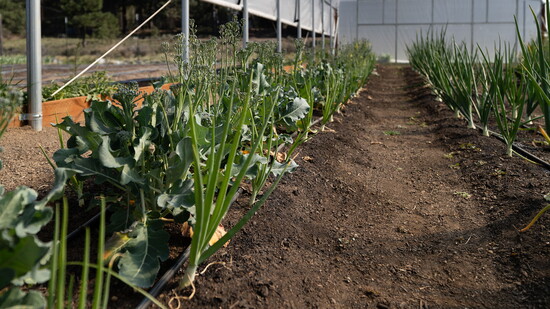
Operating small farm sites in Deschutes River Woods and Jefferson County, each less than an acre, this nonprofit works at the intersection of regenerative agriculture, food access, education and community care. Through partnerships with Warm Springs, The Giving Plate, Family Kitchen and other nonprofits, the farm grows and distributes fresh produce while helping Central Oregonians better understand the journey food takes from soil to table.
For Executive Director Kelly Moffatt and Lead Farm Manager Josh Lesko, local food is about more than fruits and vegetables. It is about helping people explore seasonal eating, support local farms and reconnect with something increasingly rare in this modern day: a meaningful relationship with the source of their nourishment.
Q & A with Kelly Moffatt, ATBF Executive Director
Q: For readers who may be unfamiliar with ATBF, tell us a bit about what you all do.
A: Around the Bend Farms, Inc. was founded in 2015 by Ben Marsh. We have been farming locally on our small parcel in Deschutes River Woods for going on three years and the small farm in Culver for going on two years.
We are a nonprofit farm focused on food access, education, and regenerative agriculture. A huge part of our work is making sure fresh, nutrient-dense food reaches communities that may not otherwise have access to it, particularly in Jefferson County and Warm Springs. We also want people to reconnect with where their food comes from and understand the impact local farming can have on community health and resilience. Last year we were able to donate over 1,500 pounds of food to The Giving Plate and over 1,800 pounds of food to Warm Springs. We also had over 100 volunteers last year giving their time to support our efforts here at the farm.
Q: Tell us a bit about your background and work in farming and food access.
A: My path into this work has been shaped by both my background in nutrition and dietetics and a growing awareness of the gaps in our food system. As a dietitian, I’ve seen firsthand that it’s not enough to talk about healthy eating if people don’t have consistent access to fresh, quality food. I worked with High Desert Food and Farm Alliance and managed their VeggieRx program. That job connected me with Ben, who contacted me about farming for Warm Springs. This lead to the creation of our “Farm to Warm Springs” program, and ultimately to my current role.
Q: Why is local food such an important part of conversations?
A: When food is grown locally, it generally stays within the community. This food is fresher, more nutrient-dense, and often harvested much closer to peak ripeness. There is also something powerful about knowing the people growing your food.
Q: Food security continues to affect many Central Oregonians. What are you seeing right now?
A: The need is growing significantly, especially as funding sources for food access programs continue to shrink. At the same time, food pantries and community kitchens are struggling with reduced purchasing power. Fresh produce is one of the hardest things for families to access consistently, so local farms really do play an important role in helping fill that gap.
We have such a unique scenario in Central Oregon. Deschutes County is one of the wealthiest and least diverse counties in Oregon. Our neighbor, Jefferson County, is one of the poorest and most diverse in Oregon. Deschutes County has a lot of resources; Jefferson County does not. Our farm serves both counties. We are working to partner with other organizations and agencies to get food out into our communities where it is needed the most. There is a growing gap, and we are seeing more people becoming food insecure.
Q: ATBF places strong emphasis on education. Why is that piece important?
A: Education creates sustainability. We work with volunteers, school groups, camps and community members to teach everything from composting and soil health to harvesting and regenerative growing practices, and even bee keeping. We want people – especially kids – to understand that food doesn’t just appear on shelves or tables.
Q: What gives you hope as you look ahead?
A: The community response. People genuinely want to reconnect – with the land, with local food, and with each other. We see it through volunteers, CSA members, partnerships, and even simple conversations at the farmers markets. There is a growing awareness that healthy communities depend on healthy local food systems.
For Lead Farm Manager Josh Lesko, that connection begins with the soil itself.
Q & A with Josh Lesko, ATBF Lead Farm Manager
Q: What first drew you to farming and urban agriculture?
A: I have a major in Environment and Sustainability with a minor in Urban Studies from the University of British Columbia. But honestly, I have learned the most from the hands-on experience I gained working on various farms, including farm-to-table operations. Farming teaches patience, observation, and adaptability in a way books really can’t. I fell in love with the process – planting seeds, watching things grow, and seeing the direct impact food can have in a community.
Q: What does your day-to-day look like as the Lead Farm Manager?
A: We try to farm in a slower and more mindful way. We use traditional hand tools, avoid chemicals, and really pay attention to the ecosystem around us. Sometimes that means noticing ladybugs naturally taking care of aphids or seeing soil health improve over time. Farming isn’t just about production; it’s about building a relationship with the land. It’s about stewardship.
It’s hard work with long days. It’s not a glamorous job. We work year-round, with the slower seasons dedicated to planning and fundraising.
Q: What are some of the things you grow at ATBF?
A: We are successfully growing crops like carrots, potatoes, corn, lettuce, herbs and strawberries, to name a few. As much as possible, we choose crops based on the success in our local climate, along with consultations with our food access partners to meet community needs and reduce waste.
Our farm operates on small parcels of land. This model aims to convert underutilized land into productive agricultural space and demonstrates that with investment, parcels of land like this can be used to improve food access.
Q: What are some of the unique challenges facing farmers and growing in Central Oregon?
A: We have to have a lot of patience. We have a very short and unpredictable growing season, and frost can happen almost anytime. Water is also a major concern. To thrive, we learn which crops thrive here and how to work with the conditions rather than against them.
Q: ATBF works closely with other nonprofits and community organizations. Why are these partnerships so essential?
A: None of this work happens alone. We partner with organizations and community programs because collaboration creates a stronger local food system. Everybody brings something valuable to the table.
Q: How can people in the community support ATBF?
A: They can sign up for a CSA subscription, which entitles them to a box per week of fresh produce throughout the year. CSA stands for Community Supported Agriculture and it’s really one of my favorite models of agriculture.
A CSA membership fee helps us pay for our seeds, our soil, our tools… everything we need to get things growing. When it comes to picking up the weekly CSA boxes, members can find us at the Elevation Farmers Market every Friday from 3 to 7 p.m.
One thing we really need is donations to keep the farm funded, growing and to help expand our team. We also welcome volunteer support – from help on the farm with harvesting to help in the office, even help with fundraising. We welcome input, ideas and support and encourage involvement here at the farm.
Cultivating Connection
In many ways, ATBF does more than grow food. It helps cultivate awareness – of the labor behind nourishment, the fragility of local food systems, and the quiet but essential value of community connection.
“When someone has access to fresh nourishing food, when they understand where it came from, and when they feel part of that process, it shifts more than just what they choose to eat, it builds resilience, dignity, and community,” states Moffatt. “At Around the Bend Farms, we are working to make that connection more accessible, especially for under-resourced populations. That is what keeps me committed to this work and excited about where it can go.”
Adds Lesko, “I hope everyone realizes that they can participate in what we are doing here and help further our mission. Even growing a few herbs or vegetables at home can reconnect someone to nature and to their food in a meaningful way. Supporting local farms isn’t just about buying produce – it’s about investing in healthier communities, stronger local economies and a more resilient future.”
AroundtheBendFarms.org