At Green Acres Ranch, the Rich family is keeping Temecula's horse country alive — one slide stop at a time.
There is a moment in reined cow horse competition that stops time.
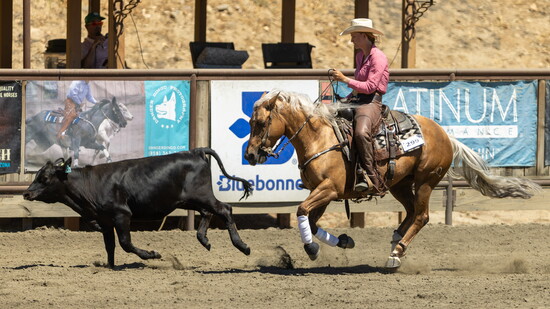
A quarter horse — twelve hundred pounds of coiled muscle and carefully selected breeding — launches down the arena at full gallop. Then, at the signal of a nearly invisible shift in the rider's weight, the horse drops its haunches, plants its hind feet, and slides. Not a stumble. Not a panic stop. A controlled, magnificent, dirt-spraying commitment to physics that looks equal parts ballet and freight train. The crowd gasps. The dust settles. The horse stands quiet, waiting, like it was nothing.
If you've watched Yellowstone and found yourself wondering whether horses like that actually exist — they do. And some of the best ones in the country are being bred, born, and trained right here in Temecula Valley.
Roy Rich grew up on this land. His mother, Margaret Rich, has owned Green Acres Ranch on DePortola Road since 1969, when Temecula was still mostly rolling hills and the smell of sage. Roy trains out of the same property today — sixty to seventy horses in work on any given day, a waiting list that never fully clears, and a competition resume that includes national championships and world-level finishes. His sister competes in dressage on the same grounds.
Different disciplines, same deep roots. A family that bet everything on horses and, quietly, keeps winning.
"Horses have been part of our culture since they got brought over here from Europe," Roy says. "People still need that. I don't want to say it's part of our DNA, but way back in the day — we had to survive, progress, fight, everything. There's just something about that we still carry."
The discipline Roy competes in — reined cow horse — has its roots in the vaquero tradition of California. Long before there were arenas and judges and serious prize money, there were working ranchers whose horses had to cut a single calf from a herd, respond instantly to the rider's hand, and stop hard when the job called for it. Those ranchers eventually started showing up at county fairs in the 1940s and '50s to put their horses against each other. They were showing off. They were also preserving something. What grew out of those informal competitions is now the National Reined Cow Horse Association — a governing body with world-level events that draw competitors from coast to coast, with the biggest shows now held in Texas, pulling audiences the California origins could never have anticipated.
The three-event format Roy competes in reflects that working-ranch heritage directly.
First, the reining: the big sliding stops, the spinning turns, the precision patterns that make newcomers wonder if the horse has been secretly practicing in the barn after dark.
Then herd work — what most people call cutting — where horse and rider separate a single cow from the group and the horse, on a loose rein, keeps the animal from returning using nothing but instinct and training.
And finally, the fence work: horse and rider push one cow down the arena fence line, control it through its turns, demonstrate mastery of an animal that very much does not want to be mastered. Three events. Three different demands. One horse, one rider.
"They can kind of contradict each other," Roy admits with a grin. "It's a challenge."
Roy turned professional in 2003. He studied under an AQHA World Champion while finishing his business degree at the University of Redlands, then apprenticed under an NRCHA Hall of Famer before coming back to Temecula to build The Rich Group at Green Acres. He breeds the majority of what he shows, standing his own stallions and running his own mares — which means he has a read on what the offspring will be before they're old enough to carry a saddle.
"I have an idea of the range they're going to be," he says. It's the same logic a coach uses to spot a future athlete — not certainty, but informed probability.
The other half of the equation is two years of daily work, five or six days a week, building a relationship precise enough that when Roy asks a horse to stop with everything it has, the animal doesn't hesitate. Twenty-five non-professional students come to him regularly, many of whom started by simply watching and found themselves hooked. They lease horses. They buy into the show program. They enter the world Roy has been living in his whole life.
"To do this, you've got to really develop a relationship with them," he says. "You've got to be able to ask them for their life — ask them to stop on a dime and go the other way with no resistance. That's what you show the judge."
Here's something Temecula doesn't always get credit for: it is genuinely remarkable horse country. The weather allows year-round training. Nights cool down even in summer. The valley sits in a sweet spot that the desert regions to the east and the congested coastal corridors to the west simply can't replicate. It's why Roy stayed. It's also why what Green Acres represents is worth paying attention to before it's gone.
Because it is under pressure. The same growth that gives Roy his customer base also drives up property values and brings in neighbors who didn't bargain for dust and flies and the sound of cattle working. Land that families held for decades starts to look a lot more valuable as a subdivision than a ranch. Roy knows it. He doesn't dwell on it. But he knows it.
"The housing pushes horse culture out," he says plainly. "Even though the horses were here first."
Temecula is one of the rare places where you can take in two entirely different worlds of horse sport in the same town — the polished pageantry of the hunter-jumper circuit on one end, and the working-ranch athleticism of reined cow horse on the other. Both are worth seeing. Both are worth supporting. What's less common is finding a place where world-class competitors in either discipline are your neighbors.
What saves horse country, Roy believes, is people showing up and falling in love with it.
The Grant Berg Memorial — a three-day SCRCHA show — runs right here at Green Acres Ranch in July. You can watch from the grass. You can see Roy compete. You can watch quarter horses slide, spin, and read cattle with a kind of athletic intelligence that will rearrange your understanding of what these animals are capable of. The people in the stands were working riders, serious competitors, and a handful of locals who wandered in curious and left wanting to sign up for lessons. That last part, Roy says, happens more than you'd think.
"Kids having horses keeps them out of trouble," he says. "They've got responsibility. They've got something to work toward."
Spectating leads to involvement. Involvement leads to something that sticks. Roy has seen it happen here for years — people who came to watch and ended up building a life around it, the same way the Rich family did, on this same piece of ground, more than fifty years ago.
To learn more about Roy Rich and The Rich Group, visit royrich.net (http://www.royrich.net/).
"The housing pushes horse culture out, even though the horses were here first."
What saves horse country, Roy believes, is people showing up and falling in love with it.