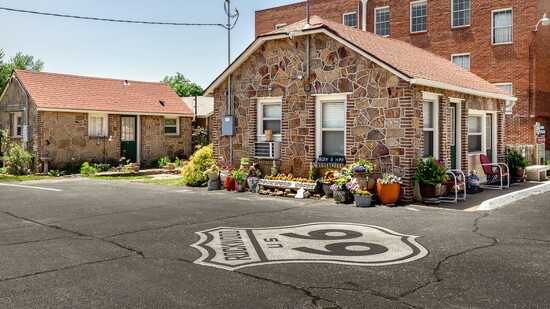
If you stay in Springfield long enough, you'll notice something unusual for a Midwest town. Accents from around the world are heard, license plates from across the country can be seen, and conversations often take place in varying languages. On any given day, travelers from Spain, Japan, or even Iceland might pass through, all drawn by the same experience: Route 66.
For the owners of the nearly century-old Rockwood Motor Court, Phyllis Ferguson and Tim Phillips, these national and international travelers are part of daily life.
In their time as owners, they have hosted guests from around the world, most recently from France, Argentina, Qatar, and Great Britain. Ferguson says that people come here because Route 66 is known as the best road trip in the world.
That perspective reveals something that many locals tend to overlook: Springfield isn’t just a stop along the route, it's an international destination on it.
The key to Route 66 has always been the passion and enthusiasm of the people who travel it. Author Jim Hinkley says that this passion shows up in places like Rockwood Motor Court, which has survived economic collapse, war, and the rise of the interstate system.
Built in 1929, Rockwood began as a modest tourist camp, offering simple cabins, garages, and even tent space for travelers who couldn’t afford a room. Over the decades, it changed hands repeatedly, evolving with each era. By the 1940s, it had become a polished motor court, complete with tiled showers and updated facades.
Today, it stands as the oldest continuously operating motor court on Route 66. But its survival wasn’t always certain.
When the current owners took over in 2019, the property required extensive restoration. Within months of reopening, the pandemic hit. Rather than shutting down, Rockwood found new life. As people began traveling by car instead of flying, Route 66 grew in appeal. And the safe parking offered right outside of the cabins gave an extra layer of safety for those trying to avoid Covid.
Business surged and hasn’t slowed since.
The increase in business highlights a broader trend described by author Michael Wallis, who was the consultant for Pixar during the making of the movie Cars and served as the voice of the Sheriff in the film.
He shares that there has been a recent global revival of interest in Route 66, shifting it from something of a relic to an international destination. He says that the road has never just been part of history, and it has a bright future ahead, especially this year as it celebrates its 100th birthday.
That bright future is also shining new light on Springfield.
From college students discovering the road for the first time to international travelers retracing its legacy, the city serves as a gateway to a new generation of Route 66 enthusiasts.
Wallis points to Springfield’s business route as one of the most intact and vibrant stretches anywhere along the road. Economic growth and cultural expansion remain at the forefront of the community as a direct result of the route’s revival.
However, Hinkley highlights another chapter that is complex and more uncomfortable. During its early decades, Route 66 reflected the segregation of American society. Black travelers often faced discrimination at gas stations and motels. In response, entrepreneur Alberta Ellis opened a hotel that became a safe haven in Springfield. This refuge was listed in The Negro Motorist Green Book and was the reason many well-known African Americans came to Springfield, including Nat King Cole, the Harlem Globetrotters, and Stevie Wonder.
Stories such as Alberta’s show context and speak to the full story of Route 66’s impact.
Today, Ferguson believes many locals underestimate how much Route 66 contributes to the city. She says that when you multiply the number of visitors by how many years the road has existed, it’s a significant amount of money spent in Springfield’s economy. When visitors come through, they eat at local restaurants, shop at destinations like Bass Pro Shops, and stay overnight, bringing hundreds or thousands of dollars to businesses.
And beyond dollars, there’s something deeper that they bring: connection.
At Rockwood, grandchildren of the owners interact with guests from around the world. The road becomes a classroom without walls as stories are exchanged and cultures overlap.
That idea resonates with Wallis, who notes that Route 66 now appears in educational curricula across the country. He points out that it crosses many disciplines, including history, music, cuisine, and social studies. “It’s a living museum,” he says. And Springfield is one of its most accessible exhibits.
Even for those who have lived in Springfield their entire lives, the road offers a new way of seeing the familiar. A simple drive down an old alignment becomes a journey through time, a restored motel becomes a symbol of resilience, and a passing travel becomes a reminder that this city is connected to something much larger; it is part of the longest small-town community in America.
From college students discovering the road for the first time to international travelers retracing its legacy, the city serves as a gateway to a new generation of Route 66 enthusiasts.
“It’s a living museum,” he says. And Springfield is one of its most accessible exhibits.