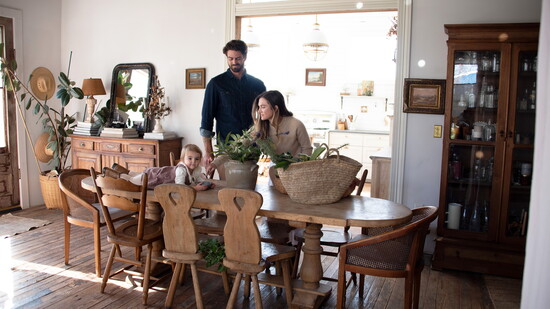
On a five-acre plot of land just outside Austin, a 1898 Folk Victorian stands with a dignity it hadn’t known in decades — all because interior designer Claire Zinnecker saw past cosmetic changes, dropped ceilings, and layers of past renovations. What others might have overlooked, Zinnecker recognized as a living piece of history worth saving.
Zinnecker didn’t discover Ida House while scrolling real estate listings. Instead, it was her aunt who spotted the Facebook Marketplace listing and sent it her way. The photos were dark and low quality, but the front porch and windows immediately stood out.
“The exterior was the first thing I saw,” Zinnecker said. “I knew there was a story there and I had to go see more.”
At the time, Zinnecker had recently purchased raw land outside Austin, planning to leave it untouched until she could eventually build. That plan changed quickly. She scheduled a visit, fell in love almost immediately, and wrote a check before fully understanding how the house would be moved.
“I didn’t understand the move portion yet,” she said. “I just knew she had to be mine.”
The house was originally built near downtown Austin in the late 19th century by Swedish immigrants Gus and Ida Anderson. Over the years, it had been thoughtfully lived in by just two families across multiple generations, each leaving behind a variety of updates and personal touches. When Zinnecker first walked through the home, she caught glimpses of original wood floors and ceilings peeking through layers of linoleum and sheetrock.
“I could see a glimpse of the wood floor and ceiling in one room,” she said. “I couldn’t wait for the demo and exploration phase to see what else we might find.”
She chose to preserve the name Ida to honor the original owners. “The name just fit her,” Zinnecker said.
Saving Ida required more than a renovation. As development closed in on the original lot, Zinnecker purchased the house outright and made the bold decision to relocate it to her property along the San Gabriel River in Georgetown.
Moving a 120-year-old home is no small feat. The structure had to be carefully cut in half, prepared, and transported overnight by professional movers before being reassembled the next morning.
“It was such a fun process,” Zinnecker said. “They were so careful and knowledgeable.”
However, not everything went smoothly. One major oversight, she said, was underestimating the urgency of replacing the roof after the move. Before that could happen, she spent countless evenings climbing onto the house during storms to re-secure tarps.
“I don’t think I factored in that I’d have to put a new roof on right away,” she said. “I spent many nights on top of the house in the rain.”
Once Ida was safely on its new foundation, the restoration began.
Zinnecker approached the renovation with deep respect for the home’s original narrative. While she had ambitious early plans, including architectural additions that didn’t survive budgeting, her overall philosophy remained consistent.
“I wanted to approach each space with the goal of keeping a bit of the original while also allowing myself to make it our own,” she said.
During demolition, Ida revealed unexpected treasures — including an entire front hallway lined with newspaper clippings dating from the 1920s through the 1960s. Preserved by the oils in old linoleum, the papers were carefully salvaged.
“That was a total surprise,” Zinnecker said. “I was able to save all of it.”
She prioritized preserving the doors, windows, floors, and trim, as well as original ceilings wherever possible.
“They’re beautiful,” she said, “and they really tell the story of the house.”
The layout was also thoughtfully reworked. Originally a two-bedroom, one-bath home, Ida was expanded to a three-bedroom, two-bath residence within the existing footprint. Zinnecker relocated the rear bathroom to maximize views of the land and spent months sketching possibilities before landing on a solution.
“I knew I wanted two bathrooms,” she said. “Figuring out how to puzzle that together took a lot of drawing.”
Modern updates were intentionally restrained. The home received new plumbing, electrical, and HVAC systems, but it still lacks a dishwasher. Vintage appliances remain, and insulation was addressed carefully to avoid damaging the original wood siding and windows.
“Insulation was the toughest design decision,” Zinnecker said. “I didn’t want to compromise the exterior or the windows.”
The restoration of Ida House became deeply personal. Zinnecker and her husband, local realtor Adam Mink, worked side by side, learning construction as they went. Mink handled many of the structural decisions, while Zinnecker led design, although she admits she often asked for his opinion.
“Framing doors and windows almost drove him crazy,” she said. “Nothing in this house is straight or level.”
The couple now lives in the home with their two-year-old daughter, Colette, nicknamed Lettie, and several pets. The house shows its age in places, with original materials and old-home quirks, a lived-in contrast to the sleek modern homes they design and sell professionally.
The project was not without hardship. Zinnecker was taken advantage of by a contractor who stole money and materials, costing her thousands of dollars and nearly derailing the renovation.
“It almost broke me,” she said. “The only reason I kept going is because I’m stubborn and determined.”
Zinnecker is the founder of the award-winning design studio Claire Zinnecker Design. Ida House, she notes, is both a portfolio piece and not one at all.
“People know me for this house,” she said, “but they wouldn’t necessarily hire me to design their home based on this.”
Living in Ida has reshaped how she thinks about design, ultimately inspiring her and Mink to launch a design-build company focused on thoughtful homes that feel grounded and enduring.
“Saving homes from demolition is so important for our history and for the planet,” she said. “This home will be standing for years after some of these new builds.”
“I knew there was a story there and I had to go see more.”
“I wanted to approach each space with the goal of keeping a bit of the original while also allowing myself to make it our own.”