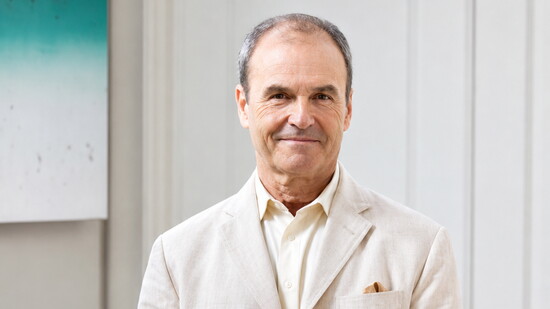
Scott Turow has spent decades exploring the uneasy space where law and human behavior collide. In Presumed Guilty, published Jan. 14, 2025, he returns to Rusty Sabich, the character who first defined his voice and helped shape the modern legal thriller.
The novel marks the third installment in the Rusty Sabich trilogy, following Presumed Innocent and Innocent. Now in his 70s, Rusty is drawn back into the courtroom, confronting not only a new case but the accumulated weight of a life lived in and around the law. At more than 500 pages, the book carries the scope and density readers expect from Turow, but its real force comes from something quieter: a reckoning with time, consequence and the possibility of change.
Turow did not return to Rusty out of convenience or nostalgia. The impulse was both creative and personal. “Rusty remains what feels like my truest voice,” he says, describing the character as the one that emerged when he first understood his strengths as a storyteller. But just as important was the sense that Rusty’s story had been left unresolved. At the end of Innocent, the character had come to recognize his own self-destructive behavior but had not yet tested what might come next. “His story wasn’t over,” Turow says. “He had not seen if he could make anything good for himself out of that knowledge.”
That tension between recognition and redemption sits at the center of Presumed Guilty. It also reflects the questions that continue to animate Turow’s work more broadly. After a lifetime in the legal world, he remains focused on its central promise and its inherent limitations. “The law establishes a set of common ground rules whose ultimate goal is fairness to all,” he says. “The question is how committed we are as a society to that idea.” It is a system, he notes, that's always being tested and never succeeds perfectly—a reality that gives his fiction its enduring sense of moral complexity.
For many readers, Turow’s work is defined not only by its intellectual rigor but by its deep humanity. His characters rarely operate at extremes. Instead, they exist, as he puts it, “somewhere between their best actions and their worst,” shaped by competing impulses, obligations and desires. The themes that have long drawn him—parents and children, ambition, regret and the constant negotiation between who we are and who we hope to be—remain firmly in place.
That sense of continuity extends beyond the page. Turow’s connection to the North Shore stretches back to his teenage years when he moved to the area for high school. Over time, it has become a place layered with memory and meaning. He speaks of “the utter familiarity that comes with a place that has been home for most of my life,” a landscape that now includes not only his own past but the presence of family across generations. The lake itself, he adds, plays no small role, magnifying daily life with “beauty, tranquility and the presence of a vast supply of the essential liquid of existence.”
Chicago, too, remains central to his work. Turow has long argued that it is “the most American of our big cities,” grounded less in spectacle than in the enduring values of work, family and faith. It's a city, he suggests, that reflects the broader national experience more honestly than coastal counterparts driven by speed or image. That sensibility runs through Presumed Guilty, where ambition and restraint, success and failure coexist in uneasy balance.
Even as he revisits one of his most enduring creations, Turow continues to engage with his earlier work in new ways. He recently served as co-executive producer and consultant on the Apple TV+ adaptation of Presumed Innocent, a project that required reexamining a story first published more than 40 years ago. “Rethinking a story that is 40 years old is intriguing,” he says, particularly in determining what still resonates and what feels dated. He credits collaborators David E. Kelley and Dusty Thomason with leading that effort, noting that their shared understanding was that the story needed to evolve for a contemporary audience.
The result is a career that remains active across multiple forms, from novels to television, without losing its grounding. Turow continues to write from the same place, both geographically and creatively, even as his audience expands and shifts.
Looking ahead, he shows no signs of slowing. He has recently completed a draft of a new novel, tentatively titled Presumed Dead, centered on an aging lawyer confronted with a newspaper obituary that appears to contradict a crime he witnessed decades earlier. The premise suggests a familiar interest in time, memory and the instability of certainty: themes that have defined his work from the beginning.
For readers discovering Turow through the recent television adaptation, he still points back to Presumed Innocent as the best place to start, calling it “time-tested” and widely appealing. But with Presumed Guilty, he offers something more than a return to form. It's an extension, a deepening and, in many ways, a reconsideration.
Rusty Sabich is older now. So is the world around him. The questions, however, remain as urgent as ever.
Know a local author? Email cat.rolfes@citylifestyle.com.