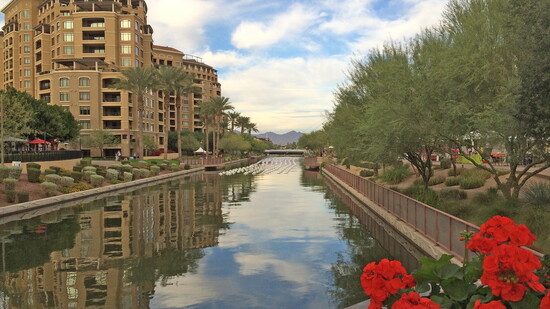
Often referred to as a ‘diamond in the desert,’ Scottsdale officially celebrates its 75th, or diamond, anniversary in 2026.
Only 75, you say? Technically, Scottsdale is a very young city in a very old place. Geologists estimate the area’s bedrock, including the McDowell Mountains, is 1.8 billion years old. Indigenous people were here over 8,000 years ago, and Army Chaplain Winfield and Helen Scott homesteaded what became Scottsdale in 1888. The settlement’s first 60 years saw slow growth as a modest farming and ranching community, with a smattering of tourist/health camps and artists’ studios. In the booming years after World War II, everything Western—climate, opportunities, affordable land and lifestyle, and the glamour Hollywood portrayed on the silver screen—drew new residents and visitors to Scottsdale.
With only one paved street and lacking a police or fire department, street signs, zoning ordinance, or business licensing, the town was ill-equipped to meet the expectations of new families, tourists, and businesses. The Scottsdale Chamber of Commerce was formed in 1947 and acted as a voluntary community organizer, hosting public hearings to debate the pros and cons of incorporating as a town.
A chamber committee circulated petitions among property owners in January 1951 in support of incorporation; the issue was dissected weekly in the local newspaper. By May, the committee had amassed enough petition signatures that the Maricopa County Board of Supervisors decreed Scottsdale incorporated as a town without the need for a special election. On June 25, 1951, the Town of Scottsdale became a municipality, boasting 2,032 residents living in about a half a square mile (now the heart of Old Town). The county appointed five town councilmen, who, in turn, elected Malcolm White Scottsdale’s first mayor. Within weeks, the town had a zoning ordinance, contracted with Rural Fire for fire protection (a relationship that lasted until the city formed its in-house fire department in 2005), and hired a town marshal and clerk.
Although Scottsdale’s council didn’t enact a sales or property tax until 1960, Scottsdale gained a reputation as an innovative, citizen-driven community with amenities that added to the cachet of its natural environment. To control its image and future, Scottsdale annexed land in all directions, reaching today’s 184.5 square miles with the last annexation northward in 1984. Residents participating in the 1964-65 Scottsdale Town Enrichment Program advocated for a new Civic Center, a municipal airport, an arts center, a Western museum, and more. Voters approved bonds to fund the Indian Bend Wash Greenbelt Flood Control Project, avoiding a miles-long, ugly concrete channel, and approved a modest sales tax increase in 1995 to buy land for the McDowell Sonoran Preserve, which is now over 30,000 acres and our signature landmark.
In 75 years, Scottsdale has evolved into a world-renowned tourism destination; profitable business location; desirable place to live, raise a family, and retire; and a city that encourages creative solutions to infrastructure and livability challenges. Now that’s worth celebrating!