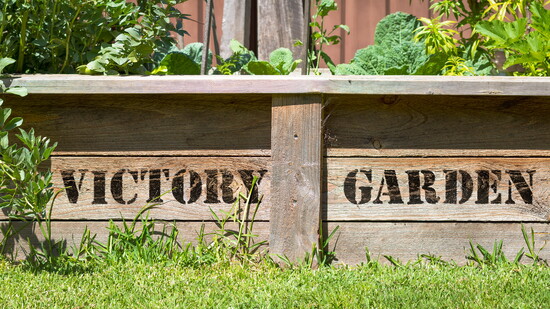
There’s a divine glory in nurturing. Victory gardens, also known as “war gardens” or “food gardens for defense,” were planted in fruit, herb and vegetable plots, on rooftops, in window boxes, public parks and ultimately, the White House lawn during World War II.
This July, in honor of our nation’s 250th birthday, we have a new opportunity to plant for a cause. Unlike the vegetable gardens of the war years designed for survival, these gardens are created for celebration. Bright borders of red, white and buoyant blue demonstrate patriotism and grow in tribute to all who fought for freedom.
A Historic Movement
Some of the earliest gardens were planted following Charles Lathrop Pack’s organization of the National War Garden Commission before the U.S. entered World War I. “Sow the Seeds of Victory” appeared on posters from New Caney to Conroe. Cultivation of schoolyards, backyards and vacant lots sprang up.
In 1943, First Lady Eleanor Roosevelt planted a victory garden in front of the White House, overruling advisers who feared it might look undignified or imply a food shortage. Rationing in 1943 made gardening not only patriotic, but necessary. At their peak in 1944, 20 million victory gardens produced 40 percent of the country’s fresh vegetables, reducing the burden on farmers and transportation.
The National Garden Bureau bloomed in 1920 in the wake of World War I. Newspaperman James Burdett pioneered the idea of enlisting horticultural writers and broadcasters for mass education to create a population of gardeners. In 1943, Burdett’s book, The Victory Garden Manual, became a go-to guide.
The Victory Garden 250 Movement
The National Garden Bureau’s Executive Director Diane Blazek says, “We had a big surge during COVID, and today Victory Gardens are officially making a comeback. People are searching for what to plant for red, white and blue gardens. In honor of America’s 250th, we’re also sharing our members’ histories, going back to 1818.”
On Instagram, the Victory Garden Alliance spearheads the movement for self-reliance, sustainability and community resilience with patriotic plant palettes. The Chicago Botanic Garden at 1000 Lake Cook Road is hosting America Grows–250 Years of Garden Stories through Sept. 27.
A Place of Potential
“You don’t need a large area,” says Carol Brouwer, who recently shared the history of victory gardens with her Alexander Love chapter of the Daughters of the American Revolution.
One of Brouwer’s favorite references is City Bountiful: A Century of Community Gardening in America by L. Lawson (University of California Press), tracing the evolution of urban gardening through both World Wars.
“Use containers on your patio to create tributes. Hanging baskets with trailing petunias or plumbago create stunning waterfalls of patriotic color.”
Vanessa Mascia, nursery manager at Nature’s Way Resources, 101 Sherbrook Circle in Conroe, recommends Blue Daze, blue salvia or cornflower as heat-tolerant options in the blue floral category.
“Red vinca, verbena, red pentas or Turk’s cap are sun-loving, and white verbena or white pentas complete the patriotic theme,” says Mascia.
Whatever you plant, may your soil—and our nation’s—grow richer for it.