Caregiving is one of those roles people fall into without a title, a handbook, or much preparation. It often starts during a diagnosis, a hospital visit, or a shift in someone’s health. And before long, life looks completely different.
For Kyle Woody, that moment came in 2011 when his spouse, Sarah, was diagnosed with metastatic colon cancer. At the time, they were raising two young sons and living in Virginia. Like many people in his position, Kyle didn’t think of himself as a caregiver.
“I told our friends I didn’t need support. Sarah was the one who was sick,” he said. “But they had talked to others and came back with a different message. Serve the caregiver.” That shift in perspective stuck. It planted the seed for what would later become Jack’s Caregiver Coalition, an organization built around one simple but often overlooked idea: caregivers need care, too.
Building Something That Didn’t Exist
After moving to Minnesota in 2013, Kyle found himself in unfamiliar territory again, this time with people recognizing his role in a way he hadn’t before. “I had never had someone refer to me as a caregiver,” he said. “I wasn’t used to people seeing me.”
That feeling of being seen was enough to spark something bigger. Alongside co-founders Justin and Dustin, Kyle launched Jack’s Caregiver Coalition to support male caregivers. While the organization centers on “guy caregivers,” many of its programs are open to anyone 18 and older who has cared for a loved one facing a health crisis.
That includes those currently in the thick of it, as well as those who have experienced loss or are living in the aftermath of remission.
Rethinking What Support Looks Like
Support doesn’t always look like a formal group. For many men, that’s exactly what keeps them away. “Most men aren’t comfortable walking into a support group,” Kyle said. “That isn’t where we start them.”
Instead, Jack’s Caregiver Coalition starts with something much simpler: a 15-minute phone call. “Once the caregiver is on the phone with someone who is listening, they start to see that there are others with wisdom and knowledge to share,” Kyle said.
From there, many participants move into one-on-one coaching through the “Jack-to-Jack” program, where they’re connected with someone who has walked a similar path. The idea isn’t to fix anything overnight. It’s to create space for honest conversation and shared experience.
Then there’s the Klatch. Held in private spaces at local spots like Urban Growler, these gatherings bring together small groups of caregivers. Topics are chosen by the group in real time, written on Post-it notes, and voted on collectively. “It’s a safe and private space,” Kyle said. “You’re sitting with people who get it.”
A Story That Changed Everything
Kyle’s own caregiving journey didn’t follow a straight line. In 2015, after several years of caring for Sarah, they decided to divorce. As Sarah’s health declined, another unexpected relationship formed. Kyle developed a close bond with Doug, Sarah’s partner, and they both supported her through hospice care.
Sarah passed away in 2020, nearly nine years after her diagnosis. Through it all, Kyle experienced firsthand how isolating caregiving can be, and how powerful it is when that isolation starts to lift.
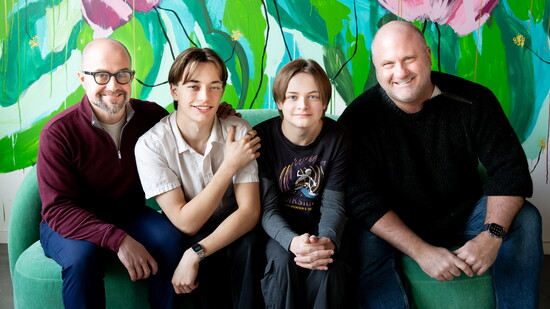
But Kyle and Doug? Today, the two co-parent Kyle’s sons, who are now in high school. “Our partnership shows what is possible when men stop performing and start showing up,” Kyle said.
From Isolation to Connection
Caregiving can feel incredibly lonely. It’s often invisible to others, even close friends and family. That’s part of what makes the work of Jack’s Caregiver Coalition resonate so deeply.
“The most rewarding thing is seeing where people start and where they end up,” Kyle said. “Helping people go from being extremely isolated to being surrounded by the support they need.”
That transformation isn’t always dramatic. Sometimes it’s as simple as someone realizing they don’t have to carry everything on their own. “I’ve been invited to funerals and weddings,” Kyle added. “You see the full arc of people’s lives.”
The organization’s long-term vision is ambitious: reaching one million male caregivers by 2035. But at its core, the work still comes back to that first step.
“It all starts with the willingness to ask for help,” Kyle said. “That’s a big ask for a lot of men.”
Showing Up Matters
Whether someone is currently a caregiver or not, Kyle believes there’s a role for everyone.
“If you’re a caregiver, book the call,” he said. “And if you’re not, be aware that there are people all around you going through this.”
Because chances are, at some point, caregiving will touch all of our lives. And when it does, knowing there’s a place to turn, a conversation to have, or simply someone who understands, can make all the difference.